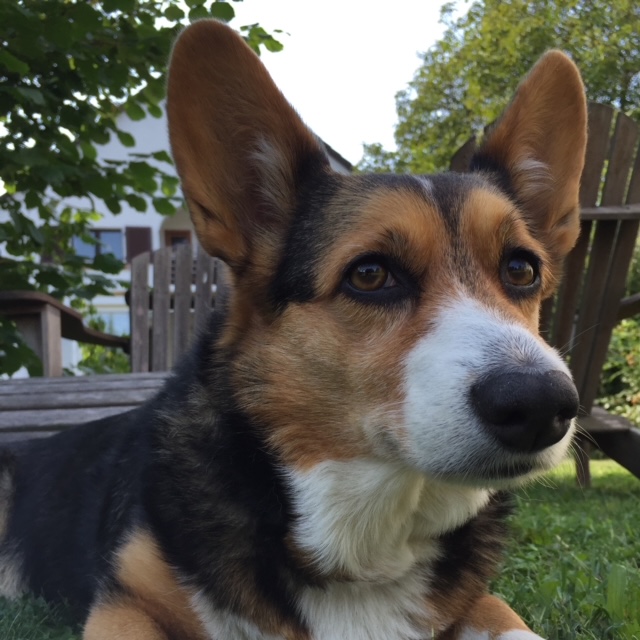
The Corgi Personality: Why Herding Dogs Suffer Differently
There are two Corgi breeds — the Pembroke Welsh Corgi and the Cardigan Welsh Corgi — and while they differ in appearance and temperament, both were developed for the same demanding work: droving cattle and sheep across the rugged Welsh countryside. These dogs didn't run beside a flock from a distance; they worked inches from the heels of cattle far larger than themselves, requiring alertness, boldness, and constant awareness of their handler's position.
That heritage produces a dog with three traits that feed directly into anxiety: intense handler bonding ("velcro" behavior), hypervigilance to movement and environmental change, and a deeply ingrained alerting instinct. In the Welsh hills, these traits kept livestock safe. In a modern apartment, they produce a dog that barks at passing neighbors, follows you to the bathroom, and destroys furniture when you leave for work.
Corgis consistently rank among the top breeds for separation anxiety in veterinary behavioral studies. Unlike some separation anxiety cases that develop from trauma or inadequate socialization, Corgi separation anxiety is often genetic — their brains are simply wired to need proximity to their person.
The Velcro Dog Problem: What It Really Means
Room-to-Room Monitoring
If your Corgi follows you from the kitchen to the living room, stands at the bathroom door when you shower, and repositions themselves to maintain constant visual contact, you are living with a velcro dog. This is not flattering attachment — it is a sign that your dog is chronically anxious about your location and has not developed the ability to self-settle when you are out of sight.
Velcro behavior is a precursor to separation anxiety. A dog that cannot tolerate you leaving the room will certainly not tolerate you leaving the house. Addressing velcro behavior early — before it entrenches — is significantly easier than treating full separation anxiety after the pattern is established.
Anticipatory Anxiety
Corgis are clever enough to read your departure routine precisely. They learn the difference between work shoes and house slippers, the specific sound of your work bag zipper versus your gym bag, even slight changes in your morning demeanor on days you leave early. Many Corgi owners report their dog begins pacing or whining while they are still in the shower. This anticipatory anxiety — stress before the departure even happens — is a strong indicator that a full departure desensitization program is needed.
Alert Barking: The Herding Breed Complication
Why Corgis Bark at Everything
Herding dogs evolved to use their bark as a working tool — moving stock, communicating position, and alerting the farmer to threats. Corgis specifically have a sharp, persistent bark designed to carry across fields. In a house, that same bark directed at the mail carrier, passing cars, or a neighbor's radio is not aggression or misbehavior — it is an expression of an instinct the dog is compelled to follow.
For anxious Corgis, alert barking and anxiety barking often overlap. A Corgi that is already in a heightened state from separation anticipation will have a lower threshold for environmental triggers. They bark faster, recover slower, and remain on edge for longer after each trigger. The result is what owners describe as "barking at everything, all day" — which is usually a dog in a chronic state of low-grade anxiety, not a confident watchdog making rational decisions.
Managing Alert Barking
The most effective management strategies for Corgi alert barking address both the physical trigger (visual access to the street) and the underlying anxiety state:
- Use frosted window film on lower windows to block street-level sightlines without eliminating light
- Create a designated calm zone away from windows with a comfortable bed and calming diffuser
- Train a "place" command — a specific mat the Corgi goes to and holds when they start alerting, rewarded with high-value treats
- Practice systematic counter-conditioning: pair the sight or sound of triggers with high-value food to change the emotional association
- Avoid shouting at a barking Corgi — they interpret raised voices as joining the alarm, which reinforces and escalates the behavior
Common Anxiety Triggers for Corgis
Owner Departure and Solitude
The primary trigger for most Corgis. Departure anxiety typically begins during the anticipatory phase (reading departure cues), peaks in the first 30-45 minutes after you leave, and may or may not settle before you return. Dogs with severe separation anxiety remain in a panic state for the entire absence — these cases require veterinary intervention, often including medication alongside behavior modification.
Routine Changes
Corgis thrive on routine and decompensate when it changes. A new work schedule, a houseguest, construction in the neighborhood, or even a furniture rearrangement can spike anxiety in a Corgi whose baseline is already elevated. If your Corgi regresses in calm behavior after a life change, do not interpret this as behavioral backsliding — it is a predictable stress response in a routine-dependent breed.
Moving Objects and Environmental Novelty
As herding dogs, Corgis are wired to track movement. Bicycles, joggers, skateboarders, children running, and cars are all potential herding targets — and in the absence of actual herding work, this drive often converts to anxiety or reactive behavior. Walks in high-traffic areas can be overwhelming for a Corgi with an already-elevated baseline stress level.
Under-stimulation
A Corgi that doesn't receive adequate mental stimulation is a Corgi generating its own stimulation, usually through barking, herding family members, or destructive behavior. At minimum, this breed needs 60 minutes of physical activity plus 20 minutes of structured mental work (training, puzzle toys, nose work) per day. Without this, anxiety and problem behaviors are almost inevitable.
Independence Training: The Core Solution
Start Small with Out-of-Sight Stays
Independence training begins at home, not at the front door. Practice stepping into another room while your Corgi holds a "stay" or a "place" command. Return before they break the stay, reward calmly, and gradually extend the duration and distance. The goal is to teach your Corgi that your absence from their visual field is normal, predictable, and safe — and that you always return.
Increase difficulty in tiny increments. If your Corgi panics when you walk behind a closed door for 10 seconds, your next step is 8 seconds — not 60. Progress is measured in seconds in the early stages of independence training.
Departure Desensitization
Make your departure cues meaningless by decoupling them from actual departure. Put on your work shoes and sit back down. Pick up your keys and walk to the kitchen. Open the front door and close it without stepping out. Repeat each cue dozens of times until your Corgi stops responding to them. Once the cues lose predictive power, anticipatory anxiety fades significantly.
Product Recommendations for Corgi Anxiety
Thundershirt — Small (Pembroke) or Medium (Cardigan)
Most Pembroke Welsh Corgis fit a Size Small Thundershirt (chest 20-27 inches). Cardigan Welsh Corgis and larger Pembrokes typically need a Medium (chest 26-34 inches). Measure the chest at its widest point behind the front legs before ordering. The constant gentle pressure is most effective when applied 10-15 minutes before a known anxiety trigger — departure routines, thunderstorms, or grooming sessions.
View on Amazon →Adaptil Calm Home Diffuser
Dog-appeasing pheromone (DAP) diffuser that mimics the calming pheromone produced by nursing mother dogs. Plug in near your Corgi's resting area or near the room they spend most time in when alone. One refill covers 700 sq ft for approximately 30 days. Particularly effective for home-based separation anxiety — the constant background calming signal reduces the baseline anxiety level that makes alert barking and velcro behavior worse.
View on Amazon →VetriScience Composure Chews — Small Breed
L-theanine, thiamine, and colostrum calming complex in a bite-size chew appropriate for Corgis (20-30 lb range). Give 1-2 chews 30 minutes before a known trigger — departure, guests arriving, grooming, or car travel. These do not sedate; they reduce reactivity and lower the alert threshold, making other calming strategies more effective. Safe for daily use.
View on Amazon →Nina Ottosson Dog Tornado Puzzle — Level 2
Mental stimulation is non-negotiable for herding breeds. This rotating puzzle toy requires your Corgi to spin compartment covers to find hidden treats, delivering 15-20 minutes of focused cognitive work. Load it with kibble or small treats before you leave — it gives your Corgi a constructive task at the highest-anxiety moment of departure and provides a positive association with you leaving.
View on Amazon →KONG Classic — Medium
A frozen KONG loaded with peanut butter (xylitol-free), kibble, and pumpkin puree extends licking behavior for 20-30 minutes. For a Corgi, introduce the KONG exclusively when you leave so it becomes associated with your departure — a powerful counter-conditioning tool that shifts the emotional valence of you leaving from "threat" to "frozen treat time."
View on Amazon →When to Seek Veterinary Help
Most Corgi separation anxiety cases respond to the combination of independence training, environmental management, and the products above. However, veterinary consultation is needed when:
- Your Corgi cannot settle within 45 minutes of your departure (evidenced by a dog camera)
- Destructive behavior is causing self-injury — bleeding paws from scratching, broken nails, injuries around the mouth from chewing hard surfaces
- Alert barking has escalated to redirected aggression toward people in the home
- The anxiety has generalized beyond departures to include severe distress when any familiar person moves to another room
Your vet may recommend a short-term trial of trazodone for acute situations, or a longer-term approach with fluoxetine (Prozac) combined with behavior modification for chronic moderate-to-severe separation anxiety. The combination of medication and training outperforms either approach used alone, typically showing improvement within 4-8 weeks.
For a full protocol on treating separation anxiety in herding breeds, see our Separation Anxiety Complete Protocol guide.