On this page
- Can French Bulldogs be left alone?
- Why long absences are hard for Frenchies
- How long can my Frenchie be alone? Quick table
- Heat and breathing safety when your Frenchie is alone
- Is it separation anxiety or just missing you?
- Set up a safe alone zone
- Teach alone time step by step
- The Frenchie 8-hour workday plan
- Helpful products
- When to get extra help
- Bottom line
Leaving your French Bulldog at home can bring two worries: whether they feel comfortable without you and whether their surroundings stay safe. You need a plan that accounts for both, especially when breathing limitations or hot weather complicate ordinary routines.
We are dog owners, not vets. This guide offers practical planning guidance rather than fixed breed limits. Our product suggestions reflect intended uses and limitations; we have not tested these products ourselves.
Can French Bulldogs be left alone?
Yes, provided the absence fits the individual dog. A Frenchie who rests comfortably after gradual preparation has different needs from a new puppy or an adult who panics when the door closes.
Want the general rules for every dog, by age and situation? Our guide on how long a dog can be left alone covers puppies, adults and seniors, signs the gap is too long, and options for long workdays.
There is no dependable breed-wide maximum. Health, toilet needs, previous experience, and observed behavior all matter. Some adults manage a few hours comfortably; others need much shorter separations.
Use a camera or recording to check what actually happens. A quiet apartment or intact furniture does not establish that your dog relaxed.
Being able to leave briefly also does not establish readiness for a full workday. Arrange support whenever necessary absences exceed your dog's comfort or physical needs.
KONG Classic Stuffable Dog Toy (choose size on listing)
A suitably sized stuffable toy offers familiar food enrichment during comfortable departures, helping some Frenchies settle without replacing separation training.
Check price on AmazonWe earn a small commission if you buy through this link, at no extra cost to you. Disclosure
Why long absences are hard for Frenchies
French Bulldogs were developed as companion dogs. Many enjoy close contact and participate enthusiastically in household routines. That people focus can make unfamiliar separation challenging, although attachment alone does not mean anxiety.
Puppies also have developing bladder control and frequent care needs. They may need a toilet opportunity after waking, eating, drinking, or playing, regardless of the clock.
Frenchies are brachycephalic, meaning flat-faced. Their anatomy can restrict airflow, and some have brachycephalic obstructive airway syndrome, or BOAS. The University of Cambridge explains this breathing condition.
Heat, excitement, and stress can increase breathing demands. This makes a reliably cool environment especially important. Do not try to exhaust your Frenchie into tolerating solitude; suitable activity followed by comfortable recovery is safer than intense exercise.
How long can my Frenchie be alone? Quick table
These are cautious planning examples, not validated French Bulldog age limits or targets. Emotional readiness may be much shorter, and health concerns can change the plan.
| Age | Typical comfortable alone time | Notes |
|---|---|---|
| 8–10 weeks | Begin with seconds to minutes; some prepared puppies manage around 30–60 minutes | New puppies need frequent company, meals, rest, and toilet opportunities. |
| 10–12 weeks | Short practiced periods; some manage around an hour | Do not assume bladder development means emotional readiness. |
| 3–4 months | Some prepared puppies manage roughly 1–2 hours | Arrange frequent care and adjust to actual toilet patterns. |
| 5–6 months | Some prepared puppies manage roughly 2–3 hours | Progress depends on relaxed behavior, health, and previous preparation. |
| Healthy adult | Some manage a few hours after gradual preparation | Plan breaks around individual comfort; eight uninterrupted hours should not be the default. |
| Senior or dog with health concerns | Often shorter, individually determined periods | Toileting, mobility, breathing, and other medical needs may require additional care. |
Swipe the table sideways to see every column.
Start below your dog's current limit rather than leaving for the longest example. Arrange help when physical or emotional needs arise sooner.
Heat and breathing safety when your Frenchie is alone
Can French Bulldogs Be Left Alone?: heat and breathing safety
- Keep the room reliably cool; use air conditioning when needed and check that it works before leaving.
- Provide fresh water in a stable container and accessible resting choices away from direct sunlight.
- Allow breathing to return to a comfortable baseline after activity before considering departure.
- Keep crate and pen ventilation clear; avoid heavy covers or enclosed spaces that trap warmth.
- Secure cords and windows, and prevent access to balconies, hot sunrooms, or other unsafe areas.
- Arrange someone who can respond if cooling fails, weather changes, or camera observations raise concern.
- Never leave your Frenchie alone in a hot room or car, even with a cooling mat.
There is no single room temperature that establishes safety for every Frenchie. Ask your vet about your dog's breathing condition and environmental needs.
A cooling mat is optional support, not a replacement for air conditioning or supervision when illness is suspected. A camera cannot reliably rule out overheating.
The Royal Veterinary College's heatstroke guidance describes panting that can progress to distressed or noisy breathing. Labored breathing, collapse, or marked weakness needs urgent veterinary attention rather than waiting for your usual return time.
Is it separation anxiety or just missing you?
A dog may briefly watch the door or give a short whine, then return to resting. That differs from distress that persists or escalates.
Possible separation-anxiety signs include:
- Repeated pacing and inability to settle.
- Persistent barking, whining, or howling.
- Destruction focused around exits.
- Frantic escape attempts.
- House soiling that occurs only when alone.
- Heavy panting, drooling, or trembling.
None establishes a diagnosis by itself. Toileting accidents can reflect incomplete training or illness, and panting may indicate heat or breathing difficulty rather than anxiety alone.
Record when signs begin, how long they last, and what happens before departure. Also note whether another familiar person helps or whether barriers trigger distress even while you remain home.
Do not punish damage or accidents. Review the setup and seek help when the pattern suggests fear.
Set up a safe alone zone
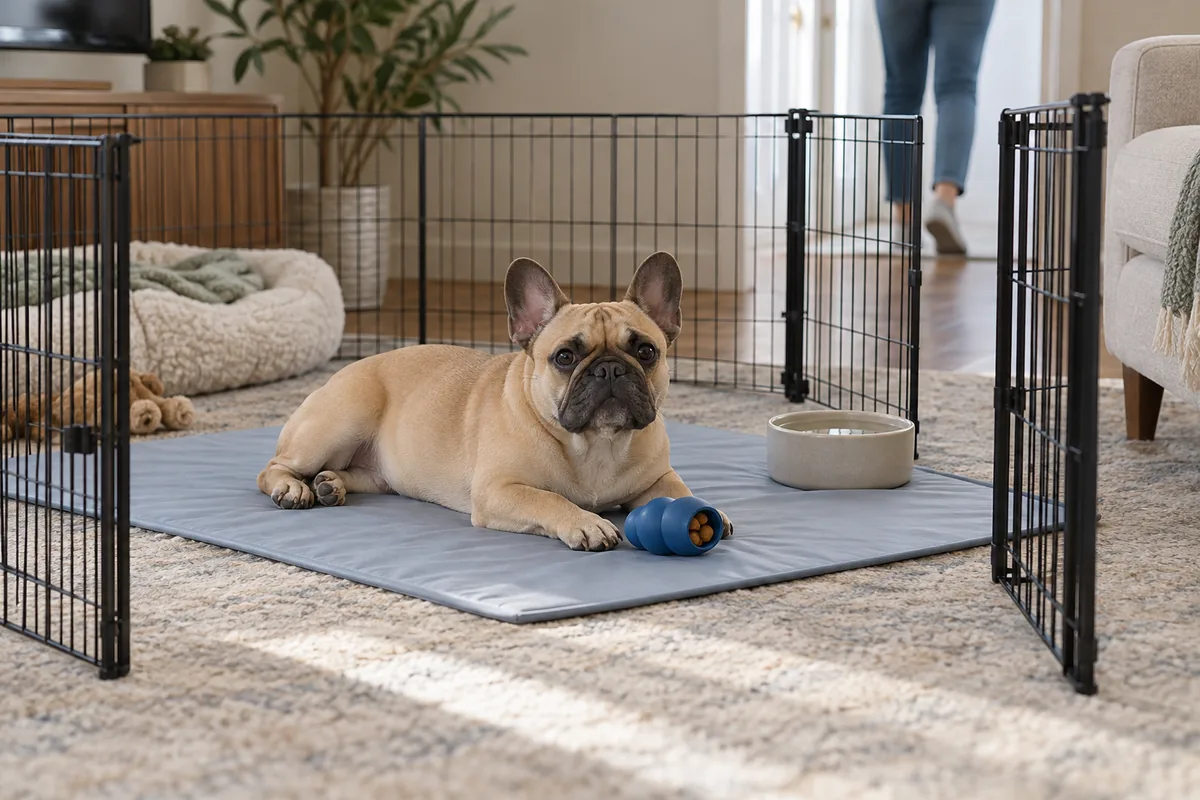
Choose a familiar, cool, dog-proofed area where your Frenchie already rests. A foldable pen can provide movement space, while a crate may suit a dog who has learned to relax there.
Introduce either positively while you remain home. Allow exploration, feed near the open entrance, and practice brief closure only when comfortable.
Remove cords, household chemicals, swallowable objects, and unstable items. Provide water and suitable bedding, keeping ventilation unobstructed.
Remove collars, tags, and harnesses before crating because they can snag. Never leave anything covering the nose or mouth.
If confinement triggers frantic chewing, digging, or escape attempts, do not upgrade to a stronger enclosure. Try a tolerated roomier arrangement and involve a professional. Some dogs need company while a safer plan develops.
Teach alone time step by step
Follow behavior rather than a calendar. Each stage may need repeated practice, and some dogs require an easier starting point.
- Meet immediate needs. Offer a toilet opportunity, suitable food and activity, then calm recovery. Begin only when breathing is comfortable and your dog can settle.
- Reward nearby independence. Sit beside the resting area and reward relaxed behavior. Move a small distance away for seconds without requiring a rigid stay.
- Briefly leave sight. Step around a doorway and return before worry. Build from moments to longer comfortable repetitions, reducing difficulty if your dog repeatedly follows or becomes tense.
- Practice mild departure cues. Pick up keys or put on shoes, then resume ordinary activity. Avoid repeatedly presenting cues until your dog becomes anxious.
- Try a tiny actual departure. Start recording and step outside for seconds. Stay close enough to return promptly; do not wait through panic to obtain silence.
- Build toward minutes. Mix easy repetitions with modest increases. Watch for door checking, food refusal, panting, or pacing rather than treating quietness as the only measure.
- Explore longer absences gradually. Work toward tens of minutes, then a few hours only when repeated observations support it. Account for toilet and breathing needs throughout.
- Arrange care beyond current comfort. Keep training separate from unavoidable long departures. If distress begins, shorten future practice and seek individual help rather than pushing through.
A familiar stuffable toy may support comfortable practice. Introduce it under supervision first, and do not use food to distract your dog while leaving for longer than they tolerate.
The Frenchie 8-hour workday plan
This example assumes an adult who comfortably manages the intervals shown. It includes eight working hours plus a lunch break; commuting also counts as time away.
- 6:30 a.m.: Offer a toilet trip and a suitable walk or sniffing activity in safe weather.
- 7:00 a.m.: Provide breakfast, water, and quiet recovery. Check comfortable breathing.
- 7:45 a.m.: Offer another toilet opportunity, check cooling, and prepare the familiar resting area.
- 8:00 a.m.: Leave only if the planned interval is within demonstrated comfort. Check recording without repeatedly using speaker audio.
- 10:00 a.m.: Arrange a trusted neighbor or caregiver for a toilet break and company if needed.
- Noon–1:00 p.m.: Come home at lunch or book a longer visit for care, quiet interaction, and another assessment of comfort.
- 3:00 p.m.: Arrange another visit or continued company if the afternoon would exceed your dog's limit.
- 5:00 p.m.: Return for a toilet trip, relaxed contact, and appropriate activity.
Visits are not enough for a dog distressed throughout the gaps. A sitter providing longer company may be necessary.
A dog walker should understand breathing and heat limits. Daycare is another possibility only if your Frenchie enjoys the setting and the provider manages rest, temperature, and health appropriately. Puppies generally need more frequent or continuous care than this adult example.
Helpful products
We earn a small commission if you buy through the Amazon links on this page, at no extra cost to you. Affiliate disclosure
| Product type | Why it helps | Notes |
|---|---|---|
| KONG Classic or similar stuffable toy | Provides familiar food enrichment during manageable departures. | Our top pick for alone-time enrichment; size for a small, sturdy dog and supervise initially. Remove damaged toys. |
| Pet camera | Shows settling, pacing, vocalizing, and changes after departure. | Secure cords; it supports observation, not emergency care or a diagnosis. |
| Foldable exercise pen | Creates a managed area with room for water and rest. | Check stability and gaps; stop using it if your dog climbs or panics. |
| Cooling mat | Offers an optional cooler resting surface on warm days. | Support only; never replaces air conditioning, and remove if chewed. |
| Lick mat | Offers supervised licking with appropriate food. | Not suitable alone for dogs who shred it; use xylitol-free ingredients and clean thoroughly. |
| Anxiety vest like ThunderShirt | May support some dogs during manageable situational stress. | Measure the chest; Frenchies can be deep-chested. Introduce under supervision and watch breathing, warmth, and movement. |
| ADAPTIL/ThunderEase pheromone diffuser | Optional background support in a familiar room. | Evidence is mixed; follow placement instructions and combine with gradual training. |
Swipe the table sideways to see every column.
Avoid introducing several aids just before a long absence. Familiarity and observed safety matter more than the number of products available.
When to get extra help
Can French Bulldogs Be Left Alone?: when to get extra help
- Your Frenchie struggles to breathe, collapses, or shows marked weakness.
- Heavy panting persists at rest or breathing becomes more effortful.
- Escape attempts, bar biting, or self-injury occurs.
- Pacing, drooling, or vocalizing repeatedly escalates during brief absences.
- New clinginess, accidents, appetite changes, or disrupted sleep appears.
- You cannot identify a comfortable starting point for training.
- Necessary work absences exceed what current care arrangements safely cover.
Breathing difficulty and collapse require urgent veterinary attention. For recurring separation distress, start with your vet and involve a qualified, reward-based behavior professional or veterinary behaviorist.
Bottom line
French Bulldogs can learn to spend time alone, but preparation, individual comfort, and physical needs determine the plan. A cool room and safe breathing are essential, not optional extras.
Build gradually, observe what happens, and arrange care around work. Long absences should not become an experiment your dog must endure.