On this page
- What is a ThunderShirt?
- What the evidence actually says
- Who a ThunderShirt may help
- Who it usually does not help enough
- Our honest verdict
- Sizing: measure the dog, not the breed
- How to introduce a ThunderShirt in five steps
- Fit check: snug should still be comfortable
- How long to wear it and safety
- ThunderShirts and separation anxiety
- What to do if it is not working
- What owners commonly report
- Is a ThunderShirt worth it for your dog?
- ThunderShirt alternatives compared
Your dog shakes when thunder starts, watches every firework flash, or struggles before a car ride. A pressure wrap offers an appealing possibility: support without asking your dog to swallow something. But deciding whether it is worth buying requires separating reasonable expectations from confident marketing.
This is a research-based assessment, not a report of personal product use: we are dog owners, not veterinarians, and have not tested the ThunderShirt ourselves. We explain the limited evidence, practical tradeoffs, and how to assess whether your individual dog is more comfortable wearing one.
What is a ThunderShirt?
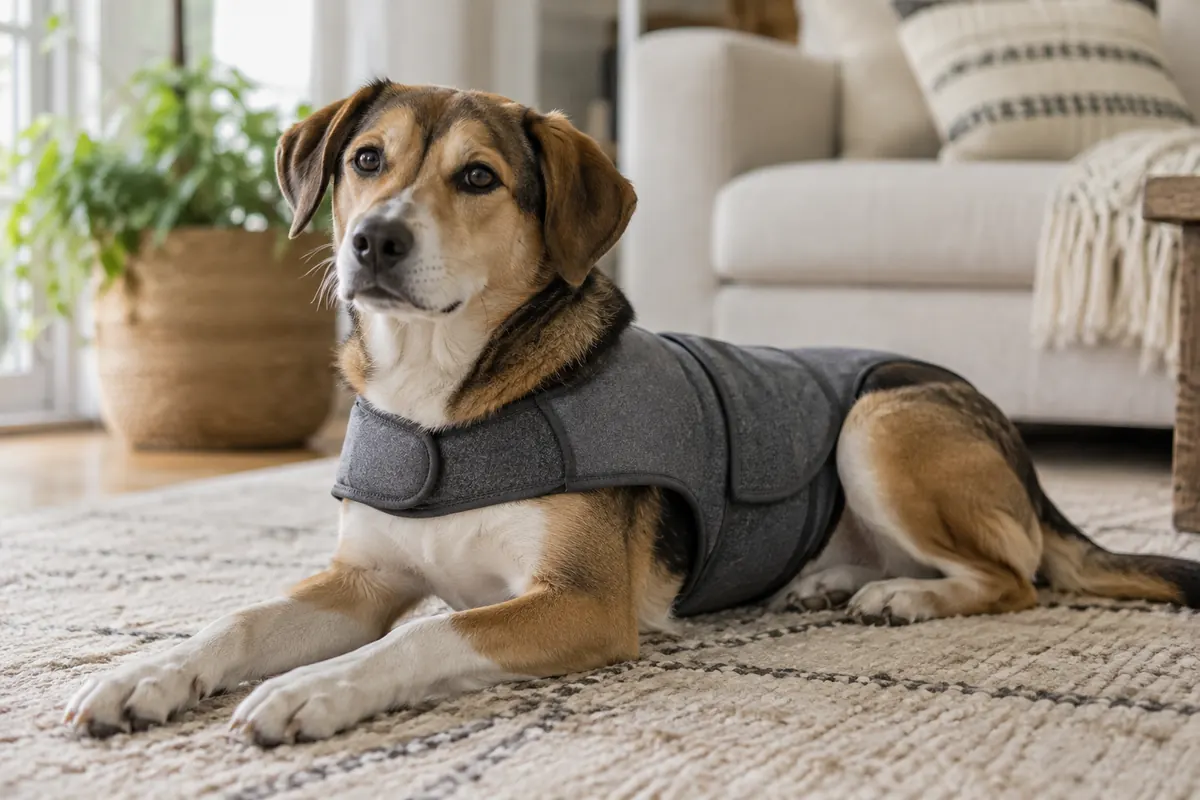
ThunderShirt Classic is an adjustable fabric garment that wraps around a dog’s torso. Overlapping panels let you create a snug fit while leaving the head, legs, and tail free.
“Thunder Jacket,” anxiety vest, and anxiety wrap are terms used for similar products. They do not necessarily describe the same brand, fabric, fastening system, or sizing.
The proposed explanation is that steady, gentle pressure may help some dogs feel more secure. That remains a theory rather than a proven mechanism. Comparisons with swaddling do not establish how a dog experiences it.
The wrap does not block noise, teach separation skills, or make an uncomfortable situation safe. It is also not a walking harness or restraint.
ThunderShirt Classic Dog Anxiety Vest
ThunderShirt Classic is a reasonable starting wrap for noise anxiety because its adjustable design allows careful fitting and gradual introduction. Pick the size by your dog's chest girth (not weight); you choose the size on the listing.
Check price on AmazonWe earn a small commission if you buy through this link, at no extra cost to you. Disclosure
What the evidence actually says
The research is limited, and findings about pressure wraps should not automatically be presented as proof about ThunderShirt Classic.
A small 2013 study by Cottam and colleagues in the Journal of Veterinary Behavior examined a similar product, the Anxiety Wrap. Eighteen dogs completed the study, which relied on owners reporting their dogs’ thunderstorm reactions.
Many owners reported some improvement. However, there was no placebo group, and owners knew their dogs were wearing the product. That makes it difficult to separate a wrap’s effect from expectations, differences between storms, or other influences.
A 2018 Veterinary Evidence review of pressure vests found weak evidence, with possible small benefits. It does not support predicting a dependable result for an individual dog.
These findings leave room for cautious use, but not certainty. A reasonable question is whether your dog moves, rests, and recovers more comfortably with the wrap—not whether the product makes them completely quiet.
Who a ThunderShirt may help
The most reasonable candidate is a dog with manageable situational stress who already tolerates gentle handling and clothing.
A wrap is optional comfort, not part of a storm safety plan. If you live in tornado country, our tornado season guide covers a shelter-spot routine, a small dog kit and what to do if a warning comes while you are at work.
Examples include:
- A dog unsettled by storms who can still accept food and reassurance.
- A dog nervous during travel while otherwise physically comfortable.
- A dog who finds clinic visits stressful but tolerates the garment.
- A dog who settles more easily when a familiar routine includes the wrap.
These are practical situations to consider, not established predictors of success.
Start with the environment too. During fireworks, offer a quiet retreat and close curtains. For travel, check temperature, restraint, and possible motion sickness. Before a vet visit, ask the clinic about reducing waiting-room stress.
A wrap is most useful when it complements those preparations rather than carrying the whole plan.
Who it usually does not help enough
A ThunderShirt is not an adequate answer to severe separation anxiety, repeated escape attempts, self-injury, or overwhelming panic. Those problems need veterinary assessment and an individualized behavior plan.
It may also be unsuitable for dogs who dislike touch or handling. Freezing while you fasten the garment is not acceptance.
Avoid adding a layer in very hot conditions. Flat-faced dogs, dogs with breathing problems, and dogs who overheat easily need particular caution and veterinary advice.
A wrap cannot address pain, illness, or a frightening environment that remains overwhelming. A dog who vomits during travel may need assessment for motion sickness rather than another clothing adjustment.
If wearing it creates more distress than the original problem, stop. Continuing simply because you bought it is not helpful.
Our honest verdict
ThunderShirt Classic is worth considering when your dog comfortably accepts a wrap, you can supervise, and your expectations are modest.
Its practical advantages are an adjustable design, no ingested ingredient, and the ability to use it alongside other preparations. Limitations include uncertain benefit, fitting effort, an extra layer of fabric, and the possibility that your dog dislikes it.
We would not buy it expecting it to resolve panic or replace training. Nor would we repeatedly tighten it or extend wear because a response is missing.
The useful outcome is a dog who appears more comfortable while still moving and engaging normally. If that does not happen, choosing a different approach is reasonable.
How to choose an anxiety wrap
- Measure chest girth and follow the manufacturer's size chart; choose adjustable fastenings that allow normal breathing and movement.
- Choose lightweight, washable fabric with smooth seams; avoid designs that cover the nose or mouth.
- Pick a wrap you can introduce gradually before storms, fireworks, or travel; skip it if handling increases distress.
- Use alongside gradual training; seek veterinary help for panic, breathing problems, or overheating instead of tightening the wrap.
Sizing: measure the dog, not the breed
Measure chest girth around the widest part of the torso, just behind the front legs. Compare that measurement with the current chart for the exact product.
| Size | Chest girth | Weight (rough guide only) |
|---|---|---|
| XXS | 9–13" | up to 7 lbs |
| XS | 13–17" | 8–14 lbs |
| S | 17–21" | 15–25 lbs |
| M | 21–25" | 26–40 lbs |
| L | 25–30" | 41–64 lbs |
| XL | 30–37" | 65–109 lbs |
| XXL | 37–50" | 110+ lbs |
Approximate ThunderShirt Classic ranges. Chest girth decides the size; always confirm against the current chart on the listing before you order.
Weight is only a guide. Dogs of similar weight can have different chest shapes.
If your dog falls between sizes, follow the manufacturer and size down — do not automatically size up for “extra pressure.” See our ThunderShirt size guide for the full chart, fit checks, and breed starting sizes, and our large-dog sizing page for large-breed remaps. Do not rely on a breed-based shortcut alone.
How to introduce a ThunderShirt in five steps
Practice in a quiet setting before a storm, departure, or appointment. Use familiar treats your dog tolerates, and let their behavior determine the pace.
- Let your dog investigate. Place the wrap nearby and reward relaxed interest. Do not chase them with it.
- Introduce contact briefly. Touch or drape the fabric gently against the body, offer a treat, and remove it. Avoid surprising your dog with fastening sounds.
- Practice fastening. Secure it comfortably for a very short supervised session. Reward calm behavior without preventing your dog from moving away.
- Check ordinary movement. Invite walking, sitting, and lying down. Remove the garment if posture, breathing, or willingness to move changes.
- Build comfortable familiarity. Repeat easy sessions before adding a manageable real-world situation.
Some dogs need smaller steps. Do not lure a reluctant dog into remaining still while completing a fit they are trying to avoid.
Fit check: snug should still be comfortable
Use the two-finger rule as a practical check: you should be able to slide two fingers under the wrap without forcing them. This is not a complete safety assessment by itself.
Also check:
- Breathing looks normal for your dog at rest.
- Walking, sitting, and lying down remain comfortable.
- Panels do not rub the armpits or bunch around the body.
- Fastenings remain secure without pulling tightly.
- Your dog can engage normally rather than freezing.
Check again after movement. Remove and reassess if the wrap shifts or appears uncomfortable. More pressure is not evidence of more benefit.
How long to wear it and safety
Use the wrap during supervised preparation and the relevant event, then remove it afterward. Follow the product instructions, but do not treat any wear-time allowance as suitable for every dog.
There is no universal duration that makes heat, rubbing, or discomfort impossible. Check regularly throughout use.
Watch for increased panting, unusual warmth, drooling, restlessness, skin redness, pawing at the garment, or greater agitation. Remove it if these develop and assess what your dog needs.
Avoid leaving it on overnight or during unattended absences as part of your initial trial. Keep it away from chewing and snagging hazards.
For flat-faced breeds or dogs with medical concerns, ask your vet about suitability. Labored breathing, collapse, or other urgent physical signs need veterinary care, not a different fastening arrangement.
ThunderShirts and separation anxiety
A wrap can only be support for separation-related distress. It cannot teach a dog that departures are safe or make an excessive absence manageable.
Pair any aid with gradual desensitization: practice absences short enough that your dog remains comfortable, then adjust in small steps according to observed behavior.
Use recordings to check what happens after you leave. Pacing, vocalizing, barrier scratching, or food refusal may mean the practice was too difficult.
A dog may also learn that putting on the wrap predicts your departure. Include comfortable sessions when you stay home so it does not become another worrying cue.
For severe distress, arrange appropriate care while seeking professional help. Talk to your vet about medication if needed.
What to do if it is not working
First ask whether it is comfortable, not whether it is tight enough. Recheck measurements, fit, heat, and handling tolerance.
Then review the situation. Loud, close fireworks or a long absence may remain overwhelming regardless of clothing.
Check your expectations too. Useful changes might include easier settling or quicker recovery rather than disappearance of every sign of worry.
Keep a simple record of the trigger, wrap use, behavior, and recovery. Different storms are not identical comparisons, so interpret observations cautiously.
If there is no meaningful benefit, stop relying on it. Do not force longer sessions, repeatedly increase pressure, or keep exposing your dog to distress to assess the purchase.
Reconsider environmental changes and training with professional guidance where appropriate.
More fixes, step by step: ThunderShirt not working? What to try next.
What owners commonly report
When reading ThunderShirt for dogs reviews or thunder jacket for dogs reviews, you will encounter mixed experiences.
Some owners describe easier settling or fewer visible signs of worry. Others report little change, discomfort with the garment, or improvement in one situation but not another.
Practical comments often concern sizing, fastening noise, ease of putting it on, and whether the dog tolerates clothing. Those details can be more useful than a broad claim that it “works.”
These are general review themes, not a measured summary of how often each response occurs. Reports may also reflect changes in training, reassurance, or circumstances.
Is a ThunderShirt worth it for your dog?
Answer each check yes or no. This is a decision aid, not a diagnostic score.
Is a ThunderShirt worth it for your dog?
- Does your dog comfortably accept gentle touch and clothing?
- Is the stress manageable, rather than severe panic or self-injury?
- Can you introduce the wrap during quiet sessions?
- Can you supervise and check breathing, movement, and temperature?
- Have you addressed obvious discomfort and environmental triggers?
- Will you continue training rather than rely on the wrap alone?
- Are you comfortable stopping if it adds stress or provides no benefit?
Mostly “yes” answers suggest a cautious trial may fit your circumstances. Any concern about handling, overheating, or severe distress deserves attention first. You do not need to buy a wrap to begin helping your dog.
ThunderShirt alternatives compared
We earn a small commission if you buy through the Amazon links in this table, at no extra cost to you. Affiliate disclosure
Cost levels are broad relative categories, not prices; they vary with product choice and professional needs.
| Option | Best for | Not ideal for | Effort | Cost level |
|---|---|---|---|---|
| ThunderShirt Classic | Dogs comfortable with pressure during manageable events | Heat, handling aversion, severe panic alone | Medium: introduction, fitting, supervision | Medium |
| Generic anxiety wrap / Thunder Jacket style vest | Owners comparing an adjustable wrap | Unclear sizing or uncomfortable construction | Medium: assess design and fit | Low |
| ThunderEase (Adaptil) pheromone diffuser | Additional home environmental support | Expecting immediate relief or learned independence | Low: correct placement and refills | Medium |
| Calming chews (Composure-style) | Possible support for mild predictable stress | Unchecked medication interactions or severe panic alone | Medium: label review and timing | Medium |
| Heartbeat comfort toy (Snuggle Puppy) | Dogs who find a comfort object reassuring | Dogs who damage or swallow components | Low to medium: introduction and checks | Medium |
| Stuffed food toy (KONG) | Enrichment for dogs comfortable enough to engage | Panic, food refusal, unsafe chewing | Medium: preparation and supervision | Low |
| Behavior plan + vet/behaviorist | Significant anxiety and individualized assessment | Expecting an instant, effortless change | High: practice, management, follow-up | High |
Swipe the table sideways to see every column.
Pheromones and supplements also have limited or mixed evidence. Ask your vet before adding chews, particularly with medication or health concerns. A toy provides an activity; it does not resolve fear by itself.
Go deeper: Anxiety Wrap vs ThunderShirt compared, ThunderShirt alternatives ranked, ThunderShirt vs calming chews, best calming chews for dogs and every type of dog calming product compared.