On this page
Calming pheromones for dogs are synthetic versions of chemical signals associated with nursing mother dogs. Available in plug-in diffusers, collars, and sprays, these products aim to create a more reassuring environment. For owners searching for dog pheromones for anxiety, the biggest questions are whether they actually help, which format makes sense, and whether the ongoing refill cost is worthwhile.
At AnxietyFreePups, we look at published research, manufacturer information, and practical considerations for dog owners. We have not independently lab-tested these products, and we don't assume every dog will respond the same way. Below, we examine the evidence, compare popular dog calming diffusers, and take a closer look at Adaptil and ThunderEase.
Quick comparison
| Product | Format | Best for | Notes |
|---|---|---|---|
| Adaptil Calm Home / ThunderEase starter kit | Plug-in diffuser and refill | Ongoing support in the main living area | Needs clear placement, continuous use, and compatible refills |
| Adaptil / ThunderEase refills | Replacement liquid bottle | Continuing an existing diffuser trial | Usually labeled for approximately 30 days |
| Adaptil Calm On-the-Go / ThunderEase collar | Wearable collar | Dogs comfortable wearing a product outside the home | Fit and replacement instructions matter; not a leash attachment |
| Adaptil / ThunderEase spray | Surface spray | Preparing travel bedding, crates, cars, or bandanas | Allow the carrier to evaporate; never spray directly on the dog |
| Comfort Zone Dog diffuser | Plug-in diffuser | Comparing a potentially cheaper dog-specific shelf option | Availability varies; less dog-specific published evidence behind our assessment |
Swipe the table sideways to see every column.
Choose by the situation, not the number of formats advertised. A home diffuser cannot provide the same placement during a car trip, and a spray is not continuous room coverage.
ThunderEase Diffuser Kit (powered by ADAPTIL)
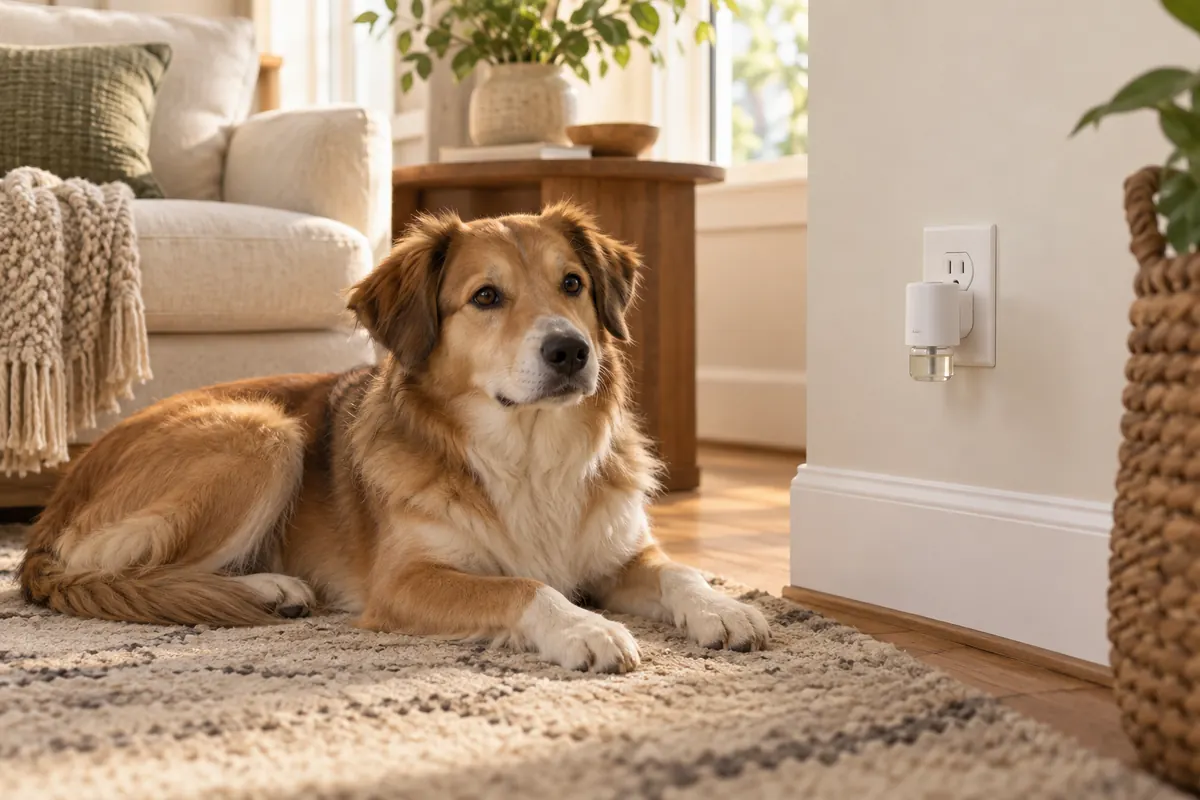
The home diffuser offers continuous environmental support without a chew or wearable, making it practical alongside training and predictable routines.
Check price on AmazonWe earn a small commission if you buy through this link, at no extra cost to you. Disclosure
Best calming diffusers for dogs compared
Choosing a dog calming diffuser involves more than selecting a familiar brand. Start by checking whether the product contains a dog-specific synthetic appeasing pheromone (DAP), rather than fragrance or essential oils. Then consider the manufacturer’s stated room coverage, refill availability, ongoing replacement costs, and whether your home has a suitable unobstructed outlet.
The research behind the formula also matters. A 2010 systematic review in the Journal of the American Veterinary Medical Association found insufficient evidence for many proposed applications of dog-appeasing pheromones. A 2021 Veterinary Evidence review rated the overall evidence as weak and found no clear evidence that diffusers, collars, or sprays were superior.
Here is how the main options compare.
| Product | What it releases | Coverage / refill | Evidence behind it | Best for | Main limitation |
|---|---|---|---|---|---|
| ThunderEase Diffuser Kit (powered by ADAPTIL) | Synthetic dog-appeasing pheromone analog | About 30 days per refill; check room coverage on the package | Uses ADAPTIL pheromone technology; evidence for real-world anxiety benefits remains limited | Owners wanting a dog-specific starter kit | Recurring refill purchases; results vary |
| Adaptil Calm Home Diffuser | Synthetic dog-appeasing pheromone analog | About 30 days per refill; manufacturer states coverage up to approximately 700 sq. ft. on its US product page | Studied DAP approach, but independent reviews find uncertain benefits | Dogs experiencing recurring stress at home | Continuous use and replacement costs |
| Comfort Zone Dog Calming Diffuser | Historical dog-specific DAP formulation; verify any listing | Check label and availability | No strong evidence establishes superiority over other DAP diffusers | Comparing older dog-specific products, if available | Current official product range focuses on cats |
| Generic / unbranded “calming” plug-ins (often essential-oil based) | Varies; may release fragrance or essential oils rather than DAP | Check label | No reliable product-specific evidence can be assumed | Not a preferred substitute for dog-specific DAP | Uncertain ingredients and possible irritation |
Swipe the table sideways to see every column.
Comfort Zone currently emphasizes cat pheromone diffusers, so its cat formulations should not be presented as dog-calming DAP products.
Which diffuser should you choose?
- Choose ThunderEase Diffuser Kit if you want a straightforward dog-specific pheromone starter kit. Its ADAPTIL-based formulation makes it a reasonable first product to compare, but not a proven solution for every dog.
- Choose Adaptil Calm Home Diffuser if you prefer buying directly within the ADAPTIL product system and can reliably source compatible refills. Check coverage and ongoing costs before purchasing.
- Consider Comfort Zone cautiously if you find an older dog-specific product. Verify the ingredients, expiration date, and refill availability. Do not substitute a Comfort Zone cat diffuser for a dog pheromone diffuser.
Bottom line: A calming diffuser is an optional add-on to behavioral training and environmental support, not a standalone fix for dog anxiety.
What are dog calming pheromones?
DAP stands for dog-appeasing pheromone. Commercial products use a synthetic copy, or analog, of a pheromone signal associated with nursing mother dogs. The intended purpose is to provide a reassuring chemical message.
This is different from adding a pleasant fragrance. The pheromone itself is odorless to people, although a spray’s carrier or a diffuser’s liquid may have a noticeable smell.
Adaptil is not a sedative or medication. It does not work by making your dog swallow a calming ingredient, and it should not be expected to make a frightened dog sleepy.
Diffusers release the analog into a room, collars release it near the dog, and sprays apply it to suitable surfaces. Those delivery methods have different practical uses, but none establishes that a dog will respond.
Dog pheromone products are species-specific. A cat-calming refill is not a substitute for a dog product, even when the packaging or plug-in device looks similar.
Does Adaptil actually work?
Evidence for calming pheromones for dogs is mixed. Small studies have reported improvements in some situations, while other studies have found little clear benefit. Results depend on the dogs, setting, measurements, and study design.
A 2010 systematic review in JAVMA concluded there was insufficient evidence that pheromone products treat undesirable behavior in dogs. A later Veterinary Evidence knowledge summary (2021) likewise found the evidence for DAP weak overall and did not show that spray, diffuser, or collar was superior.
Owner-reported improvement can be useful, but it is difficult to interpret when training, routines, or the environment change at the same time. Research on dogs in a shelter or clinic also does not automatically predict what happens in your living room.
Our editorial view is that a correctly used pheromone product can be considered as an additional aid, with realistic expectations. It should not carry the main responsibility for treating panic.
Before starting, choose behaviors to track: pacing during departures, recovery after noises, or willingness to rest in a new home. Compare similar situations rather than judging only whether your dog seems “better.”
Look for comfortable behavior, not silence alone. A dog who freezes or hides quietly may still be frightened.
Adaptil vs ThunderEase vs Comfort Zone
Adaptil and ThunderEase for dogs are related products within the same Ceva family. ThunderEase is marketed as powered by ADAPTIL and using the ADAPTIL pheromone analog. They should not be treated as unrelated calming technologies.
For Amazon US shoppers, ThunderEase is often easier to find, although listings and stock change. Confirm the dog-specific formula, seller, included components, and refill supply before ordering.
The branding relationship does not mean every bottle fits every heater. Follow explicit compatibility instructions rather than assuming parts are interchangeable.
Comfort Zone Dog is a different DAP brand. We give Adaptil/ThunderEase preference because the research base discussed here is more closely associated with that product family; we have less dog-specific published evidence supporting Comfort Zone in this comparison.
If a Comfort Zone Dog kit is cheaper locally, check the current label and replacement-refill availability. Do not accidentally buy a cat diffuser or assume a lower starter price means lower ongoing cost.
Our picks
We earn a small commission if you buy through the Amazon links on this page, at no extra cost to you. Affiliate disclosure
Home diffuser starter kit: our top pick
Best for: Owners seeking ongoing environmental support where their dog rests, settles, or practices manageable alone time.
In practice: The kit includes a plug-in unit and liquid refill. Place it correctly in the main room your dog uses and operate it according to the label.
Pros: No treat acceptance or collar tolerance is required. Continuous delivery is convenient alongside a predictable home routine.
Cons: Placement and room layout matter. It brings recurring refill costs and may produce no noticeable behavioral improvement.
We favor the Adaptil Calm Home Diffuser or ThunderEase equivalent for convenience, not demonstrated superiority over every format. Plan a measured trial alongside training rather than buying it as a cure.
Diffuser refills
Best for: Continuing use when your existing diffuser trial appears worthwhile.
In practice: Replace the bottle with an explicitly compatible dog-specific refill. Many are labeled for approximately 30 days, though consumption can vary.
Pros: Refills let you maintain the setup without buying a complete kit each month. Multipacks may reduce ongoing cost.
Cons: A refill does not replace an aging or damaged heater. Buying a large pack before assessing your dog’s response can waste money.
Write down the start date and check the bottle regularly. Replace the diffuser unit periodically as its label directs; some Adaptil instructions specify replacement after six months.
Do not top up a bottle with water, fragrance oil, or another liquid.
Collar (on-the-go)
Best for: Dogs who comfortably tolerate a collar and need an aid that travels with them.
In practice: Adaptil Calm On-the-Go or a ThunderEase collar releases the analog near the dog. Fit it according to the package and follow bathing and replacement instructions.
Pros: It is portable and does not require an outlet in each location.
Cons: Some dogs dislike an additional collar. Skin comfort, fit, chewing risk, and interaction with other equipment need attention.
A pheromone collar is not a restraint: attach the leash to appropriate walking equipment instead. Check for rubbing and follow precautions about snagging or confinement.
It cannot make overwhelming outings appropriate. Use distance, shorter trips, and gradual exposure rather than relying on the collar to prevent fear.
Spray (travel and crates)
Best for: Preparing suitable bedding or surfaces before car rides, carrier use, or other short events.
In practice: Apply Adaptil or ThunderEase spray to label-approved surfaces while the dog is elsewhere. Allow the carrier to evaporate before bringing them back; product instructions commonly specify waiting at least 15 minutes.
Pros: It is portable and can be used where a plug-in diffuser is impractical.
Cons: It requires advance preparation and reapplication as directed. The carrier may initially smell, and not every surface is suitable.
Never spray directly onto your dog, their face, or into an occupied crate. Check fabric instructions before treating a bandana, and let it dry before use.
The spray cannot replace positive crate introductions, comfortable travel conditions, or veterinary assessment of motion sickness.
Comfort Zone Dog (brief)
Best for: Comparing a dog-specific option that may cost less on the shelf, when available.
In practice: Check that the kit and refills are specifically labeled for dogs and follow their own instructions.
Pros: A lower local price may make an initial purchase more accessible.
Cons: Availability and ongoing costs vary, and there is less dog-specific published evidence behind our assessment.
It is not our top pick. Compare complete running costs and evidence rather than treating all pheromone brands as equivalent.
How to use a diffuser correctly
Choose the right room. Plug it in where your dog spends meaningful time, such as their main resting area. An outlet in a little-used hallway may not be useful.
Keep it upright. Follow the unit’s orientation instructions, with the refill below and vents pointing up. Do not rotate it sideways simply to fit an awkward outlet.
Leave space above it. Avoid placement under shelves, behind furniture, or beneath curtains. The device needs unobstructed space for the warmed vapor to rise.
Check the electrical instructions. Use the correct regional unit and approved outlet arrangement. Keep the device and liquid away from chewing, water, and children.
Maintain the setup. Use continuously if the label directs, replace refills approximately monthly, and replace the heater periodically. Inspect for damage, leaks, or unusual operation; discontinue use if something looks wrong.
Allow a sensible assessment period. Follow the product’s suggested trial duration rather than expecting an immediate personality change. Start ahead of a predictable event where possible, while continuing preparation and training.
Keep a simple record. Note placement, start date, trigger intensity, pacing, vocalizing, and recovery. Do not increase the difficulty of departures just because the diffuser is running.
If nothing improves, check setup once, then reassess whether continued spending is useful. Buying additional units is not automatically the next step.
When pheromones are not enough
For separation stress, practice absences short enough that your dog remains comfortable. Use recordings to observe behavior and arrange care when unavoidable absences exceed their current tolerance.
For noise fear, provide a retreat and work on gentle sound exposure outside the real event. Do not leave a panicking dog to cope alone because a diffuser is plugged in.
For new-home settling, prioritize predictable meals, bathroom breaks, rest, and manageable introductions. A diffuser cannot compensate for constant disruption.
For travel, use safe restraint and comfortable ventilation. Vomiting or persistent drooling may indicate motion sickness requiring veterinary advice.
Severe panic, self-injury, escape attempts, aggression, or an inability to eat or sleep warrants help from a vet or veterinary behaviorist. Sudden behavior changes also need a health check.
Do not interpret every symptom as anxiety. Breathing difficulty, collapse, or other urgent physical signs need prompt care. Pheromone products support environment and behavior modification; they do not replace either.
Bottom line
Do calming pheromones for dogs work? Adaptil and ThunderEase may help some dogs, but the evidence is mixed and the response is individual. Our home-use pick is an Adaptil Calm Home Diffuser or ThunderEase kit powered by ADAPTIL because it is convenient alongside an existing routine.
Choose the appropriate format, follow the label, and track meaningful changes. Continue only when the benefit seems worthwhile, and seek professional help rather than waiting through severe distress.