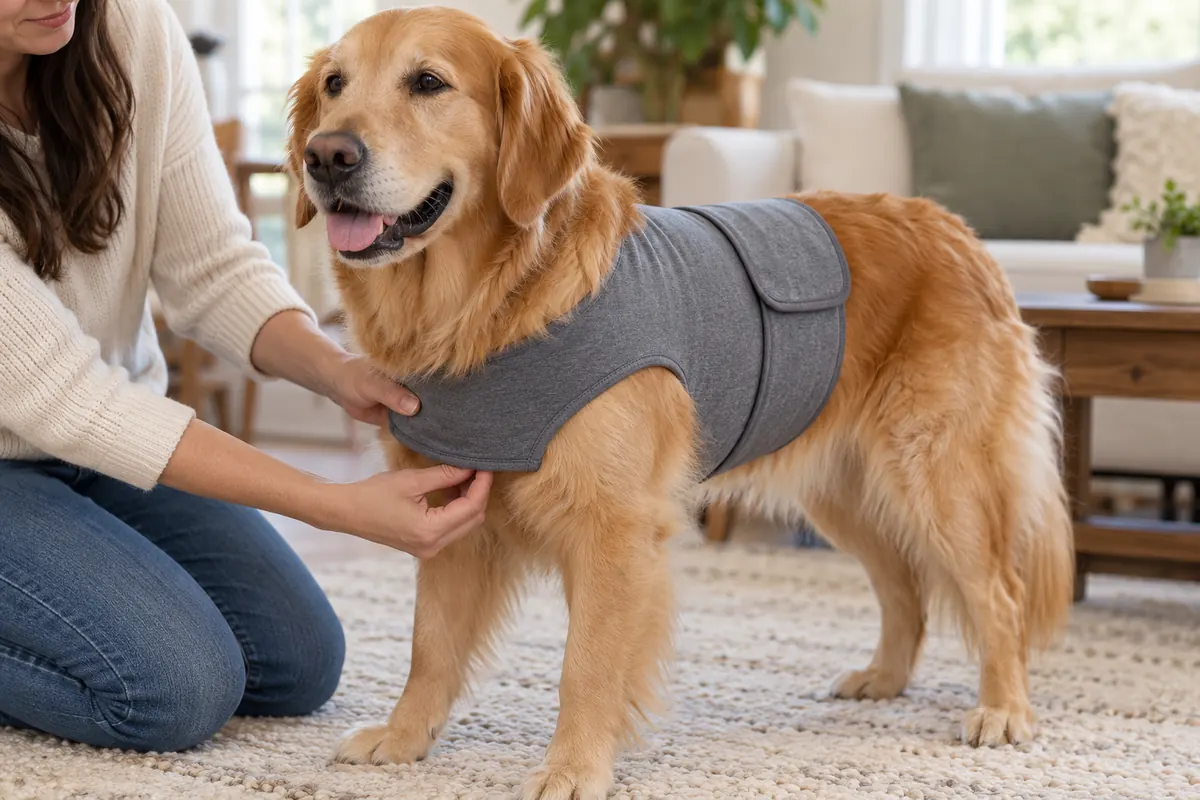
The Thundershirt is the most widely recommended anxiety wrap for dogs — and small studies suggest it helps some dogs, though not all. Whatever benefit it has depends on correct sizing. In large breeds especially, a wrap that rides loose around a 65-pound Husky's barrel chest provides zero calming pressure. This guide gives you the exact measurements, a full size chart, and breed-specific recommendations so you can get it right on the first order.
The size ranges below match the current ThunderShirt Classic chart on our ThunderShirt review. For the full XXS–XXL chart, fit checks, and all 18 breed hubs, see the ThunderShirt size guide.
How Thundershirt Sizing Works
The single most important number is chest girth — not weight, not breed name, not age. Chest girth is measured at the widest point of your dog's ribcage, just behind the front legs. You wrap a soft measuring tape snugly around that point while your dog is standing. That number, in inches, determines the size.
Weight ranges published on Thundershirt packaging are approximate guides, not hard rules. A heavily muscled male Labrador and a slim, narrow-chested female Lab can both weigh 65 pounds yet need different sizes. Body type, gender, and individual build all influence girth independently of weight. Always measure — it takes 30 seconds and prevents a frustrating return.
For large and giant breeds, also check that the wrap's chest plate will clear your dog's sternum and that the belly band will reach comfortably around the lower torso. Deep-chested breeds such as Dobermans, Weimaraners, and Standard Poodles can sometimes have a girth measurement that lands in one size but a chest depth that strains the panels — more on that in the breed-specific section below.
Full Thundershirt Size Chart
The table below reflects Thundershirt's current sizing specifications. Highlighted rows cover the sizes most relevant to large breeds.
| Size | Chest Girth | Weight (rough guide only) | Example Breeds |
|---|---|---|---|
| XXS | 9–13" | up to 7 lbs | Tiny toys / puppies |
| XS | 13–17" | 8–14 lbs | Chihuahua, Maltese, Toy Poodle |
| S | 17–21" | 15–25 lbs | Pug, Beagle, Miniature Schnauzer |
| M | 21–25" | 26–40 lbs | Corgi, Cocker Spaniel, lean Border Collie |
| L | 25–30" | 41–64 lbs | Husky, Standard Poodle, stocky Border Collie |
| XL | 30–37" | 65–109 lbs | Golden (female), Labrador, German Shepherd |
| XXL | 37–50" | 110+ lbs | Golden (large male), Great Dane, Mastiff |
Approximate ThunderShirt Classic ranges. Chest girth decides the size; always confirm against the current chart on the listing before you order. L, XL, and XXL (highlighted) are the sizes most relevant to large dogs.
Breed-Specific Size Recommendations
The following recommendations cover the large breeds most commonly searched alongside Thundershirt sizing questions. These are starting points — always verify with your own girth measurement.
What to Do If Your Dog Is Between Sizes
When your dog's girth measurement falls on the boundary between two sizes, follow the manufacturer: size down. Do not automatically size up for “extra pressure.” Measure chest girth carefully, confirm against the current ThunderShirt Classic chart (the same one on our ThunderShirt review), then fasten and run the two-finger fit test. The Velcro panels still let you fine-tune snugness within the chosen size.
XXL (37–50") is for dogs whose girth truly lands in that range — including many large male Goldens and giant breeds — not a default “go bigger” choice. A dog whose girth sits at the top of XL should size down into XL when between XL and XXL, then verify fit. If you are unsure after measuring twice, check the current listing chart or contact ThunderShirt support before ordering.
How to Check the Fit
Once the Thundershirt arrives, test the fit before any anxiety event so your dog can acclimate in a calm environment. A properly fitted Thundershirt should feel like a firm hug — snug and constant, but never restrictive.
Large Dog Thundershirt Alternatives
The Thundershirt works exceptionally well for most large dogs with a standard body shape. However, certain large-breed body types — extreme deep chest, very narrow torso, or heavy barrel chest with a pronounced tuck-up — can cause the Thundershirt's standard panel design to gap or slip. If you have tried two sizes and still cannot get a secure fit, these alternatives are worth considering.
Anxiety Wrap (Original)
Uses a different panel design with an elastic band that wraps around the torso in a figure-eight pattern rather than flat panels. The elastic construction conforms better to deep, narrow chests — particularly good for Dobermans, Standard Poodles, and Weimaraners. Available in sizes up to XL (75 lbs).
View on Amazon →American Kennel Club Comfort Wrap
A wider belly band than the standard Thundershirt, which helps it stay put on large-breed dogs with a wider girth. Machine washable, available up to XXL, and slightly lower price point. Fewer independent clinical studies than Thundershirt, but owner-reported effectiveness is comparable for storm and fireworks anxiety.
View on Amazon →Calming Chews (Complement or Replace)
For dogs whose anatomy makes any wrap difficult to fit — or who simply will not tolerate wearing one — a fast-acting calming chew with L-theanine provides an alternative route to anxiety relief. Onset is 30–45 minutes, so plan ahead. Works well combined with a properly fitted wrap for severe storm or fireworks phobia.
View on Amazon →For a full comparison of anxiety wraps vs. calming chews vs. pheromone products, see the complete Thundershirt review. For dogs whose anxiety is severe enough that no over-the-counter product provides adequate relief, the Thundershirt alternatives guide covers prescription and prescription-adjacent options.
Frequently Asked Questions
What size Thundershirt for a Golden Retriever?
Most Golden Retrievers need a size XL or XXL under the current chart. Measure chest girth — the widest point of the ribcage behind the front legs. Female Goldens typically measure 32–37 inches (size XL); males often measure 37–46 inches (size XXL). If your dog's measurement is right at a boundary, size down per the manufacturer. See the dedicated Golden Retriever anxiety guide for more breed-specific tips.
Should I size up or size down a Thundershirt?
When between sizes, follow the manufacturer and size down. Do not automatically size up for “extra pressure.” Measure chest girth, confirm the current ThunderShirt Classic listing chart, fasten the panels, and use the two-finger fit test. If the wrap is so large that panels hang open or slip, you likely need the size down. If you cannot slide two fingers under a panel, loosen it or re-check that you chose the correct size for the measured girth.
Why does my large dog's Thundershirt keep slipping off?
Slipping almost always indicates the wrap is too large, or the belly band was not fastened snugly enough. Re-measure your dog's girth and check whether a smaller size would be more appropriate. Make sure to fasten the panels in the correct order: chest flap first, belly band second, neck flap third — pulling each panel firmly before moving to the next. For deep-chested breeds where the belly band cannot make solid contact with a narrow lower torso, try the Anxiety Wrap alternative above.
Can a Thundershirt be too tight on a large dog?
Yes. A wrap that is too tight compresses the ribcage and restricts the diaphragm — the opposite of calming. After fastening, use the two-finger test: you should be able to slide two flat fingers under any panel without forcing them. Signs a wrap is too tight: rapid shallow breathing, wide eyes, pawing at the wrap continuously, or refusal to move. Remove immediately if you observe any of these and either loosen the panels or order the next size up.
How long can a large dog wear a Thundershirt?
For most anxiety events — a thunderstorm, fireworks display, car ride, or vet visit — 1 to 2 hours is the ideal wear window. Continuous wear beyond 4 hours is not recommended; the nervous system adapts to constant pressure over time, reducing the calming effect. In warm weather, large double-coated breeds like Huskies and German Shepherds face added overheating risk with a wrap on. Always remove the Thundershirt between anxiety events and give at least a one-hour break.