On this page
Your puppy falls asleep beside you but cries the moment you disappear. That can feel worrying, especially when you need to shower, sleep, or return to work. A puppy adjusting to a new home needs reassurance as well as opportunities to learn independence.
We are dog owners, not vets. This guide offers an adaptable eight-week framework for puppies roughly eight weeks to six months old. Our product suggestions are editorial assessments of intended uses and limitations; we have not tested these products ourselves.
Is it separation anxiety or normal puppy crying?
A new puppy has recently lost familiar surroundings and company. Crying can communicate uncertainty, needing the toilet, hunger, discomfort, or being overtired. A brief complaint does not establish separation anxiety.
Did your puppy cope well and then start struggling at 6 to 18 months? Our guide to separation anxiety in adolescent dogs explains why it happens and how to rebuild alone time in four stages.
For the very first times you step out, follow our guide to leaving your dog alone for the first time, with a before-you-leave checklist and a flexible first-week plan.
Puppies and newly adopted dogs often stick close to their people. To see when that is normal and how to build calm independence gently, read our guide to why your dog follows you everywhere.
Puppies can learn early that keys and shoes mean you are leaving. Our guide to departure cue training shows gentle, short practice to keep those cues boring.
For rough alone-time limits by age, from 8-week-old puppies to seniors, see our guide on how long a dog can be left alone.
Look at what happens next. A puppy who briefly vocalizes, investigates a familiar toy, and relaxes is showing a different pattern from one whose distress keeps building.
Concerning signs include persistent howling, frantic pacing, heavy drooling, scratching barriers, escape attempts, and inability to settle. Some puppies become still and watchful rather than noisy, so silence alone is not proof of comfort.
Check needs before labeling behavior. Notice whether your puppy struggles with all separation, only closed barriers, or a particular person's departure. To tell under-stimulation from true panic, see separation anxiety vs. boredom: 10 signs.
Letting a puppy “cry it out” for long periods is not a reliable way to build independence. Aim to return before distress starts; if you misjudge, respond calmly and make the next exercise easier. You do not need to wait for silence while a puppy panics.
Snuggle Puppy Heartbeat comfort toy
A heartbeat comfort toy may offer a familiar settling cue during a puppy's first weeks, alongside nearby company and gradual training.
Check price on AmazonWe earn a small commission if you buy through this link, at no extra cost to you. Disclosure
What your puppy needs before you leave
Begin with a toilet opportunity. Young puppies commonly need to go after waking, eating, drinking, or active play, not just when a scheduled interval ends.
Provide age-appropriate meals and access to fresh water. Do not restrict drinking to make an absence possible. Ask your vet about feeding needs if your puppy is very small or has health concerns.
Offer suitable activity, followed by time to settle. Gentle sniffing, a short learning game, or relaxed exploration may fit better than intense play immediately before departure.
Protect sleep. Young puppies need frequent rest, but sleeping longer overnight does not establish readiness for an equivalent daytime absence.
Introduce enrichment while you are present. Use familiar food and a puppy-appropriate toy with easy access. Food refusal or frantic chewing suggests the situation needs reassessment, not a harder puzzle.
How long can my puppy be alone? Quick table
These are cautious planning examples for healthy, gradually prepared puppies, not researched age-based guarantees. Start separation training in seconds; a puppy's comfortable duration may remain far below these ranges.
If your puppy still panics as they get older, our step-by-step separation anxiety training plan walks through camera-watched sessions, stress signs and how fast to add time.
| Age | Typical comfortable alone time | Notes |
|---|---|---|
| 8–10 weeks | Initially seconds to minutes; some prepared puppies manage around 30–60 minutes | Arrange frequent care. A new puppy may not yet tolerate even a brief departure. |
| 10–12 weeks | Short practiced periods; some manage around an hour | Check individual toilet patterns and behavior rather than assuming an age milestone means readiness. |
| 3–4 months | Some prepared puppies manage roughly 1–2 hours | Provide regular company, meals, and toilet opportunities; distressed puppies need shorter absences. |
| 4–5 months | Some prepared puppies manage roughly 2–3 hours | Progress depends on observed comfort, health, and care needs. |
| Around 6 months | Some prepared puppies manage roughly 3–4 hours | This is not permission for a full workday alone or a target every puppy must reach. |
Swipe the table sideways to see every column.
Bladder control and emotional tolerance are separate. Use whichever limit is shorter, and arrange help when your schedule exceeds it.
Set up a safe puppy zone
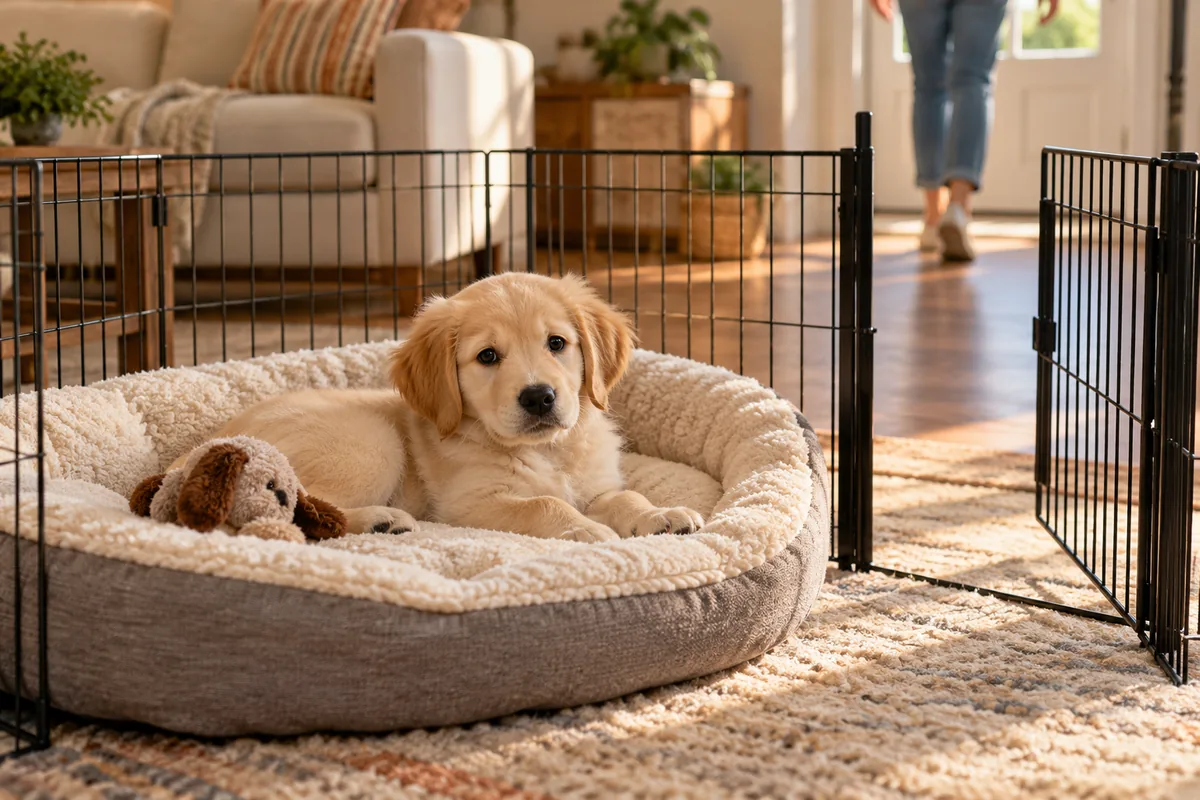
Choose a quiet, comfortable area near everyday household life. A foldable exercise pen can provide space for bedding, water, and movement. A crate may suit a puppy introduced to it positively; neither is automatically calming.
For a crate, allow natural standing, turning, sitting, and lying comfortably. A divider can adjust space as your puppy grows. Remove collars, tags, and harnesses before crating because they can snag.
For a pen, check gaps, stability, and climbing attempts. Keep cords, curtains, household chemicals, and chewable hazards beyond reach.
Introduce the area while you remain nearby. Feed near an open entrance, reward voluntary exploration, and allow retreat before practicing closure.
Do not leave a puppy attempting frantic escape in a stronger enclosure. Try a tolerated alternative and seek professional guidance. The ASPCA's separation anxiety guidance explains why confinement can worsen distress for some dogs.
The week-by-week puppy independence plan
“Weeks” describe stages from the beginning of practice, not your puppy's age. Repeat stages as necessary. There is no requirement to reach a particular duration by week eight.
- Week 1: Establish safety and predictability. Goal: Help your puppy feel comfortable in the home and resting area. Practice: Keep meals, toilet opportunities, and rest predictable. Sit near the open pen or crate, rewarding voluntary exploration and relaxed pauses. Slow down if: Your puppy avoids the area, freezes, or cries when you merely move away. Begin with easier nearby activity.
- Week 2: Practice resting without constant interaction. Goal: Make ordinary nearby movement manageable. Practice: While your puppy rests, shift position or take a step away, then return casually. Begin with seconds and avoid requiring a rigid stay. Slow down if: Your puppy repeatedly springs up, becomes tense, or cannot return to resting. Reduce distance rather than insisting they remain still.
- Week 3: Introduce very brief visual separation. Goal: Make disappearing briefly less surprising. Practice: Step around a doorway for a moment, then return before worry. A gate is optional and only useful if barriers are tolerated. Slow down if: Your puppy rushes the barrier, scratches, or begins escalating vocalization. Return to visible practice and reassess the setup.
- Week 4: Make departure cues less significant. Goal: Reduce worry around preparations to leave. Practice: Pick up keys or put on shoes, then continue an ordinary home activity. Work with one mild cue rather than rehearsing the entire departure repeatedly. Slow down if: Your puppy becomes increasingly watchful or starts following frantically. Use a smaller cue or pause this exercise.
- Week 5: Practice tiny real departures. Goal: Transfer comfortable indoor separation to the exterior door. Practice: Meet care needs, start recording, and step outside briefly. Stay close enough to return promptly. Seconds may still be the right starting point. Slow down if: Door-focused pacing, food refusal, or sustained crying appears. Shorten the next repetition and consider professional help for marked distress.
- Week 6: Build variation without pressure. Goal: Maintain comfort across slightly different manageable absences. Practice: Mix very easy repetitions with modest increases, changing one factor at a time. Do not make every departure longer than the previous one. Slow down if: Settling takes longer or your puppy becomes worried before practice. Reduce difficulty and review sleep, health, and daily care.
- Week 7: Coordinate training with practical support. Goal: Keep necessary departures within a safe care arrangement. Practice: Introduce a familiar caregiver and rehearse their routine. Continue brief training separately instead of using an unavoidable work absence as practice. Slow down if: Caregiver visits or changes in routine unsettle your puppy. Arrange gentler introductions and more continuous company.
- Week 8: Review behavior and choose the next step. Goal: Build a sustainable plan rather than declare training finished. Practice: Compare recordings and notes on settling, toileting, and recovery. Increase duration only when consistently comfortable, retaining easier repetitions. Slow down if: Progress stalls, distress persists, or necessary absences exceed readiness. Seek individual guidance rather than pushing through the calendar.
Nights: crying in the crate
Place the crate near your bed initially if your puppy is comfortable using one. A nearby pen or other safe arrangement may suit a puppy who dislikes the crate.
Your presence helps you notice waking and toilet signals. Offer a calm potty trip when needed, then return to a quiet sleeping routine without exciting play.
Puppies often have accidents simply because they cannot wait long yet. Our guide to a dog peeing or pooping when left alone gives rough potty-break intervals by age and explains how to tell a full bladder from separation distress.
Comfort is appropriate. The PDSA's first-night guidance explains that new puppies may cry because they are worried and can benefit from reassurance.
Once nights are comfortable, move the sleeping area gradually if desired. If a move brings renewed distress, reduce the distance and proceed more slowly.
A cover may reduce visual activity, but preserve airflow and keep fabric out of chewing reach. Repeated crying after needs are met deserves reassessment; unusual panting, discomfort, diarrhea, or frequent urination warrants veterinary advice.
When you have to go to work
A puppy's needs do not expand to match a workday. Arrange family help, a familiar sitter, staggered schedules, or another appropriate care arrangement.
Very young puppies may need substantial daytime company, not just a brief midday visit. Plan coverage around meals, toilet opportunities, rest, and demonstrated separation comfort.
Choose caregivers who follow your gentle introduction and handling routine. Discuss health precautions and vaccination status with your vet before group care or contact with unfamiliar dogs.
For step-by-step sitter introductions, a care sheet, and a trial absence before you travel, see our guide on how to prep a pet sitter for an anxious dog.
A camera helps identify problems, but does not replace someone able to respond. If your puppy panics during an unavoidable absence, arrange safe assistance and revise the plan.
Helpful products
Picks on this page are a research-based assessment of features and intended use — not hands-on testing. We earn a small commission if you buy through the Amazon links on this page, at no extra cost to you. Affiliate disclosure
| Product type | Why it helps | Notes |
|---|---|---|
| Snuggle Puppy heartbeat comfort toy | May provide a familiar comfort cue during early settling. | Our top pick for the first weeks; supervise, remove if chewed, and protect access to internal components. Supervise closely and remove the toy if your puppy chews open seams or swallows parts. |
| KONG Puppy or similar soft-rubber stuffable toy | Offers accessible food enrichment and appropriate supervised chewing. | Match size to the puppy; inspect for damage and introduce familiar fillings gradually. Choose the soft Puppy rubber size for your pup; Classic (harder) is for older dogs. |
| Foldable exercise pen / puppy playpen | Creates a managed area with more movement space than a crate. | Check gaps, stability, and climbing; discontinue if confinement triggers panic. |
| Wire crate with divider | Offers adjustable resting space for a puppy comfortable with crating. | Introduce positively; never use it to force a distressed puppy through an absence. |
| Crate cover | May reduce visual distractions for some puppies. | Keep ventilation clear and fabric beyond reach; remove if warmth or distress increases. |
| Pet camera | Shows whether the puppy settles during practice. | Secure cords, verify recordings, and prioritize observation over remote talking. |
| ADAPTIL/ThunderEase pheromone diffuser | Optional background support in a familiar resting area. | Evidence is mixed; follow placement instructions and combine with care and training. Optional support only — evidence is mixed; it does not replace gradual alone-time training. |
Swipe the table sideways to see every column.
No toy is automatically safe for unsupervised use. Initial supervision and regular inspection matter, and some puppies cannot safely retain particular comfort items when alone.
When to get extra help
Puppy Separation Anxiety: A Week-by-Week Plan: when to get extra help
- Distress escalates during absences measured in seconds or very brief separations.
- Frantic escape attempts, bar biting, or self-injury occurs.
- Persistent pacing, drooling, howling, or inability to rest accompanies departure.
- Crying occurs alongside appetite changes, vomiting, diarrhea, pain, or unusual toileting.
- Your puppy cannot tolerate any practical resting or care arrangement.
- Necessary absences repeatedly exceed your puppy's current comfort.
- Behavior worsens or you cannot identify a manageable starting point.
Start with your vet to assess health and discuss appropriate support. A qualified, reward-based behavior professional can help distinguish unmet needs, confinement distress, and separation-related problems.
Bottom line
Puppy separation anxiety training begins with care and manageable experiences, not prolonged crying. Protect toilet opportunities and sleep, introduce a safe resting area gently, and let behavior determine the pace.
Use this eight-week framework flexibly. Arrange help for absences your puppy cannot manage, and seek individual support when distress builds rather than waiting for maturity to solve it.