On this page
- Who this plan is for
- Before you start
- Find your dog's starting point
- Stress signs to watch on camera
- Session steps
- Week-by-week example plan
- How fast to increase time
- Departures and returns
- Bad days and setbacks
- Managing real absences while you train
- Training log
- Helpful products
- Mistakes to avoid
- When a structured training program helps
- When to get extra help
- Bottom line
If your dog panics when you leave, stepping outside can feel like a difficult decision. A practical separation anxiety training plan makes that decision smaller: find an absence your dog can manage, repeat comfortable experiences, and build gradually.
We are dog owners, not vets or certified trainers. This guide explains the training process and how to organize it; dogs experiencing true panic need veterinary involvement and may benefit from individualized professional support.
Who this plan is for
This plan is for dogs whose distress relates to being left alone or separated from a particular person. Signs may include pacing, howling, drooling, exit scratching, accidents, or escape attempts.
Does your dog live in two homes? Our guide to dog separation anxiety after a breakup or shared custody shows how to keep this training plan at the same level in both homes.
Term starting soon? Begin short, comfortable absences before the first school day. Our guide to back to school and dog separation anxiety has a two-week plan and a school morning routine checklist.
Working shifts? Keep practice to calm days off and never use a work shift as a training session. Our guide to dog separation anxiety and shift work shows how to fit tiny steps around a changing roster.
Not sure whether the plan is working? Judge progress from video of the first minutes of each absence, not from how your dog greets you. Our guide to separation anxiety progress signs, plateaus and setbacks shows what real progress looks like, why progress stalls and how to recover from a setback without starting over.
If your dog starts shaking or trembling during practice, the step was probably too big. Our guide to dog shaking or trembling when left alone covers what to film, when to call the vet, a warmer set-up and a 5-step plan.
If your dog starts licking or chewing their paws during practice, the step was probably too big. Our guide to dog licking or chewing paws when left alone covers what to film, when to see the vet and a 5-step plan.
If your dog starts drooling during practice, the step was too big. Our guide to dog drooling when left alone covers what to film, when drool needs a vet and a 5-step plan.
If an office start date is coming, begin this plan as early as you can. Our guide to going back to the office with a dog with separation anxiety shows how to fit practice into the weeks before and into home days.
If pacing or panting starts during practice, check heat, water and health before the next step. Our guide to dog pacing and panting when left alone covers what to film and a 5-step plan.
Door getting scratched while you train? Our guide to dog scratching the door when left alone covers a safe set-up away from the exit while you build up alone time.
Training a dog aged 6 to 18 months? Our guide to separation anxiety in adolescent dogs covers what changes in the teenage stage and a before-you-leave checklist.
Training with a baby due? Our guide to separation anxiety when a new baby arrives covers the hospital days, the first weeks home and a minimum routine on little sleep.
Travelling before training is finished? Our guide to boarding a dog with separation anxiety shows how to choose care that keeps absences within what your dog can cope with.
Going back to work or school after a long break? Start this plan a week early and use our guide to separation anxiety after vacation or working from home for a day-by-day re-entry schedule.
If your dog is mainly upset when one person leaves, pair this plan with our guide to helping a dog attached to one person so other family members share the care.
If your dog is brand new to your home, start with our guide to leaving your dog alone for the first time before you begin formal sessions.
Training an older dog? Our guide on separation anxiety in senior dogs adapts this approach with smaller steps, comfort changes and a gentle 2-week plan.
Adding a second dog does not replace this plan. If you are considering one, our guide on whether a second dog helps separation anxiety covers how to trial canine company safely while you keep training.
If your dog is too distressed for even the shortest practice absences, it may be worth asking your vet whether medication could help alongside this plan. Our guide on separation anxiety medication: what to ask your vet explains how the two fit together.
If your dog tries to break out of the crate or room while you train, keep absences under their limit and change the set-up first. Our guide on dog escaping the crate or room when left alone includes a first week plan and confinement options compared.
Training around a 9-to-5? Our guide on working full time with a dog that has separation anxiety shows how to fit short sessions in before work, in the evenings and at weekends while workday cover keeps absences below your dog's limit.
If your dog whines or howls during practice absences, keep the next ones shorter and calmer. Our guide on why dogs whine or howl when left alone includes a 2-week plan built around absences below that point.
If your dog cannot settle even when you are just in another room, start there. Our guide to why your dog follows you everywhere includes a room-to-room ladder and a 2-week independence plan to build on before longer absences.
Training works best when real absences do not undo it. For ways to cover the hours you cannot be home, see our guide to care cover options for a dog with separation anxiety.
Want a ready-made sheet for your sessions and real absences? Print our free printable separation anxiety log: one row per absence, short codes for the signs you see, and a weekly review so you can tell a real trend from one good day.
Before you start, it helps to film one short, ordinary absence so you know your dog's starting point. See our guide on how to record your dog when you leave for camera placement, a first-30-minutes timeline and a recording log.
If your dog panics within seconds of being alone or you are not seeing progress, involve your vet early. Our guide on how to prepare for a vet or behaviorist visit explains how to bring your training log, videos and a clear timeline to that appointment.
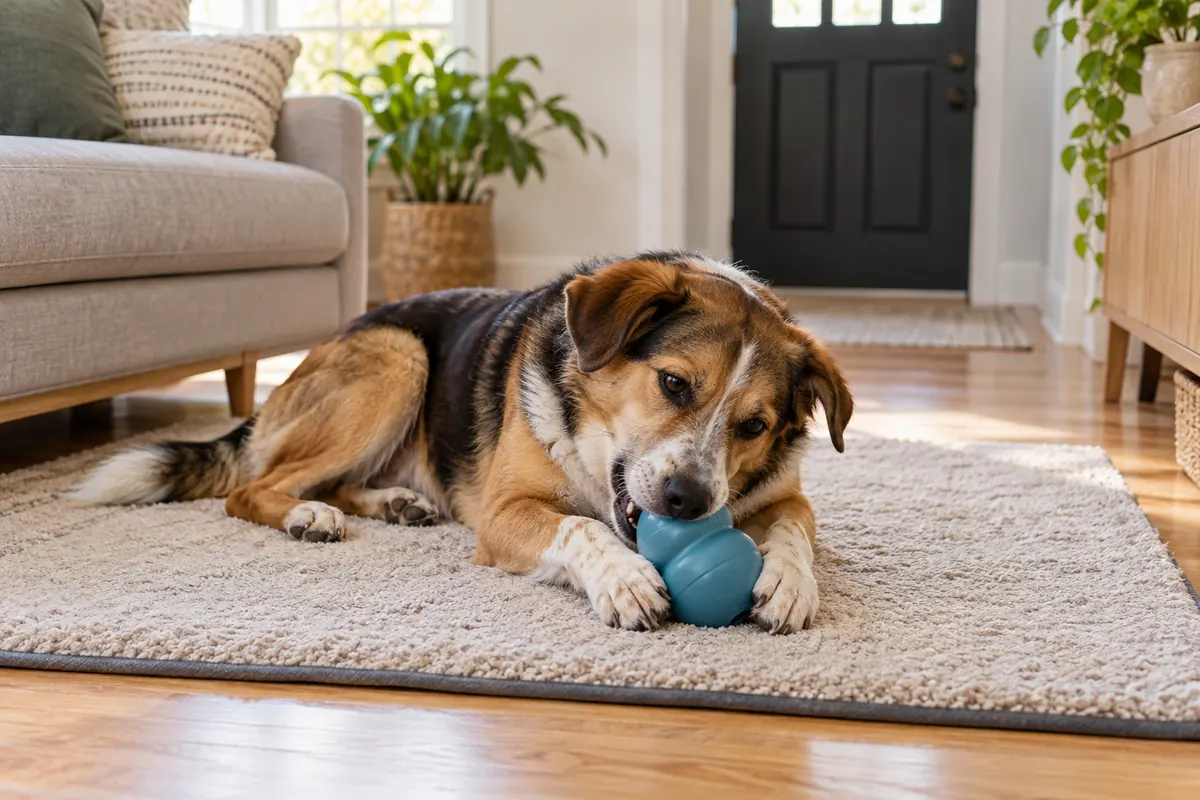
A stuffed food toy can make short practice absences more pleasant, though it does not replace the plan itself. Our guide on how to stuff a KONG shows easy fillings to start with and what to do if your dog will not eat when alone.
Does your dog start pacing or panting before you even leave, when you pick up your keys or put on your shoes? Our guide to departure cue training shows how to make those cues boring, so absence practice starts from a calmer place.
Not sure what a realistic goal looks like once training works? Our guide on how long a dog can be left alone gives rough alone-time ranges by life stage and a sample workday plan.
Our separation anxiety guide covers the overview. If the cause is unclear, start with our separation anxiety signs guide, Separation Anxiety or Boredom? 10 Signs. For young puppies, use our puppy separation anxiety guide alongside age-appropriate toilet and sleep planning.
See your vet first for sudden behavior changes, medical symptoms, or injuries from escape attempts. Do not conduct a home threshold test if previous departures have caused self-injury or dangerous panic.
Gradual absence practice is part of established behavior guidance. The Merck Veterinary Manual describes reducing the challenge when a dog reacts during desensitization.
Furbo 360° Dog Camera
A pet camera shows early stress signs in real time, helping you adjust absences before your dog becomes overwhelmed.
Check price on AmazonWe earn a small commission if you buy through this link, at no extra cost to you. Disclosure
Before you start
The practical preparation matters as much as the practice.
Separation Anxiety Training Plan for Dogs, Step by Step: before you start
- Arrange a veterinary check when signs are new, severe, or accompanied by illness.
- Set up a camera showing the exit and your dog's usual resting area.
- Test live viewing, sound, connection reliability, and recording.
- Choose a quiet time without an immediate work or appointment deadline.
- Arrange company for necessary absences beyond your dog's current tolerance.
- Choose a safe area your dog already finds comfortable.
- Meet toilet, water, movement, and rest needs before practicing.
- Prepare a simple training log and a timer.
- Agree that everyone involved will avoid punishment and overwhelming absences.
A safe area may be an ordinary room rather than a crate. Barriers can create additional distress, so assess the setup before leaving.
Find your dog's starting point
Your dog's threshold is the point where separation starts becoming stressful. Training begins below that point, not at the longest absence your dog can endure.
First observe relaxed behavior while you are home: normal breathing, loose muscles, comfortable resting, and ordinary movement. This gives you something to compare with departure footage.
Then try a tiny departure action. Walk toward the door, touch the handle, or step outside briefly while watching the camera. Stop at the earliest meaningful change. You do not need to wait for barking.
If stress appears before you leave, start with easier door movements or brief indoor separations. If your dog remains relaxed outside the door, use an absence shorter than the comfortable time observed.
This is a cautious observation, not an endurance test. Do not repeatedly push until your dog reacts.
Stress signs to watch on camera
Read the whole pattern. One yawn, glance, or position change does not establish anxiety.
| What you see | What it likely means | What to do next |
|---|---|---|
| Loose posture, normal breathing, resting | Your dog appears comfortable | Continue within the established easy duration |
| Brief glance toward the door, then settling | Ordinary awareness may be present | Watch whether your dog disengages comfortably |
| Repeated pacing between door and window | Difficulty settling; possible rising distress | Return and shorten the next absence |
| Repeated whining or escalating barking | The exercise may be too difficult | End the absence calmly; do not wait for silence |
| Panting without heat or recent exertion | Possible stress or a medical concern | Return, assess your dog, and seek veterinary advice when appropriate |
| Drooling or trembling | Significant distress or possible illness | Stop practice and reassess with professional help |
| Scratching, biting, or throwing against the door | Escape behavior and injury risk | Return promptly and get professional support |
| Abandoning familiar food when you leave | Possible distress, though appetite has other causes | Check other signals and make the exercise easier |
| Rigid stillness or prolonged door watching | Possible vigilance rather than relaxation | Do not increase time based on quietness alone |
Swipe the table sideways to see every column.
Session steps
- Check readiness. Offer a potty opportunity and appropriate activity, followed by settling time. Skip practice if your dog is already unsettled by illness, visitors, construction, or another difficult event.
- Choose an easy target. Use recent comfortable observations rather than yesterday's longest absence. Decide what stress signs will end the exercise before starting.
- Start the camera. Confirm you can see your dog and hear vocalizations. Keep cables and devices safely out of reach.
- Make an ordinary departure. Use only departure cues your dog can currently tolerate. Step out for the planned brief interval while watching live.
- Return before worry develops. If stress appears unexpectedly, return promptly. Waiting outside for silence can prolong distress.
- Allow recovery between repetitions. Spend ordinary time at home until your dog is fully relaxed again. End the session if tension carries into the next repetition.
- Record and adjust. Note duration, behavior, and context. Finish with an easy repetition when appropriate, rather than pushing for a record.
Week-by-week example plan
This is an illustration, not a deadline, prescribed schedule, or expected progression. “Session lengths” below means individual practice absences, not the total appointment with your dog. A dog may spend several weeks at one row.
| Week | Typical session lengths | Goal |
|---|---|---|
| Week 1 | Door movements or roughly 1–5 seconds outside, if comfortable | Find an easy starting point |
| Week 2 | A varied mix of comfortable seconds-long absences | Build relaxed repetition |
| Week 3 | Seconds to approximately a minute, only if ready | Introduce small duration changes |
| Week 4 | Brief minutes mixed with easier absences, if already comfortable | Maintain relaxation as time varies |
| Week 5 | Several comfortable minutes, or repeat an earlier stage | Confirm progress across different days |
| Week 6 | Continue within the dog's demonstrated range | Plan further gradual practice rather than a sudden long absence |
Swipe the table sideways to see every column.
Some dogs remain at seconds during this period. Others progress further. Reaching hours may require additional weeks or months, and professional adjustments may be needed.
How fast to increase time
There is no universal increase that suits every dog. At a seconds-long starting point, even a small addition may be substantial.
Increase only after comfortable repetitions, and mix easier absences among harder ones. For a dog already relaxed at these durations, a sequence might be 10 seconds, 5 seconds, 12 seconds, then 7 seconds. It is an example, not a required formula.
Once minutes become comfortable, continue using observations rather than assuming a jump to an hour will be easy. Longer absences also introduce practical needs: water, toilet access, outside noises, and changes in household activity.
Start with one brief session on a suitable day. Some dogs can manage a second well-separated session, but repeated drilling is unnecessary. A few calm repetitions are more useful than many increasingly tense ones.
Departures and returns
Keys, shoes, and bags can predict separation before the door opens. If those cues cause worry, work on them gently: touch the keys, remain home, and continue an ordinary activity.
Practice one manageable cue at a time. Repeatedly rattling keys while your dog paces is not helpful exposure. Once cues are comfortable, include them gradually in real practice departures.
Keep goodbyes and greetings friendly and low-key. You do not need to ignore your dog or withhold affection. Aim for predictable transitions rather than an exciting ritual.
Bad days and setbacks
Progress is usually slow and uneven. Poor sleep, a frightening noise, discomfort, or a change in routine can reduce what your dog manages today.
If an absence goes badly, return, help your dog settle, and end or simplify practice. Next time, restart comfortably below the difficult duration.
A panic episode can disrupt progress, but it does not mean every previous success disappeared. Review the circumstances without blaming yourself or your dog. Repeated setbacks warrant professional reassessment.
Managing real absences while you train
A training plan needs an accompanying care plan. Regularly leaving far beyond current tolerance makes it harder to build comfortable experiences.
Options include an in-home sitter, a familiar friend, family help, suitable daycare, adjusted work arrangements, or taking your dog along when appropriate. Daycare is unsuitable if the environment frightens or overwhelms your dog.
Check that company actually helps. Some dogs relax with another person; others remain distressed when a particular person leaves.
The ASPCA's separation anxiety guidance emphasizes managing absences during desensitization. If this seems impossible, discuss realistic support with your vet and trainer early rather than trying to manage alone.
Training log
Record what happened rather than labeling an absence simply “passed” or “failed.”
| Date | Absence length | Dog's behavior | Next step |
|---|---|---|---|
| Example: Monday | 8 seconds | Glanced at door, then rested with loose posture | Repeat an easy duration before considering an increase |
| Example: Tuesday | 12 seconds | Stood, paced, and whined near the end | Shorten the next absence and review readiness |
Swipe the table sideways to see every column.
Also note unusual noise, sleep disruption, caregiver changes, and recovery time. Short video clips can help a professional interpret subtle behavior.
Helpful products
Picks on this page are a research-based assessment of features and intended use — not hands-on testing. We earn a small commission if you buy through the Amazon links on this page, at no extra cost to you. Affiliate disclosure
These tools support observation and comfort; they do not replace training. We have not tested these products ourselves.
| Product type | Why it helps | Notes |
|---|---|---|
| Pet camera: Furbo 360° camera | Shows stress signs in real time | Needs reliable Wi-Fi; does not train your dog. Limitation: it shows you when to end a session but does not train your dog; needs 2.4GHz Wi-Fi, and some owners report connection drops. Alternative: a spare phone or laptop on a free video call app. |
| KONG-style stuffable toy | Offers familiar food enrichment during suitable practice | Introduce safely first; eating does not prove comfort. Limitation: a very anxious dog may ignore food when alone, and it must be sized to your dog. Alternative: a lick mat or a few treats scattered on a snuffle mat. |
| Lick mat: LUKITO lick mat | Provides a simple food activity for dogs who enjoy it | Supervise; remove if chewed. Limitation: strong chewers can damage it, so use it for short supervised practice only. Alternative: a stuffed KONG-style toy. |
| Exercise pen or baby gate: MidWest exercise pen | Helps create a safe area | Use only when the barrier does not cause distress. Limitation: introduce it gradually; some dogs climb or push panels, and confinement does not fix panic. Alternative: a baby gate across a dog-proofed room. |
| Pheromone diffuser: ThunderEase diffuser | May offer additional environmental support | Optional; evidence is mixed. Limitation: evidence is mixed and it cannot replace gradual training. Alternative: a familiar worn T-shirt or blanket in the resting spot. |
Swipe the table sideways to see every column.
An old phone or laptop on a free video call app can substitute for a dedicated camera. Secure the device, protect privacy, and test the connection before relying on it.
Observe your dog after food runs out too. A toy that briefly occupies your dog can hide the point at which worry begins.
Mistakes to avoid
- Following a calendar despite stress signals.
- Testing the maximum absence every day.
- Using silence as the only measure of comfort.
- Increasing duration and departure complexity together.
- Waiting for a frightened dog to stop barking before returning.
- Forcing crate confinement when it causes panic.
- Relying on exhaustion or food distraction alone.
- Never using punishment, bark collars, shock collars, or long cry-it-out sessions.
Exercise, enrichment, and sleep support wellbeing, but cannot make an overwhelming absence comfortable by themselves.
When a structured training program helps
A structured program can help when daily decisions feel confusing or progress repeatedly stalls.
Look for individualized gradual absences, review of camera footage, clear adjustment rules, and access to feedback. Good programs explain stress signals, include realistic absence management, avoid punishment, and acknowledge that timelines vary.
Ask who provides coaching, what qualifications they hold, and when they refer to a veterinarian. A course should not promise the same result or completion date for every dog.
When to get extra help
Seek veterinary help promptly for escape injuries, severe drooling, sudden behavior changes, illness signs, or panic even during tiny separations.
A certified separation anxiety trainer can help design and adjust sessions. A veterinary behaviorist can assess complex cases and coordinate medical and behavioral care.
Ask your vet about anti-anxiety medication for true panic. Medication may support learning and welfare alongside a behavior plan; decisions belong with the veterinarian.
Get support for yourself too. A plan that depends on constant vigilance without practical help may be difficult to sustain.
Bottom line
Start with an absence your dog can comfortably manage, watch carefully, and build through small, varied steps. Arrange care for longer absences and reduce the challenge when stress appears.
The useful measure is how your dog feels during separation. Comfortable repetition, an honest log, and appropriate professional support give you a workable way forward.