On this page
- Why a dog bonds most with one person
- Normal bond or hyper-attachment?
- Fine with others, upset when one person leaves
- See your vet first if it is sudden
- The family handover plan
- Who does what
- Building independence at home
- Daily independence checklist
- Practicing your departures
- What the favorite person should and should not do
- When the favorite person travels or works long hours
- Mistakes to avoid
- When to get extra help
- Helpful products
- Bottom line
Your dog enjoys everyone in the household, yet cries when one particular person picks up a bag. Someone else may be sitting beside them, but their attention stays fixed on the door.
We are dog owners, not vets or trainers, and the products below are chosen from research, not from personal testing. This guide focuses on sharing care and building comfort without asking the favorite person to reject the dog or abruptly disappear.
Why a dog bonds most with one person
Dogs may develop preferences through familiar routines, enjoyable activities, gentle handling, and time spent together. One person may provide most meals, walks, play, or reassurance.
If the person your dog was most attached to has died or moved out, your dog may follow the people who remain or wait by the door. Our guide to dog separation anxiety after losing another pet or person covers how to keep feeding, walks and bedtime steady and how to rebuild alone time kindly.
Is your dog upset when one person leaves, or whenever nobody is home? Our guide to separation anxiety vs isolation distress has a simple filmed company test to tell the two apart.
If the favorite person is about to have a baby, our guide to separation anxiety when a new baby arrives shows how to shift routines months ahead and keep alone-time practice going.
Temperament and previous experiences can influence which interactions feel comfortable. A quiet dog may prefer a calm household member, while another enjoys the person who regularly plays.
A preference does not mean the rest of the household has done something wrong. Nor does it establish a behavior problem.
The useful question is whether your dog can feel safe when that person is unavailable. Our velcro dog guide covers ordinary following and everyday closeness more broadly.
Furbo 360° Dog Camera
A pet camera shows whether your dog settles with another person or remains worried after their favorite person leaves.
Check price on AmazonWe earn a small commission if you buy through this link, at no extra cost to you. Disclosure
Normal bond or hyper-attachment?
“Hyper-attachment” is a descriptive label, not a diagnosis you can establish from affectionate behavior. Focus on comfort and functioning.
| What you see | Usually normal when | Worth working on when |
|---|---|---|
| Chooses one person's company | Can also rest elsewhere comfortably | Cannot settle without constant proximity |
| Follows between rooms | Movement is relaxed and optional | Follows urgently and becomes tense when blocked |
| Watches departure preparations | Briefly notices, then disengages | Paces, pants, whines, or hides |
| Waits near the door | Soon moves away and rests | Remains vigilant or increasingly distressed |
| Greets the favorite person enthusiastically | Recovers and resumes ordinary activity | Prolonged agitation follows a distressing absence |
| Accepts care from another person | Eats, walks, and rests comfortably | Cannot engage or settle after the favorite person leaves |
| Responds to an interior door closing | Remains comfortable during a manageable gap | Scratches, vocalizes, or attempts to escape |
| Eats during another person's company | Continues ordinary behavior after food ends | Stops eating and repeatedly searches for the absent person |
| Wants contact | Enjoys it without losing other activities | Sleep, toileting, or ordinary rest is disrupted |
Swipe the table sideways to see every column.
Dogs Trust's separation anxiety advice notes that “attachment issues” is another phrase used for separation-related behaviors. It also explains that close following does not necessarily mean a dog struggles when alone.
Our separation anxiety signs guide helps organize the wider pattern.
Fine with others, upset when one person leaves
Being friendly with another household member is different from feeling comfortable when the favorite person leaves.
If your dog relaxes with suitable human company regardless of who remains, being entirely alone may be the more important difficulty. This is sometimes described as isolation distress.
If worry persists specifically when one person leaves, even with familiar company, that person's absence may be an important trigger. These patterns need observation rather than a diagnosis based on one event.
Record whether your dog recovers after briefly noticing the departure or remains distressed. Another person being physically present does not automatically provide effective care cover.
See your vet first if it is sudden
New clinginess or separation difficulty deserves a veterinary check, particularly when accompanied by changes in sleep, movement, appetite, drinking, or toileting.
Pain, illness, sensory changes, and other health concerns can affect confidence and behavior.
Dogs Trust notes that if a dog suddenly seems stuck to you like glue, it may be a sign of something else, and that changes in behavior are often influenced by physical health.
Do not assume a recent holiday or work change explains everything. Tell the vet about both household changes and physical observations.
The family handover plan
Share enjoyable care gradually while the favorite person remains kind and available. This four-week example is an organizer, not a deadline or a requirement to remove that person from daily life.
| Week | Favorite person | Other family members | Move on when |
|---|---|---|---|
| Week 1 | Remains nearby during familiar routines | Adds low-pressure meals, play, or quiet company | Dog comfortably engages without being coaxed away |
| Week 2 | Participates less in selected activities but stays available | Leads familiar activities the dog enjoys | Dog remains relaxed through these routines |
| Week 3 | Practices tiny movements away during comfortable moments | Continues ordinary care without restraining the dog | Dog can disengage from monitoring and settle |
| Week 4 | Adds manageable departures with support | Provides trialed company and follows the agreed plan | Observations show comfort; otherwise repeat earlier steps |
Swipe the table sideways to see every column.
Do not hand over every valued activity at once. The dog should gain additional trustworthy relationships, not suddenly lose an established one.
Who does what
This is an editable example. Replace the roles with your household's actual arrangements.
| Daily task | Who does it now | Who takes it over | Tip |
|---|---|---|---|
| Breakfast | Favorite person | Another adult | Begin while the favorite person remains nearby |
| Familiar walk | Favorite person | Another comfortable handler | Join together first if helpful |
| Gentle play | Favorite person | Willing family member | Use games the dog already enjoys |
| Short reward-based practice | Favorite person | Another adult | Keep cues simple and familiar |
| Evening food activity | Favorite person | Another household member | Offer it during ordinary time too |
| Bedtime routine | Favorite person | Shared between comfortable caregivers | Change one part at a time |
| Quiet companionship | Favorite person | Several household members | Let the dog choose proximity |
Swipe the table sideways to see every column.
Do not withhold meals or necessary care until the dog accepts someone else. Simplify the interaction and seek help if everyday care becomes difficult.
Building independence at home
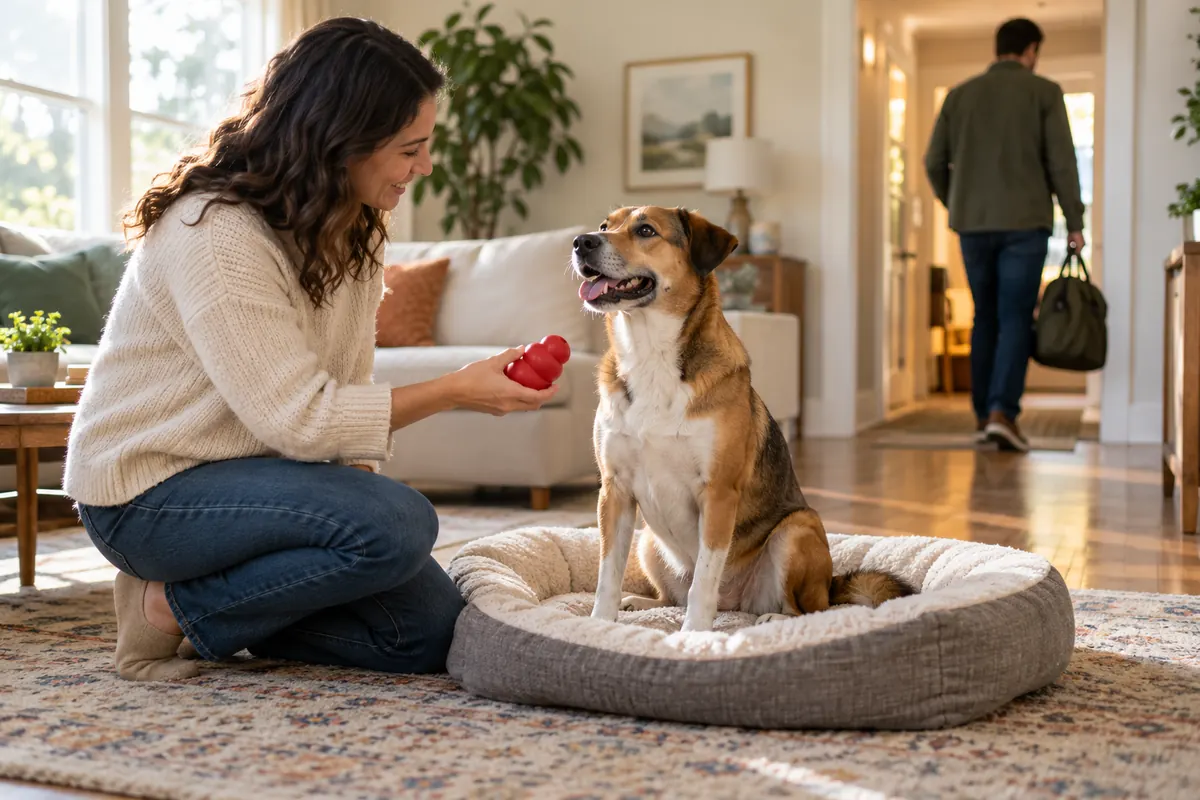
Make a bed or mat pleasant while the favorite person is close. Reward voluntary resting, then introduce small movements such as standing or taking one step away.
Dogs Trust suggests calmly praising independent choices, such as moving away or settling in a safe space. Keep that recognition quiet enough that it does not interrupt rest.
A familiar gate can support brief room-to-room practice, but only if the dog accepts it comfortably. Begin with it open, then try tiny changes while everyone remains available.
Do not hold the dog back while the favorite person leaves. That can turn the other caregiver into part of a frightening event.
Use easy food enrichment if the dog enjoys it. Watch what happens after food finishes, since occupation is not the same as lasting comfort.
Daily independence checklist
Dog Attached to One Person: How to Help When Their Favorite Person Leaves: daily independence checklist
- Health concerns or sudden changes are being assessed.
- Toilet, water, food, activity, and rest needs are met.
- The resting spot is familiar and comfortable.
- The favorite person remains affectionate and predictable.
- Another household member offers an enjoyable activity.
- Interactions allow choice rather than forced closeness.
- Calm independent resting receives gentle recognition.
- Any gate or barrier is already comfortable.
- Practice begins with an easy movement or gap.
- Someone watches posture and behavior, not only sound.
- The favorite person returns before worry when possible.
- Distress leads to easier practice, not punishment.
- Necessary longer absences have suitable coverage.
- Brief observations are recorded honestly.
A day without departure practice can still include helpful shared care and comfortable resting.
Practicing your departures
Choose a relaxed time without an immediate work deadline. The other caregiver should already be present and involved before departure preparations begin.
Start with a manageable action: standing, walking toward an interior doorway, or briefly stepping out of sight. Build actual departures only when earlier steps remain comfortable.
Use a camera to observe the dog without changing the situation through speaker audio. If concern appears, return calmly and shorten the next attempt.
Do not wait outside for a frightened dog to become silent. The aim is comfortable repetition, not teaching endurance through distress.
Our departure cues guide covers keys, shoes, and bags. Our separation anxiety training plan explains gradual absences, and our how to record your dog when you leave guide covers camera setup.
What the favorite person should and should not do
Keep affection and ordinary contact. There is no need to ignore, reject, or abruptly stop interacting with your dog.
Encourage shared activities without directing every moment. Allow another caregiver to build their own predictable relationship rather than constantly calling the dog back.
Keep departures and returns friendly and low-key. Avoid dramatic goodbyes, but do not confuse calmness with emotional distance.
Do not test a long absence because another household member is home. Review how the dog actually copes before extending.
When the favorite person travels or works long hours
Begin preparations well ahead where possible. Rehearse the caregiver's routine and brief departures rather than making the first trial an overnight trip.
Keep familiar meals, walks, resting places, and bedtime arrangements. Give caregivers clear instructions and a plan for distress.
Our care options guide can help organize coverage. If the dog remains distressed with the chosen person, more hours of the same arrangement may not solve it.
Seek professional help before an unavoidable long separation when trials show continuing panic. Be honest about schedules and available support so the interim plan is realistic.
Mistakes to avoid
- Suddenly making the favorite person unavailable.
- Forcing affection from other family members.
- Making meals or comfort depend on the dog accepting someone else.
- Restraining the dog during departures.
- Using a barrier that already causes panic.
- Assuming eating or silence proves relaxation.
- Repeating departures that consistently exceed tolerance.
- Scolding or punishing crying, following, accidents, or damage; use reward-based methods instead.
- Treating the four-week example as a required timeline.
Changes should make daily life easier for the dog, not create a competition for their attention.
When to get extra help
Contact your vet for sudden behavior changes, physical concerns, or severe distress. Self-injury and dangerous escape attempts need prompt attention.
A qualified, reward-based behavior professional or veterinary behaviorist can help when the dog cannot tolerate tiny gaps, refuses ordinary care from others, or repeatedly remains distressed despite company.
Seek help for guarding or threatening behavior around the favorite person too. Do not force family members into closer interaction to resolve it.
Bring representative observations and existing footage without recreating panic.
Helpful products
Picks on this page are a research-based assessment of features and intended use — not hands-on testing. We earn a small commission if you buy through the Amazon links on this page, at no extra cost to you. Affiliate disclosure
These are support tools chosen from research, not from personal testing.
| Product type | Why it helps | Notes |
|---|---|---|
| Pet camera with two-way audio: Furbo 360° camera | Shows the response when the favorite person leaves | Limitation: it shows behavior but does not fix it, and hearing the favorite person through the speaker can upset some dogs. Alternative: an old phone or laptop with a free video call app, speaker off. |
| Stuffable rubber food toy: KONG Classic | Lets another caregiver offer a familiar enjoyable activity | Limitation: some worried dogs won't eat when their person is gone, which is itself a useful sign. Alternative: a lick mat or scatter feeding. |
| Walk-through pet gate: Carlson walk-thru pet gate | Supports manageable room-to-room practice | Limitation: some determined dogs jump or push gates, and it needs a doorway it fits. Alternative: a closed door or an exercise pen, only if your dog is comfortable with it. |
Swipe the table sideways to see every column.
Whatever you use, keep the camera speaker off during early observations, and never swap one barrier your dog dislikes for another.
Bottom line
A favorite person is not a problem by itself. Distress during that person's absence is the issue to address.
Keep the bond kind, share enjoyable care gradually, and build tiny comfortable separations. If worry persists or changes suddenly, involve your vet and a qualified professional.