On this page
- What changes you may see after a loss
- Grief-like changes or separation anxiety?
- When to call the vet
- Call the vet now, soon or book a visit?
- Why alone time can suddenly be harder
- What to film and note
- Keeping routines steady
- Steady routine checklist
- A calm set-up for alone time
- Calm set-up checklist
- Rebuilding alone time in 5 steps
- Should you get another dog?
- Looking after yourself too
- Mistakes to avoid
- When to get extra help
- Helpful products
- Bottom line
After a pet or family member dies or moves away, the home can feel different in countless small ways. Your dog may wait by a familiar door, sleep elsewhere or stay closer to you. You may be grieving too, with less energy for routines that once felt easy.
You do not need to interpret every behavior or solve everything immediately. We are dog owners, not vets or trainers. This guide offers practical ways to check your dog’s health, maintain familiar care and gently rebuild alone time without claiming to know what dogs understand about death.
What changes you may see after a loss
Some dogs appear quieter, sleep more, eat less, search familiar places or follow the remaining people. Others show little obvious change.
Losing a person from the household can unsettle a dog too. Our guide to dog separation anxiety after a breakup or shared custody covers the first week after someone moves out and how to keep two homes consistent.
Many begin settling over days to weeks as a new routine forms, but there is no timetable that applies to every dog. Changes that persist, worsen or affect health need attention.
Notice what still feels comfortable: an ordinary walk, quiet company or resting in a familiar spot. Offer those opportunities without forcing play, greetings or affection.
Furbo 360° Dog Camera
A pet camera shows whether your dog rests or struggles during absences, helping you plan appropriate support without guessing.
Check price on AmazonWe earn a small commission if you buy through this link, at no extra cost to you. Disclosure
Grief-like changes or separation anxiety?
Adjustment and separation distress can happen together. The key question is whether being left produces a distinct pattern of worry. These clues cannot provide a diagnosis.
| What you see | Often part of adjusting | More likely separation anxiety, plan for it |
|---|---|---|
| Following you | Also chooses independent rest | Cannot settle whenever you move away |
| Waiting near a door | Checks briefly, then resumes ordinary activities | Remains tense or repeatedly scratches the exit |
| Searching familiar places | Occasional exploration with comfortable pauses | Repetitive searching escalates during absences |
| Sleeping differently | Rest remains comfortable | Cannot rest while alone despite a suitable space |
| Eating less | A general change needing monitoring and veterinary advice | Eats comfortably with company but repeatedly refuses food alone |
| Vocalizing | Occasional sounds without escalating worry | Persistent barking or howling during separation |
| Pacing | Brief restlessness that resolves | Repeated routes begin as you leave |
| Indoor accidents | Routine or health changes need checking | Occur during separation alongside distress |
| Panting or drooling | Requires consideration of physical causes | Repeatedly accompanies departure-related worry |
| Damage | An isolated event needs investigation | Concentrated exit damage or escape attempts |
Swipe the table sideways to see every column.
See our separation anxiety signs guide for the broader pattern. Quietness alone does not establish comfort.
When to call the vet
Do not attribute every change to loss. The ASPCA’s separation anxiety advice recommends ruling out medical issues first.
Contact your vet about reduced appetite, weight loss, vomiting, unusual lethargy or sudden behavior changes. If your dog has eaten nothing for about a day, call rather than waiting another day; seek advice earlier for puppies, medically vulnerable dogs or other symptoms.
Older dogs deserve particular care. Our senior dog separation anxiety guide explains why new alone-time difficulties should include a health assessment.
Call the vet now, soon or book a visit?
If uncertain, describe the signs to your vet or emergency clinic and follow their guidance.
| Sign | What to do |
|---|---|
| Collapse, breathing difficulty or severe weakness | Seek emergency veterinary care immediately |
| Significant injury from an escape attempt | Seek urgent veterinary care |
| Repeated vomiting, inability to keep water down or marked lethargy | Contact your vet urgently today; severe deterioration needs emergency care |
| No food eaten for about a day | Call your vet today; call sooner if vulnerable or otherwise unwell |
| Weight loss or persistently reduced appetite | Arrange a prompt veterinary assessment |
| Sudden behavior, mobility, thirst or toilet changes | Contact your vet soon, particularly for an older dog |
| Repeated panic during even brief separations | Book veterinary and qualified behavior support promptly |
| Mild changes with comfortable eating, movement and rest | Monitor closely and book a visit if persistent, worsening or concerning |
Swipe the table sideways to see every column.
Why alone time can suddenly be harder
Your dog may previously have had company during every human absence. Losing a companion dog or cat can turn familiar departures into the first experiences of being completely alone.
If a person has died or moved away, caregiving, schedules and household activity may change too. The ASPCA identifies the sudden absence of a resident family member through death or moving away as a possible separation anxiety trigger.
Some dogs relax with another trusted person; others struggle without someone specific. Our separation anxiety vs isolation distress guide explains why that distinction matters for care.
What to film and note
Observe the first 10–20 minutes only if your dog can remain comfortable that long. This is not a required test duration. Return earlier if distress appears, and avoid recreating panic simply to document it.
Dog Separation Anxiety After Losing Another Pet or Person: what to film and note
- Start recording before departure preparations.
- Include the exit and resting area.
- Capture the whole body and sound.
- Note who was present before departure.
- Record the time you left.
- Mark the first sign of worry.
- Note searching, pacing or exit checking.
- Record barking, howling or whining.
- Note panting, trembling or drooling.
- Record food interest without forcing eating.
- Note comfortable rest, if any.
- Record accidents or unsafe escape attempts.
- Note appetite and behavior when you are home.
- Record recent routine changes.
Our best pet camera guide covers recording options. Mark missing or unclear footage as unknown rather than assuming everything went well.
Keeping routines steady
Keep feeding, walks, potty opportunities and bedtime reasonably familiar. Predictability can come from a simple sequence rather than exact timing: breakfast, a quiet walk, then rest.
Preserve kind contact without suddenly providing uninterrupted attention and then returning to long absences. You can comfort your dog while also gently rewarding voluntary independent rest.
Let another familiar person help with enjoyable care where possible. Introduce that change gradually rather than handing over every routine at once.
Steady routine checklist
Dog Separation Anxiety After Losing Another Pet or Person: steady routine checklist
- Keep meals reasonably close to familiar times.
- Record how much your dog actually eats.
- Maintain suitable walks and sniffing opportunities.
- Provide dependable potty breaks.
- Protect quiet daytime rest.
- Keep bedtime arrangements familiar where practical.
- Offer ordinary affection without forcing contact.
- Reward comfortable independent activities.
- Introduce helpers gradually.
- Avoid sudden long absences.
- Write down necessary schedule changes.
- Confirm who covers each caregiving task.
A calm set-up for alone time
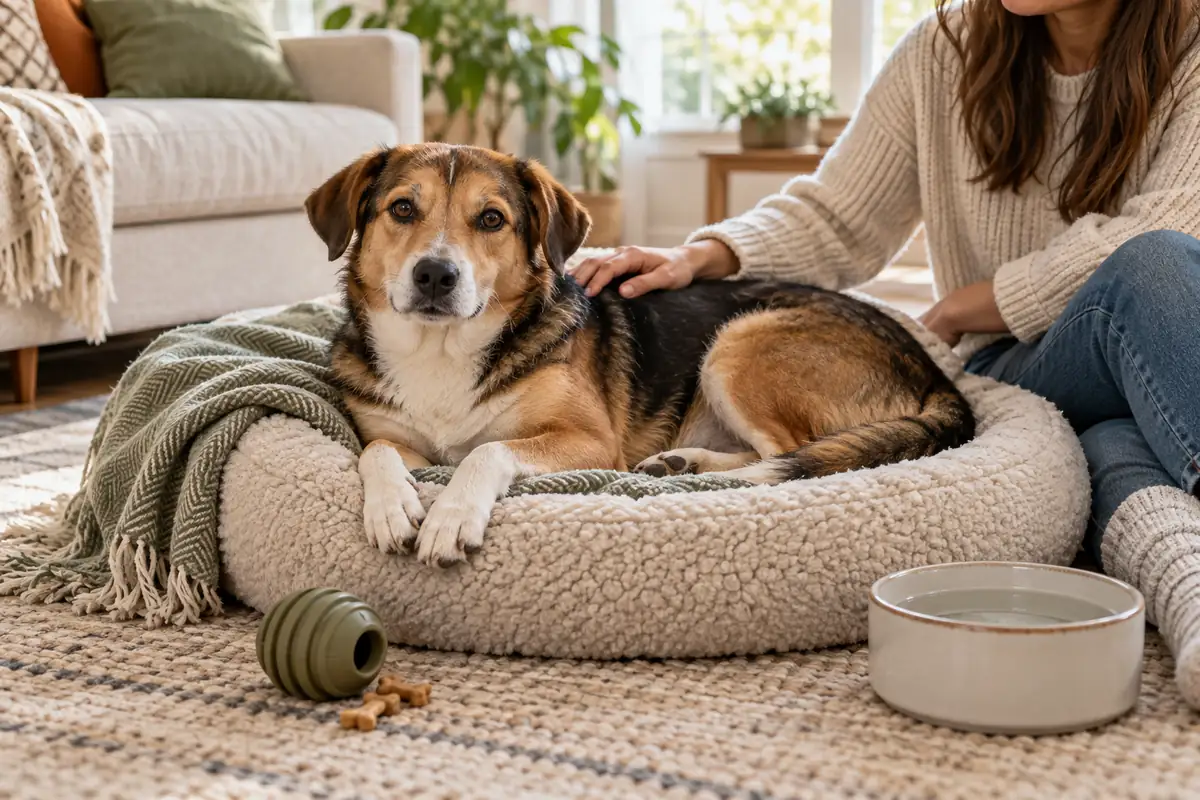
Choose a familiar resting area with comfortable bedding, water and suitable room conditions. Avoid changing the entire environment at once unless safety requires it.
A blanket that smells of home may be comforting if your dog uses fabric safely. Remove items they shred or swallow.
Do not introduce confinement solely to stop pacing or damage. Never shut a panicking dog in a crate. A dog-proofed room or other familiar space is useful only when your dog remains comfortable there.
Trial any changes while someone is home.
Calm set-up checklist
Dog Separation Anxiety After Losing Another Pet or Person: calm set-up checklist
- Use a resting area your dog already likes.
- Provide familiar, safe bedding.
- Keep drinking water accessible.
- Check warmth, cooling and ventilation.
- Remove cords and swallowable objects.
- Secure trash and household chemicals.
- Reduce avoidable window or hallway triggers.
- Inspect any food toy for damage.
- Keep pathways and exits safe.
- Confirm comfort with any barrier.
- Test the camera view.
- Arrange a helper for gaps beyond current ability.
Rebuilding alone time in 5 steps
Progress depends on comfortable behavior, not a deadline after the loss.
| Step | What you do | Move on when |
|---|---|---|
| 1. Check health and support | Discuss concerning changes with your vet and arrange care | Immediate concerns are addressed and coverage is available |
| 2. Encourage comfortable rest | Reward voluntary settling while you remain nearby | Your dog can disengage from you comfortably |
| 3. Find an easy separation | Practice a gap shorter than the time worry usually begins | Comfort continues throughout |
| 4. Repeat and build gradually | Mix easy repetitions with small increases while observing | Repeated comfortable sessions support another step |
| 5. Apply to ordinary absences | Practice relevant routines and continue covering longer gaps | Your dog remains comfortable in those situations |
Swipe the table sideways to see every column.
Start with seconds if necessary. “Below threshold” means keeping practice manageable enough that distress does not build.
Return before worry develops. If it appears, come back calmly and make the next attempt easier; do not wait for silence during panic.
Follow our separation anxiety training plan. Arrange suitable company, such as a trusted friend, sitter or daycare, through our care options guide so unavoidable absences do not exceed current ability. A brief dog-walker visit may not be enough if your dog panics before or after it.
Should you get another dog?
Another dog is not a quick fix. Company may be reassuring for some dogs, but it may not resolve distress about a missing person or being separated from you.
Consider another dog only when the family wants and can support that dog for their own sake. Allow time to assess compatibility, responsibilities and your readiness.
Our second dog guide covers testing canine company and considering alternatives without making adoption a treatment plan.
Looking after yourself too
A simple written care plan can reduce decisions when grief makes ordinary tasks difficult. Ask for specific help: a familiar friend covering an appointment, someone handling an evening walk or another family member organizing meals.
Keep training modest. You do not need to make every difficult day productive, and missing a session is not failure.
Use our separation anxiety log for brief factual notes rather than constant monitoring. You and your dog both need opportunities to rest.
Mistakes to avoid
Do not assume you know what your dog understands about the loss, or compare their adjustment with another dog’s.
Avoid dismissing appetite changes or lethargy as grief. Do not return immediately to the previous longest absence because your dog once managed it with a companion present.
Never punish accidents, damage or vocalizing. Avoid aversive collars, forced confinement and leaving your dog to cry until exhausted.
Do not rush another adoption or expect a food toy to make an overwhelming absence manageable.
When to get extra help
Dogs Trust’s separation anxiety advice explains that physical health can influence behavior and recommends veterinary advice when behavior has recently changed. That remains important even when the timing seems clearly connected to a loss.
Seek prompt help for self-injury, dangerous escape attempts or panic that begins almost immediately. Get a qualified, reward-based professional experienced in separation difficulties involved if your dog is worsening or not improving.
Bring short clips and notes using our vet visit preparation guide. You do not need to wait until you feel completely organized to ask.
Helpful products
Picks on this page are a research-based assessment of features and intended use — not hands-on testing. We earn a small commission if you buy through the Amazon links on this page, at no extra cost to you. Affiliate disclosure
These picks are chosen from research, not from personal product testing. They are practical support options, not a fix on their own, and none of them replaces a vet check, a steady routine or care cover.
| Product type | Why it helps | Notes |
|---|---|---|
| Pet camera: Furbo 360° camera | Shows whether your dog rests or struggles alone | Limitation: it needs Wi-Fi and only shows what happens; it cannot comfort your dog or tell you why. Alternative: an old phone or laptop recording or on a video call. |
| Stuffable rubber food toy: KONG Classic | Offers a familiar activity during comfortable quiet time | Limitation: a sad or anxious dog may ignore food, so not eating it is useful information, but the toy will not fix distress. Alternative: scatter feeding. |
| Calming donut dog bed with raised sides: Best Friends by Sheri calming donut bed | Provides cozy rest for dogs who like curling up | Limitation: a cozy bed can help a dog rest but does not fix distress about being alone, and some dogs chew beds. Alternative: a folded blanket that smells of home in a quiet corner. |
Swipe the table sideways to see every column.
Bottom line
After a loss, support starts with health checks, familiar care and manageable expectations. Rebuild alone time from your dog’s current comfort and arrange company for longer gaps. Small, steady steps and practical help can support both of you.