On this page
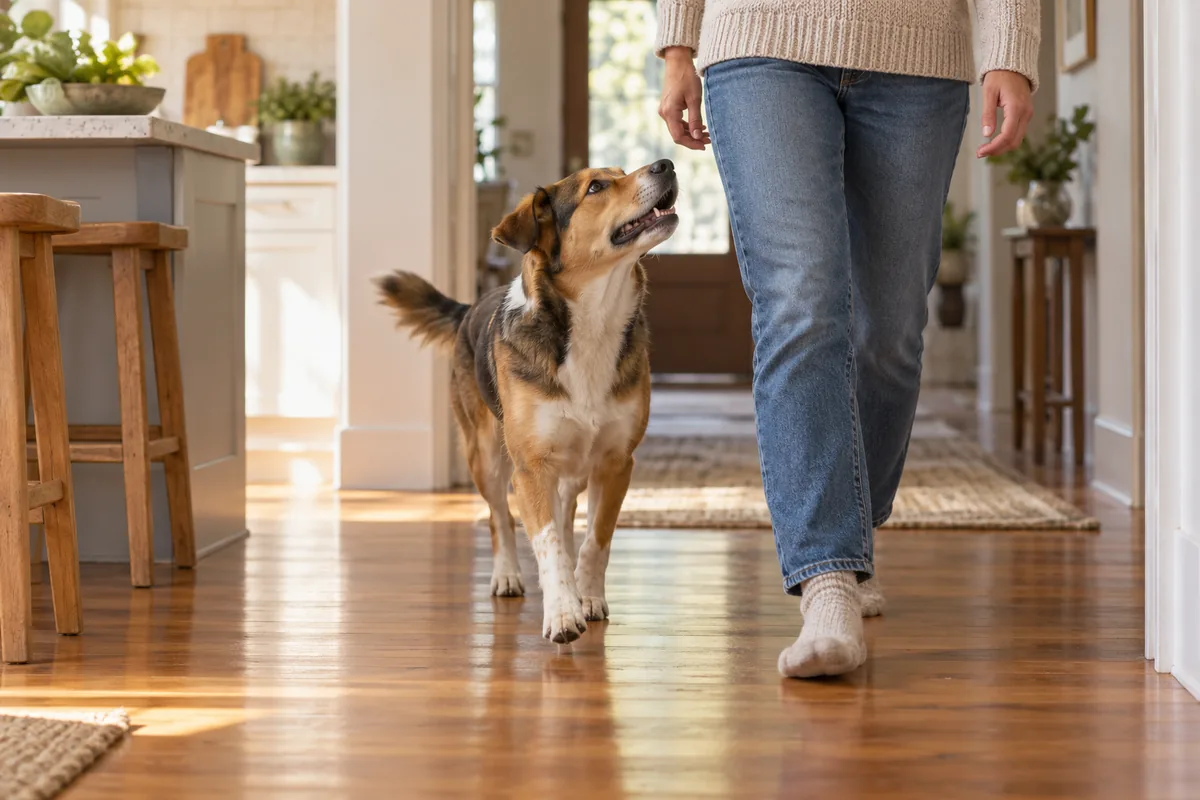
You walk to the kitchen, and your dog comes too. You head upstairs, and paws follow behind. Living with a “velcro dog” can be affectionate, inconvenient, or worrying, depending on whether your dog seems comfortable.
We are dog owners, not vets or trainers. This guide helps you understand everyday shadowing and introduce manageable independence practice. The aim is to help your dog feel safe during short spells apart while keeping the closeness you both enjoy.
Why dogs follow you everywhere
Company feels good
Dogs are social animals, and being near a familiar person can be enjoyable. A dog who follows, settles nearby, and sometimes chooses another resting spot may simply like your company.
If your velcro dog also panics when you leave, our guide to separation anxiety vs isolation distress helps you see whether it is about you or about being alone.
A baby on the way means new gates and closed doors. Our guide to separation anxiety when a new baby arrives explains how to practise being apart behind a gate before the due date.
If your dog shadows one family member and pines when that person goes out, see our guide to helping a dog attached to one person, with a gentle plan for the rest of the household.
If your dog only started following you everywhere in their senior years, our guide on separation anxiety in senior dogs explains why a vet check comes first and how to make home easier for an older dog.
A dog who follows one person everywhere may not relax just because another dog is home. Our guide on whether a second dog helps separation anxiety explains why, and what to try instead.
Working and companion backgrounds
Some breeds were developed to cooperate closely with people, while others were selected primarily for companionship. Those tendencies can influence attention to their person, but breed alone cannot explain an individual dog's behavior. If you live with one of these people-focused breeds, our breed guides look at the Golden Retriever, Labrador and French Bulldog in more detail.
Puppies and newly adopted dogs seek reassurance
An unfamiliar home can make a person the most predictable part of the environment. Puppies and new arrivals may follow while learning routines and finding comfortable resting places.
Allow adjustment without expecting immediate independence. Our Puppy Separation Anxiety guide covers age-appropriate care and alone-time practice.
Following has paid off
If following you often leads to food, play, a walk, or attention, your dog may repeat it. You do not need to blame yourself for this learning.
You can also make calm resting rewarding, rather than reserving every pleasant interaction for a dog already underfoot.
Something is needed
Your dog may want a toilet trip, water, dinner, movement, or help reaching a resting place. Check those needs before treating following as a training problem.
Boredom or uncertainty keeps them moving
Some dogs follow because little else is available to do. Others monitor movements because they are unsure what happens next. Look at the whole routine, including activity, sniffing, enrichment, sleep, and recent changes.
KONG Classic Stuffable Dog Toy
A familiar stuffable food toy offers an enjoyable mat activity while you practice small, comfortable movements into another room.
Check price on AmazonWe earn a small commission if you buy through this link, at no extra cost to you. Disclosure
Velcro dog or separation anxiety?
Shadowing alone cannot diagnose separation anxiety. The more useful question is what happens when your dog cannot follow.
| What you notice | Usually normal shadowing | Could be separation anxiety |
|---|---|---|
| Following between rooms | Loose posture, then resting nearby | Urgent monitoring with difficulty settling |
| Staying behind while you move | Sometimes chooses to keep resting | Immediately becomes tense or distressed |
| Briefly closed interior door | Waits comfortably or finds another activity | Paces, whines, scratches, or panics |
| Departure preparations | Brief interest without sustained concern | Increasing worry around keys, shoes, or bags |
| Barking or howling | Occasional response to an identifiable event | Persistent vocalizing linked to separation |
| Chewing or damage | Ordinary play or chewing has other explanations | Exit-focused damage or frantic escape attempts |
| Toilet accidents | Schedule, training, and medical needs require checking | Accidents accompany separation-related distress |
| Food offered during separation | Eats comfortably and can settle afterward | Stops eating and becomes vigilant or restless |
| Behavior while alone | Rests, changes position, and responds normally | Repeated pacing, panting, drooling, or inability to settle |
Swipe the table sideways to see every column.
The ASPCA describes separation anxiety as dogs becoming upset because of separation from the people they are attached to. Its guidance suggests gradual out-of-sight stays that start at an inside door, such as the bathroom, then a bedroom door, and only later an exit door.
Our separation anxiety guide explains the overview. For a fuller observation checklist, read Separation Anxiety or Boredom? 10 Signs.
When to check with your vet
Sudden new clinginess deserves a veterinary check, particularly in an older dog. Pain, illness, hearing or sight changes, and cognitive changes may affect confidence and behavior.
Mention changes in sleep, movement, appetite, drinking, toileting, or willingness to be touched. A dog who follows while also struggling to lie down needs more than mat practice.
Do not assume a recent household change explains everything. A behavior change can have more than one contributor, and a vet can decide what assessment is appropriate.
Velcro dog checklist
Use these questions to understand the pattern rather than score your dog.
Velcro Dog: Why Your Dog Follows You Everywhere (and When It Is Separation Anxiety): velcro dog checklist
- Can my dog remain relaxed when I move within the room?
- Do they sometimes choose to rest away from me?
- What happens when an interior door closes briefly?
- Have I observed what happens after I leave home?
- Is the following longstanding or a sudden change?
- Are there changes in health, movement, sleep, or appetite?
- Are toilet, water, and comfort needs being met?
- Does the routine include suitable movement and sniffing?
- Does my dog have enjoyable, manageable activities?
- Is their resting place comfortable and accessible?
- Do household members respond consistently to attention-seeking?
- Does company from another familiar person help them settle?
If you cannot answer a question, write “unknown.” Missing observations are a reason to look carefully, not assume distress or comfort.
How to build calm independence
Make a settle spot worthwhile
Use an existing bed, blanket, or mat in a comfortable place near you. Reward voluntary approaches, lying down, and relaxed resting.
Begin with no separation at all. The spot should feel pleasant, not like a place your dog is sent when company disappears.
Avoid turning the exercise into a long obedience hold. A dog remaining rigidly in position is not necessarily relaxed.
Meet activity and sniffing needs
Offer appropriate exercise, opportunities to sniff, simple training, and restful downtime. Needs vary with age and health.
A working breed may enjoy searching for food or solving an easy task. More strenuous exercise is not always the answer, especially if your dog struggles to wind down afterward.
Our enrichment guide offers ways to make activities manageable rather than frustrating.
Reward calm before pestering starts
Notice your dog resting without demanding attention and offer quiet recognition or a reward there.
If nudging or pawing repeatedly brings immediate play, plan more predictable interaction and reward an easy alternative such as settling nearby. Check genuine needs first. Do not mistake anxious contact-seeking for a behavior to ignore.
Keep movements and greetings ordinary
Stand up, take a step, and sit down again during easy practice. Small movements can become less significant through comfortable repetition.
Keep comings and goings friendly and low-key. There is no need for dramatic goodbyes, excited reunions, or deliberate emotional distance.
If worry begins during preparation to leave, use our departure cues guide alongside the broader plan.
Room-to-room independence ladder
Start only when your dog is comfortable and basic needs are met. Introduce a gate while open first; if barriers already trigger distress, seek help before closing one.
- Try a few seconds with a familiar baby gate between you. Stay immediately beside it and fully visible. Reopen before worry begins; begin even easier if needed.
- Add a small step away. Reward relaxed behavior and return promptly. Avoid increasing both distance and time together.
- Do an ordinary visible activity. Briefly sit, put away an item, or move nearby while your dog rests. Keep repetitions short.
- Approach an inside doorway. Let your dog remain on the settle spot while you move toward a bathroom or bedroom doorway.
- Disappear for a moment. Step just out of sight and return before concern develops. This may initially be less than a second.
- Build varied, short indoor gaps. Mix very easy repetitions with slightly longer ones, observing posture, movement, and recovery.
- Transfer carefully to another room. Change the location without also increasing duration. Comfortable indoor separation does not automatically mean readiness for leaving home.
If your dog gets upset, return calmly, allow recovery, and go back a step—or simplify further. Do not wait for silence while distress continues.
For actual departures, use our separation anxiety training plan rather than extending this ladder on your own.
2-week independence plan
This is an organizing example, not a promise of progress by a deadline. Repeat earlier rows whenever needed.
| Day | Practice | Goal |
|---|---|---|
| Days 1–2 | Observe following and reward voluntary resting near you | Establish a comfortable baseline |
| Days 3–4 | Make the mat pleasant; practice tiny movements nearby | Rest continues during ordinary movement |
| Days 5–6 | Introduce a gate without pressure, closing briefly only if comfortable | Build ease with a familiar barrier |
| Days 7–8 | Practice small visible distance changes | Maintain relaxation rather than increase speed |
| Days 9–10 | Try momentary out-of-sight gaps at an inside doorway if ready | Introduce a manageable change |
| Days 11–12 | Vary easy repetitions and try another familiar location | Support comfort across settings |
| Days 13–14 | Review observations and repeat the easiest useful exercises | Decide whether professional help or continued practice is needed |
Swipe the table sideways to see every column.
A dog may still be working on the first rows after two weeks. That information should guide the next step, not trigger a sudden increase.
Mistakes to avoid
- Punishing following, whining, or contact-seeking.
- Shutting a worried dog away without preparation.
- Forcing long gaps because shorter ones went well.
- Treating quietness or a stay command as proof of comfort.
- Giving every reward only after persistent pestering.
- Using food to conceal an overwhelming separation.
- Expecting a new bed or toy to resolve distress.
- Avoid withholding affection to make your dog “less attached.”
Independence grows through manageable experiences. Your dog does not need to be frightened, exhausted, or emotionally pushed away to learn.
When to get extra help
Contact your vet for sudden clinginess, physical changes, or severe distress. Seek prompt help for self-injury or dangerous escape attempts.
A qualified, reward-based behavior professional or veterinary behaviorist can help if your dog cannot tolerate tiny indoor gaps, panics behind barriers, or remains distressed during absences.
Arrange suitable company for necessary absences beyond current tolerance. Everyday indoor practice does not replace a care plan for workdays.
Bring brief observations or existing video, but do not provoke panic to collect evidence.
Helpful products
Picks on this page are a research-based assessment of features and intended use — not hands-on testing. We earn a small commission if you buy through the Amazon links on this page, at no extra cost to you. Affiliate disclosure
These are support tools, chosen from research, not from personal testing.
| Product type | Why it helps | Notes |
|---|---|---|
| Stuffable rubber food toy: KONG Classic | Offers a calm mat activity during manageable separation practice | Limitation: some stressed dogs will not eat, so supervise at first. Alternative: scatter feeding or a snuffle mat. |
| Lick mat: LUKITO lick mat | Gives easy access to a familiar food activity | Limitation: wash after every use, and some dogs chew the edges, so supervise. Alternative: a frozen stuffed KONG. |
| Soft round calming-style bed: Best Friends by Sheri donut bed | Provides a consistent settle spot | Limitation: a bed does not fix anxiety on its own, and some dogs chew soft beds. Alternative: a folded blanket or your dog's existing bed. |
Swipe the table sideways to see every column.
Use food from the daily allowance and introduce activities while you are present. Check what happens after the food finishes.
For supervised nose work, a snuffle mat can be useful; it is unsuitable for a dog who tears off and swallows fabric.
Bottom line
A dog who follows you comfortably may simply enjoy your company. Concern rises when separation brings distress, or when clinginess changes suddenly.
Build relaxed resting and tiny, manageable gaps while meeting daily needs. Keep affection, adjust to your dog's response, and get help when safety or comfort is in doubt.