On this page
- What departure cues are
- Does your dog react to departure cues?
- Make your cue list
- Departure cue ladder
- Daily practice session
- Chaining cues into a full departure
- Using food the right way
- Calm departures and calm returns
- Managing real workdays while you train
- Cue practice log
- Helpful products
- Mistakes to avoid
- When to get extra help
- Bottom line
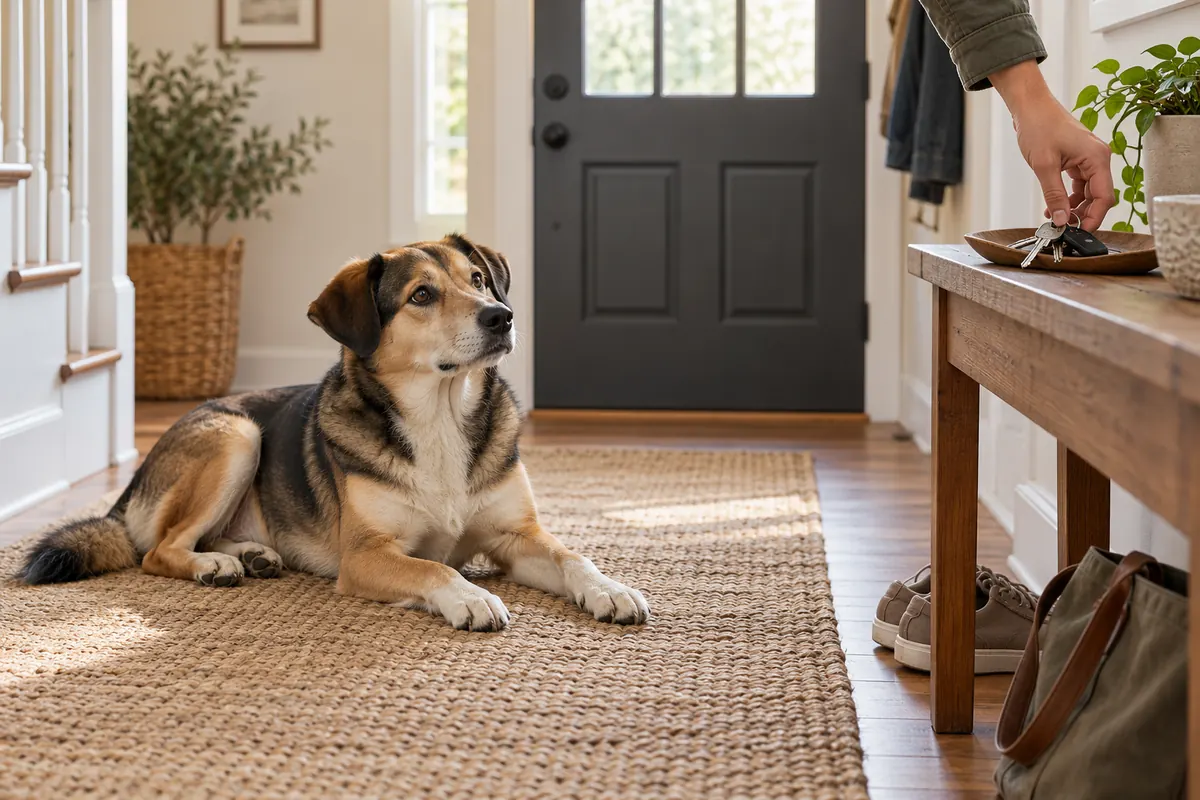
You reach for your keys, and your dog is already pacing. You have not opened the door, yet the worry has started. For some dogs, the familiar sequence before departure becomes almost as troubling as the absence itself.
We are dog owners, not vets or certified trainers. This guide focuses on making those preparation cues less significant. For the actual work of building comfortable absences, use our Separation Anxiety Training Plan alongside appropriate professional support.
What departure cues are
Departure cues are things your dog learns predict you leaving. They may include shoes, keys, a coat, a work bag, an alarm sound, switching lights off, or finishing breakfast at a particular time.
Backpacks, lunch boxes and the school run can become new departure cues. Our guide to back to school and dog separation anxiety shows how to keep school mornings calm for an anxious dog.
Calmer reactions to keys, shoes and coats are one of the first signs of progress. Our guide to separation anxiety progress signs, plateaus and setbacks covers the other signs to look for, plus what to do after a setback.
A new work morning brings new cues: the alarm, smart shoes, a work bag. Our guide to going back to the office with a dog with separation anxiety explains how to rehearse that routine before your first office day.
Does your dog start pacing as soon as you pick up your keys? Our guide to dog pacing and panting when left alone explains how to tell departure stress from heat or pain.
If your dog goes straight for the door once you have gone, see our guide to dog scratching the door when left alone for a safer set-up and door protection options.
After a holiday or time off, departure cues can feel new again. Our guide to separation anxiety after vacation or working from home shows how to bring them back in small steps.
When the cues that matter belong to one person, our guide to helping a dog attached to one person shows how that person can practice short, calm departures.
Bringing home a new dog? Our guide to leaving your dog alone for the first time covers how to keep the very first departures and returns low-key.
Some dogs react to you leaving the room, not just the house. Our guide to why your dog follows you everywhere covers calm comings and goings and short out-of-sight practice at home.
To see whether your cue practice is helping on real absences, track each one on our free printable separation anxiety log.
To see which cues really matter, start recording before you pick up your keys. Our guide on how to record your dog when you leave explains camera placement and what to note in the first minutes after you leave.
Pairing a calm cue with a stuffed food toy is one way to make getting ready feel less worrying. Our guide on how to stuff a KONG covers safe fillings and easy-to-hard levels so your dog does not give up.
Dogs notice patterns. If your coat usually leads to an upsetting absence, the coat can begin to trigger worry before separation happens.
The ASPCA describes practicing departure cues without leaving as one approach to reducing this anticipatory anxiety.
The aim is for a cue to lose its strong connection with something frightening. Picking up keys can become an ordinary household action rather than a reliable warning.
Some dogs show no concern during preparation and only struggle after the door closes. That is fine: they do not need extra cue exercises simply because other dogs do.
Furbo 360° Dog Camera
A pet camera helps you compare reactions before and after departure, including stress signals you might miss while getting ready.
Check price on AmazonWe earn a small commission if you buy through this link, at no extra cost to you. Disclosure
Does your dog react to departure cues?
Watch an ordinary routine before adding practice. A camera can help you see your dog's body while your attention is on shoes or a bag.
| What you see | When it usually happens | What it can mean |
|---|---|---|
| Repeated pacing | As shoes, coat, or keys appear | Anticipatory worry may be building |
| Following closely from room to room | During your preparation sequence | Monitoring your movements; assess posture and ability to settle |
| Panting without heat or recent exercise | After a particular cue | Possible stress; medical causes also need consideration |
| Whining or trembling | When you lift a bag or approach the exit | The cue may predict an upsetting departure |
| Hiding or withdrawing | As the routine begins | Avoidance or fear, rather than relaxed independence |
| Refusing familiar food | Once departure preparations start | Possible rising anxiety, though appetite has other causes |
| Standing in the doorway | When you approach the exit | Concern about separation or difficulty disengaging |
| Briefly looking up, then resting again | After a cue | Ordinary awareness rather than a problem requiring training |
Swipe the table sideways to see every column.
One signal alone is not a diagnosis. Following can be normal, and quietness can conceal tension. Compare breathing, posture, movement, and recovery.
Our Separation Anxiety Signs guide, Separation Anxiety or Boredom? 10 Signs, helps you assess the wider pattern.
Make your cue list
Write down what happens before a typical departure, starting earlier than the front door. Include:
- Clothing changes, shoes, and outerwear.
- Keys, phone, wallet, lunch, and bag.
- Bathroom or breakfast routines.
- Lights, alarm sounds, and household announcements.
- Walking toward, touching, or opening the door.
Next, rank cues by your dog's actual reaction. Keys are not automatically easier than a coat. Note whether your dog remains loose, becomes watchful, or starts pacing.
Break difficult cues into smaller actions. Touching the key bowl may be manageable when lifting jangling keys is not.
Avoid deliberately performing the whole routine to see how upset your dog becomes. Existing observations or footage may provide enough information to begin safely.
Departure cue ladder
This is an adaptable example, not a required order. Repeat or subdivide rows according to your dog. Move on after comfortable repetitions across separate opportunities, not after one quiet response.
| Step | Cue to practice | Ready to move on when |
|---|---|---|
| 1 | Briefly touch the key bowl, then resume sitting | Your dog stays loose or easily returns to resting |
| 2 | Lift and replace keys without deliberately jingling them | Your dog notices without sustained vigilance |
| 3 | Hold keys briefly while staying in the room | Normal resting and breathing continue |
| 4 | Touch shoes, then put on one or both if comfortable | Your dog can disengage without pacing |
| 5 | Lift a coat, then briefly wear it | Your dog remains comfortable through the action |
| 6 | Pick up and replace an empty bag | Your dog does not become increasingly watchful |
| 7 | Practice one safe light or departure-related sound cue | Your dog remains relaxed; household safety is maintained |
| 8 | Walk partway toward the door, then return | Your dog stays comfortable without urgently following |
| 9 | Touch the handle, then open and close the door slightly | Your dog stays relaxed and cannot slip outside |
| 10 | Step outside for a few seconds only if already comfortable | Camera footage shows relaxation; continue through the absence plan |
Swipe the table sideways to see every column.
The last row crosses into absence training. Do not attempt it simply because earlier cues became easier. Follow the starting-point guidance in our Separation Anxiety Training Plan.
For alarms, use only a safe, appropriate practice method. Never disable or compromise security, smoke, or carbon monoxide protection for training.
Daily practice session
- Check readiness. Choose a quiet moment when your dog has had a potty opportunity and is settled. Postpone if illness, poor sleep, visitors, or frightening noise have already made the day difficult.
- Select one easy cue. Use a small action from your ranked list. Decide what would count as worry before you begin, such as repeated following, stiffening, or interrupted resting.
- Perform the cue gently. Touch the keys or lift the bag briefly. Avoid exaggerating the sound or movement to attract attention.
- Stay home. Put the item down and continue an ordinary activity, such as reading or sitting at your desk. Do not add another departure cue immediately.
- Watch recovery. A brief glance followed by relaxed resting may be fine. Persistent monitoring, pacing, panting, or hiding means the exercise was too difficult.
- Repeat sparingly. If your dog is fully relaxed, another easy repetition may be appropriate. Spread comfortable opportunities across the day rather than drilling the cue repeatedly.
- Log and finish. Record what happened and end before tension builds. Keep the same easy action next time, or simplify it if your dog showed concern.
There is no required daily repetition count. Many brief, comfortable experiences over time are the aim; repeated worry is a reason to change the exercise, not keep going.
Chaining cues into a full departure
Once individual cues are ordinary, combine two easy ones. Put on shoes, touch the keys, then sit down and remain home.
A combination can be harder than either action alone. If concern returns, separate the cues again or reduce their intensity. Add one element at a time rather than rehearsing the full workday routine immediately.
Gradually vary harmless details. Carry your bag to another room while staying home, or put on shoes before reading. Mixing the order can reduce the predictive value of a rigid sequence.
However, changing the routine is not a way to sneak out for an absence your dog cannot manage. The door closing may still trigger distress, regardless of how quietly you prepared.
When your full preparation sequence is comfortable, integrate it cautiously with the absence durations your dog already handles. Continue camera monitoring.
Using food the right way
Food is optional. Some dogs benefit when a manageable cue predicts something pleasant: you touch the keys, then offer a small treat or familiar food activity while staying home.
Introduce the food toy during ordinary relaxed time too. If it only appears before difficult departures, it may become another warning signal.
Avoid using food to distract your dog while you perform a routine that would otherwise overwhelm them. The aim is a comfortable response to the cue, not hiding the cue behind a busy activity.
If your dog stops eating when you pick up the bag, make the cue easier. Do not keep increasing food value while ignoring other stress signs.
Eating is useful information, but not proof of comfort. Check posture, breathing, and what happens after the food finishes. Count enrichment food toward daily intake.
Calm departures and calm returns
Keep preparation and greetings ordinary, predictable, and friendly. You do not need to ignore your dog or withhold affection.
A calm goodbye can be brief. Avoid a prolonged emotional ritual if it increases anticipation, but there is no need to become distant.
When returning, greet your dog in a way they handle comfortably and offer a potty opportunity when needed. If a practice departure causes distress, return promptly rather than waiting outside for silence.
The central task is reducing fear, not enforcing a particular greeting style.
Managing real workdays while you train
Cue practice is easier when it is not squeezed into a rushed departure. Practice at other times so you can stay home afterward.
For necessary absences, arrange suitable care: a familiar sitter, friend, family member, appropriate daycare, or another arrangement your dog finds comfortable. Some dogs need company throughout an absence rather than a midday visit.
Prepare practical items in advance when that reduces a difficult morning sequence. Keep changes simple rather than constantly inventing ways to hide your departure.
Review camera footage from real departures carefully. A calmer response to shoes is progress, but it does not establish comfort after you leave.
Our How Long Can a Dog Be Left Alone? guide covers physical care needs. A time chart cannot determine an anxious dog's emotional tolerance.
Cue practice log
Record small changes, including how quickly your dog returns to ordinary resting.
| Date | Cue | Dog's reaction | Next step |
|---|---|---|---|
| Example: Monday | Touched keys without lifting them | Looked briefly, then rested with loose posture | Repeat at another relaxed time |
| Example: Tuesday | Put on shoes and lifted bag together | Stood, followed, and began pacing | Separate cues; return to an easier action |
Swipe the table sideways to see every column.
A bad day does not erase previous learning. After disrupted sleep, illness, or a frightening event, pause or choose an easier cue. Repeated setbacks warrant a review of the whole plan.
Helpful products
Picks on this page are a research-based assessment of features and intended use — not hands-on testing. We earn a small commission if you buy through the Amazon links on this page, at no extra cost to you. Affiliate disclosure
These tools support observation and comfort. We have not personally tested them, and none replaces training.
| Product type | Why it helps | Notes |
|---|---|---|
| Pet camera: Furbo 360° camera | Shows reactions during preparation and after departure | Needs good Wi-Fi; does not train your dog. Limitation: it shows you when to end a session but does not train your dog; needs 2.4GHz Wi-Fi, and some owners report connection drops. Alternative: a spare phone or laptop on a free video call app. |
| KONG-style stuffable toy | Offers a familiar food activity during suitable practice | Introduce separately; some worried dogs stop eating. Limitation: a very anxious dog may ignore food when alone, and it must be sized to your dog. Alternative: a lick mat or a few treats scattered on a snuffle mat. |
| Lick mat: LUKITO lick mat | Provides an easy food activity for dogs who enjoy it | Supervise; remove if torn or chewed. Limitation: strong chewers can damage it, so use it for short supervised practice only. Alternative: a stuffed KONG-style toy. |
| Baby gate or exercise pen: MidWest exercise pen | Helps establish a safe area | Use only if the barrier is already comfortable. Limitation: introduce it gradually; some dogs climb or push panels, and confinement does not fix panic. Alternative: a baby gate across a dog-proofed room. |
| Pheromone diffuser: ThunderEase diffuser | May provide additional environmental support | Optional; evidence is mixed. Limitation: evidence is mixed and it cannot replace gradual training. Alternative: a familiar worn T-shirt or blanket in the resting spot. |
Swipe the table sideways to see every column.
An old phone or laptop on a free video call app can substitute for a dedicated camera. Secure devices and cables, protect account access, and test the connection.
A gate should never hold your dog near a cue they are trying to avoid. Give them space and choice.
Mistakes to avoid
- Repeating a cue while your dog remains worried.
- Starting with the hardest part of the routine.
- Adding several cues before easier ones are comfortable.
- Treating stillness or silence as automatic relaxation.
- Making every food toy predict departure.
- Following harmless practice with an overwhelming real absence.
- Punishing worry: never scold following, whining, hiding, or doorway behavior.
- Continuing cue work when your dog shows no cue-related concern.
Avoid expecting instant indifference. Progress may be a softer posture, less monitoring, or an easier return to resting.
When to get extra help
Talk to your vet if reactions are sudden, severe, spreading, or accompanied by appetite changes, pain, unusual panting, or other illness signs.
Seek qualified separation anxiety support if your dog reacts to tiny movements, cannot settle between repetitions, blocks exits dangerously, or panics after departure. Escape injuries require prompt veterinary attention.
A qualified separation anxiety professional can help identify an easier starting point and coordinate cue work with absence training. Our Separation Anxiety guide explains the broader approach.
If every cue seems difficult, more repetitions are unlikely to be the answer. Simplify, pause, and get individualized help.
Bottom line
Practice a manageable cue, stay home, and allow your dog to return to ordinary relaxation. Build individual cues before combining them, and step back whenever worry grows.
Departure cue work can reduce anxiety before leaving. On its own, it rarely resolves separation anxiety; pair it with a gradual absence plan that respects your dog's current comfort.