On this page
- Why back to school can be hard for dogs
- Missing the kids or separation anxiety?
- Getting ready before school starts
- Two weeks before school starts
- The morning school rush
- School morning routine checklist
- What kids can do to help
- Kids' calm dog jobs checklist
- The first weeks of term
- After-school returns
- After-school return checklist
- When your dog can't be left alone yet
- Mistakes to avoid
- When to get extra help
- Helpful products
- Bottom line
Summer can mean children playing, doors opening and someone always nearby. When school starts, that busy house becomes quiet almost overnight, and some dogs struggle with the change.
You have lunches, transportation and homework to organize too. This guide offers a manageable family plan. We are dog owners, not vets or trainers; the aim is to help you observe your dog, make mornings easier and recognize when professional support is needed.
Why back to school can be hard for dogs
The change involves more than missing a favorite child. Walks may happen earlier, playtime shrinks, and everyone leaves together. A dog who rarely experienced an empty house during summer may have had little recent practice being alone.
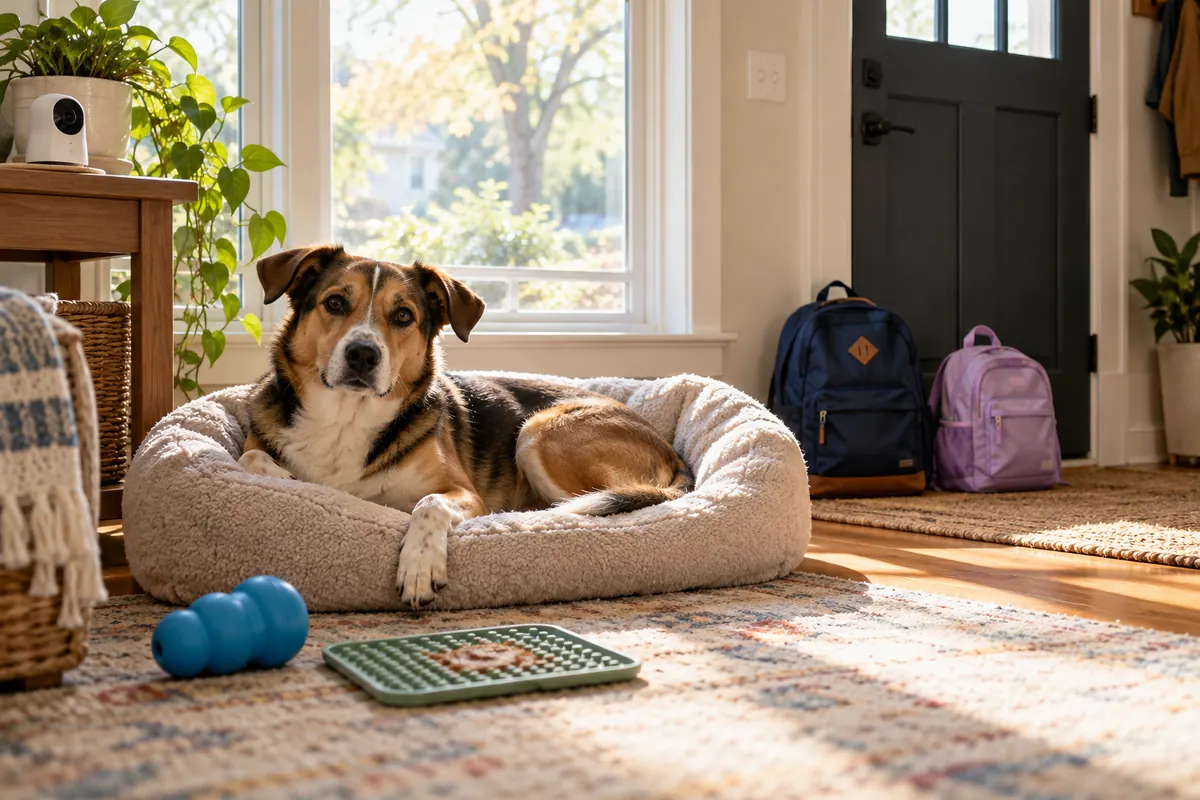
School bags, lunch boxes and the morning rush can also become signals that company is about to disappear. Some dogs react before anyone reaches the door.
Other dogs simply enjoy a quieter house and catch up on sleep. A dog lying beside a child's bedroom is not automatically anxious. Look at their whole behavior, especially whether they can relax, eat and move away from the exit.
Furbo 360° Dog Camera
A pet camera shows whether your dog settles after school departures, helping your family plan practice and care cover.
Check price on AmazonWe earn a small commission if you buy through this link, at no extra cost to you. Disclosure
Missing the kids or separation anxiety?
These patterns offer clues, not a diagnosis. Timing and body language matter more than a sad-looking expression.
| What you see | More likely boredom or missing company | More likely separation anxiety |
|---|---|---|
| Waiting near the door | Checks it occasionally, then rests | Remains fixed there and cannot settle |
| Brief whining | Fades while the dog relaxes | Continues, escalates or accompanies pacing |
| Chewing | Explores loose belongings, then stops | Frantically damages exits after departure |
| Food toy use | Eats, finishes and rests | Abandons familiar food as everyone leaves |
| Movement | Changes resting spots casually | Repeatedly follows the same restless route |
| Toileting indoors | Long gap or incomplete house-training | Happens during short absences with other distress |
| Quiet behavior | Loose body, comfortable resting | Trembling, hiding or remaining rigid |
| After-school greeting | Excited but soon settles | Frantic greeting follows distress recorded earlier |
Swipe the table sideways to see every column.
Accidents, chewing and food refusal can also have physical causes. Neither this table nor a recording can rule those out.
Getting ready before school starts
If possible, begin about two weeks before school starts. That is preparation time, not a deadline for your dog to manage a full school day.
First, film a very short absence with an adult watching live. Start with seconds if your dog already worries. Return before stress develops; if worry appears, return calmly and make the next attempt easier. Do not leave them distressed to discover how long it lasts.
The ASPCA's separation anxiety advice describes treatment as helping a dog tolerate being alone by gradually getting used to short absences. Our separation anxiety training plan explains the actual absence work.
Bring back the school-day order of walks, meals and rest gradually. Let backpacks appear during ordinary home time, too. If those objects trigger worry, use our departure cues guide.
Two weeks before school starts
This example covers preparation, not a required progression. Repeat an easier row whenever necessary.
| Day | What to practice | Who helps |
|---|---|---|
| Days 1–2 | Observe resting habits; film a tiny comfortable absence | Adult monitors the camera |
| Days 3–4 | Introduce the future walk, breakfast and settle order | Adults lead; children follow |
| Days 5–6 | Handle backpacks and shoes, then remain home | Family practices casually |
| Days 7–8 | Repeat easy absences; increase only if relaxed | Adult controls duration |
| Days 9–10 | Rehearse children leaving while an adult stays | Children give brief goodbyes |
| Days 11–12 | Try the planned carer and check the handover | Adult and chosen carer |
| Days 13–14 | Rehearse the morning with confirmed care cover | Whole household |
Swipe the table sideways to see every column.
The morning school rush
Prepare bags and clothing the night before so the dog is not surrounded by frantic movement. Leave enough time for a toilet break and a suitable walk or sniffing activity.
Exercise should meet your dog's needs, not exhaust them into tolerating fear. Give them time to cool down and settle afterward.
Choose one adult to manage the dog while children leave. This reduces mixed instructions and keeps the doorway safer. Children can say a brief, friendly goodbye without repeatedly returning for another hug.
Keep school lunches, dropped snacks and backpack contents out of reach. A familiar resting area should be somewhere the dog already likes, rather than a new space introduced on the first morning.
School morning routine checklist
Back to School: Dog Separation Anxiety When the Kids Go Back: school morning routine checklist
- Pack school bags the night before.
- Confirm who is responsible for the dog.
- Check the day's actual absence, including travel.
- Confirm the carer and backup contact.
- Offer a toilet break before departure.
- Provide suitable walking or sniffing time.
- Allow a quiet settling period afterward.
- Refresh drinking water.
- Remove lunches, school supplies and chewable hazards.
- Check the familiar resting area is comfortable.
- Start the camera before departure preparations.
- Keep children's goodbyes brief and gentle.
What kids can do to help
Children can support a calm routine, but adults remain responsible for training, supervision and care arrangements. A child should never feel that the dog's anxiety is their fault.
Adults should supervise children with an anxious dog. Kids should not hug, crowd, follow or try to comfort a stressed dog physically. Give the dog a resting place children leave alone.
Choose jobs based on age and ability. Young children might help choose a towel for the settle area; older children may help prepare a food toy under adult supervision. Adults should handle any dog who guards food or toys.
Kids' calm dog jobs checklist
Back to School: Dog Separation Anxiety When the Kids Go Back: kids' calm dog jobs checklist
- Put backpacks in the agreed storage place.
- Help an adult prepare a familiar food toy.
- Let an adult give and retrieve food toys.
- Use a quiet voice around the resting dog.
- Say one short, friendly goodbye.
- Leave the dog's bed undisturbed.
- Avoid hugging or crowding a worried dog.
- Tell an adult about pacing, shaking or hiding.
- Enter calmly after school.
- Let the dog choose whether to approach.
- Join an adult-led sniffing game when appropriate.
- Help keep doors and gates safely closed.
The first weeks of term
Treat the early school days as observation days. Keep care cover in place while you learn how your dog handles the real routine.
Record when the last person leaves, when worry starts and whether the dog settles. Check beyond the food toy: eating briefly does not show that the remaining absence was comfortable.
Watch for differences between days. Bus noises, an earlier departure or after-school activities may change the experience. A dog comfortable during school pickup may struggle when everyone leaves in the morning.
Keep weekends and holidays supportive by practicing occasional short, comfortable absences. You can still enjoy plenty of family time. For households also returning to work, see our back-to-office guide and working full time guide.
After-school returns
A calm return can still be warm. Come in quietly, put belongings down and greet your dog gently if they approach.
There is no need to withhold affection until the dog behaves perfectly. If they are highly excited, adults can create space and help children avoid running, squealing or leaning over them.
Offer a toilet break, then something enjoyable: a sniffy walk, gentle play or a simple training game. A predictable reunion gives the dog attention without turning the doorway into a daily burst of chaos.
After-school return checklist
Back to School: Dog Separation Anxiety When the Kids Go Back: after-school return checklist
- Have an adult manage the doorway.
- Close the outside door securely.
- Put backpacks and snacks out of reach.
- Keep voices and movement gentle.
- Let the dog approach voluntarily.
- Avoid hugs, crowding and face-to-face greetings.
- Offer a timely toilet break.
- Check for damage or signs of injury.
- Review the recording rather than judging the greeting.
- Note any worry and changes in routine.
- Plan a suitable walk or sniffing activity.
- Give the dog space to rest afterward.
When your dog can't be left alone yet
A school schedule does not change your dog's current ability to cope. Include the school run, commute and activities when calculating the actual gap.
The ASPCA's separation anxiety advice suggests avoiding leaving the dog alone except during training while you work on the problem, for example by having a family member, friend or sitter stay with them, or using doggy daycare.
A trusted adult staying home, a neighbor or an in-home sitter may help. Daycare suits some dogs, but only if they enjoy that environment. Trial every arrangement before relying on it.
A dog walker can help with toilet needs and boredom in milder situations. A midday visit cannot cover a dog who panics soon after the morning departure. Some dogs also remain upset when a particular child leaves, even with another person present.
Our care options guide helps compare arrangements. Use our how long can a dog be left alone guide for general needs, while remembering that anxiety can make even short gaps difficult.
Mistakes to avoid
Do not make the first empty-house day a full school-day test. Avoid increasing absence time simply because yesterday went well; repeat comfortable steps and watch the dog.
Never punish damage, accidents or vocalizing. Avoid bark-control devices and leaving a distressed dog to cry until quiet. Never shut a panicking dog in a crate and leave.
Do not ask children to manage panic or retrieve guarded toys. Food toys and activities from our enrichment guide can support comfortable rest, but they cannot replace company or gradual training.
When to get extra help
Dogs Trust's separation anxiety advice explains that physical health often influences behavior, so contact your vet if your dog's behavior has recently changed.
Seek prompt veterinary advice for injuries, escape attempts, persistent food refusal or other signs of illness. Do not wait for the school routine to fix these problems.
A qualified, reward-based behavior professional can help if distress starts quickly, continues despite easier practice or makes family life difficult. Keep children separated from a dog who stiffens, growls or cannot settle around them, and seek professional guidance.
Helpful products
Picks on this page are a research-based assessment of features and intended use — not hands-on testing. We earn a small commission if you buy through the Amazon links on this page, at no extra cost to you. Affiliate disclosure
| Product type | Why it helps | Notes |
|---|---|---|
| Pet camera: Furbo 360° camera | Shows how the dog copes in an empty house | Our top pick. Limitation: it needs Wi-Fi and only shows what happens; it cannot comfort your dog or replace care cover. Alternative: an old phone or laptop on a video call. |
| Stuffable rubber food toy: KONG Classic | Provides a familiar settle activity children can help prepare | Limitation: an anxious dog may ignore food when alone, and it only lasts a short time. Alternative: scatter a few kibbles or a supervised snuffle game. |
| Lick mat: LUKITO 2-pack | Offers a gentle food activity during calm routines | Limitation: needs supervision at first, some dogs chew it, and it is calm enrichment, not a fix. Alternative: food smeared on a flat plate. |
Swipe the table sideways to see every column.
These picks are chosen from research, not from personal product testing, and none of them replaces company or a gradual training plan. For choosing recording equipment, see our best pet camera guide. Supervise new toys before considering leaving them with your dog.
Bottom line
Help your dog adjust to the family's changing routine with short, comfortable practice, gentle school departures and predictable reunions. Let recordings guide decisions, give children safe supporting jobs, and arrange company whenever the school-day absence exceeds what your dog can manage.