On this page
- Why a full workday is hard for a dog with separation anxiety
- Know your dog's current limit
- The "suspend absences" approach while you train
- Workday cover options
- Workday cover options compared
- Sample workday schedule
- Back to the office after working from home
- Hybrid and shift work
- How to train around a full-time job
- Budget-friendly ideas
- When the plan falls apart on a busy day
- Workday readiness checklist
- Mistakes to avoid
- When to get extra help
- Helpful products
- Bottom line
A nine-to-five job rarely means being out for only eight hours. Add commuting, a delayed meeting, or an errand, and a dog who struggles alone may face a much longer absence than you intended.
We are dog owners, not vets or trainers, and the products and services mentioned here were chosen from research, not from personal testing. This guide focuses on organizing the working week: dependable care during work, realistic training outside it, and a backup when plans change.
Why a full workday is hard for a dog with separation anxiety
A dog who panics after a short separation cannot simply jump to an office day because your schedule requires it. Long absences beyond current tolerance can cause distress and disrupt progress.
Did your dog have company all summer while the kids were home? Our guide to back to school and dog separation anxiety has a two-week plan for before term starts and simple calm jobs for children.
Work nights, 12-hour shifts or a rotating roster instead of a steady 9-to-5? Our guide to dog separation anxiety and shift work covers night shifts, sleeping during the day and a sample rotating roster week showing who is with the dog.
Still working from home but heading back soon? Our guide to going back to the office with a dog with separation anxiety covers the switch itself: a weeks-ahead plan, care cover for office days and a hybrid week example.
For trips away rather than workdays, our guide to boarding a dog with separation anxiety explains when a kennel may work, when a sitter is kinder and why overnight staffing matters.
Switching from working at home back to the office? Our guide to separation anxiety after vacation or working from home covers the week before, your first day back and hybrid weeks.
A second dog is not a substitute for workday cover. Our guide on whether a second dog helps separation anxiety explains the risks, the real costs and how to test the idea before adopting.
A lunchtime visit may meet toilet and exercise needs while leaving hours of emotional difficulty on either side. Physical needs and comfort with separation are different limits.
This takes effort to manage, and paid help may be costly. Recognizing that early helps you build a workable plan rather than relying on a toy or hoping each day improves.
Furbo 360° Dog Camera
A pet camera shows whether workday care leaves comfortable gaps or ongoing distress, helping you adjust arrangements using actual observations.
Check price on AmazonWe earn a small commission if you buy through this link, at no extra cost to you. Disclosure
Know your dog's current limit
Start with existing footage or a short, safe camera observation. Watch when concern begins, what it looks like, and whether your dog settles.
Pacing, repeated whining, panting, drooling, door scratching, and food abandonment can be concerning. Quiet but rigid door-watching may also deserve attention.
Do not deliberately wait for panic to discover a maximum. If your dog has injured themselves or made dangerous escape attempts, ask your vet how to proceed safely.
Use our Separation Anxiety Signs guide to organize observations. Our How Long Can a Dog Be Left Alone? guide covers general care needs, but an age-based range cannot establish an anxious dog's tolerance.
The "suspend absences" approach while you train
“Suspending absences” means avoiding separations beyond what your dog currently handles while practicing easier ones within a structured plan. It does not mean abandoning training.
The ASPCA's separation anxiety page explains that during treatment a dog with separation anxiety should not be left alone except during training sessions. It suggests that you take your dog to work if possible, having a family member, friend, or dog sitter stay with your dog, or using a sitter's home or doggy daycare.
Think of two linked schedules:
- Workday management: company and care during necessary hours away.
- Training practice: brief, planned absences your dog can manage comfortably.
Care arrangements may change as your dog progresses, but there is no dependable end date. Some dogs need any suitable person present; others struggle when a particular person leaves.
Trial the arrangement before relying on it. A booked sitter is useful only if the dog can settle with them.
Workday cover options
Family and friends
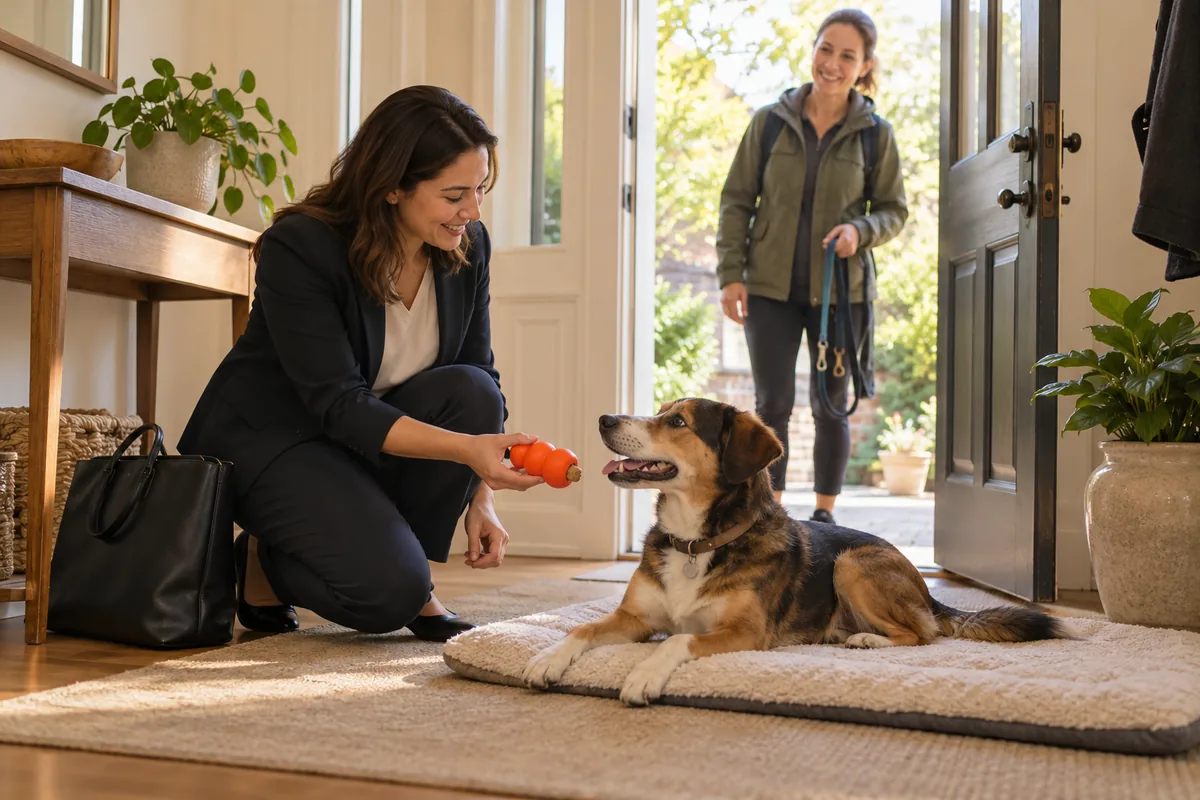
A familiar person may provide comfortable company with relatively little disruption. Agree on specific hours, access, and what happens if you are late.
Check that help is sustainable rather than assuming availability every week.
Pet sitter at home
An in-home sitter preserves familiar surroundings. Confirm whether they remain throughout the booking or leave for other clients and errands.
Use our Prepare a Pet Sitter guide to document routines, triggers, escape precautions, and contact instructions.
Dog walker for mild cases
A walker can work when your dog comfortably manages the gaps before and after the visit.
Choose by observed tolerance rather than the label “mild.” A brief walk does not provide continuous cover for a dog who panics soon after departure.
Doggy daycare if your dog enjoys it
Daycare may suit social dogs who relax with staff and can rest in the setting. It can overwhelm dogs uncomfortable with noise, groups, or unfamiliar confinement.
Ask whether rest periods include being left alone and arrange a gradual trial.
Taking your dog to work
An approved dog-friendly workplace may help if your dog settles there. Consider travel, meetings, other animals, and who stays with the dog during breaks.
Permission alone does not establish suitability.
Swapping care with another owner
A reciprocal arrangement may reduce costs when households are reliable and compatible. Dogs do not have to share space if that causes tension.
Agree on schedules, handling, food separation, and cancellations.
Working from home on some days
Remote days or split household schedules can reduce paid coverage. They also create opportunities for brief practice without a rushed departure.
Plan coverage for errands or appointments on home days too.
Workday cover options compared
Cost levels are broad planning categories, not quoted rates. Arrangements and local availability vary.
| Option | Best for | Watch out for | Cost level |
|---|---|---|---|
| Family or friends | Dogs settled with familiar people | Availability and unclear expectations | low |
| In-home sitter | Extended company in familiar surroundings | Confirm continuous attendance | high |
| Dog walker | Dogs comfortable between visits | Long uncovered gaps remain | medium |
| Doggy daycare | Dogs who enjoy and rest in the setting | Noise, groups, and solitary rest periods | high |
| Taking dog to work | Dogs comfortable in an approved workplace | Meetings, travel, and workplace restrictions | low |
| Reciprocal care swap | Reliable, compatible households | Introductions and backup availability | low |
| Working from home | Flexible jobs and household schedules | Errands and office days still need planning | low |
Swipe the table sideways to see every column.
Our Care Options guide compares these arrangements in more depth. A mixed week may be more practical than using one service every day.
Sample workday schedule
This example assumes continuous company is currently needed. The owner works from 9:00 a.m. to 5:00 p.m., with commuting included.
| Time | What happens | Who is with the dog |
|---|---|---|
| 6:45 a.m. | Suitable walk, sniffing, breakfast, and water | Owner |
| 7:45 a.m. | Quiet rest and final potty opportunity | Owner |
| 8:00 a.m. | Sitter arrives for a calm handover | Owner and sitter |
| 8:15 a.m. | Owner leaves for work | Sitter |
| 10:30 a.m. | Ordinary company and rest | Sitter |
| 11:45 a.m. | Familiar friend arrives before sitter leaves | Sitter and friend |
| 12:00 p.m. | Potty break and afternoon care begin | Friend |
| 3:00 p.m. | Rest, water, and appropriate activity | Friend |
| 5:45 p.m. | Owner returns; handover and potty opportunity | Owner and friend |
| Evening | Optional short practice if dog and owner are ready | Owner |
Swipe the table sideways to see every column.
The friend in this example remains all afternoon. A midday drop-in would not provide the same coverage.
Back to the office after working from home
A sudden schedule change can expose separation difficulties that were not obvious during remote work. Start preparation weeks ahead where possible.
This four-week example organizes the transition. It does not promise your dog will manage a workday by Week 4.
| Week | What to practice | Goal |
|---|---|---|
| Week 1 | Review current behavior, arrange veterinary help when needed, identify caregivers | Establish needs before the schedule changes |
| Week 2 | Trial caregivers and practice tiny comfortable absences | Confirm suitable support and a starting point |
| Week 3 | Rehearse morning handovers and practical care hours | Find gaps while adjustments are still possible |
| Week 4 | Confirm office-day bookings, backups, and separate training opportunities | Begin the new routine with appropriate cover |
Swipe the table sideways to see every column.
If your return date arrives before your dog is ready, keep the care plan rather than forcing the training timeline.
Hybrid and shift work
Hybrid schedules need explicit planning. A dog comfortable during short remote-day errands may still struggle on office days.
Keep feeding, toilet opportunities, activity, and rest reasonably predictable while allowing flexibility. Avoid using home days to push training harder in preparation for uncovered office days.
For shift work, write down actual departure and return times, including overtime. Overnight work may require someone staying with the dog, not just an evening visit.
Build overlapping handovers if household members work different shifts. Account for their sleep and other commitments rather than assuming someone technically “at home” can always provide care.
How to train around a full-time job
Use brief sessions when your dog is relaxed and you have time to observe. Before work can suit some households, but skip it if a deadline makes you rush.
Evenings may work after a potty break, appropriate activity, and settling. On weekends, choose a few manageable opportunities rather than repeated drilling.
Return before concern begins when possible, and simplify if worry appears. Do not wait out distress to finish a planned duration.
Our Separation Anxiety Training Plan explains starting points and gradual increases. Record a short note after practice so decisions do not depend on tired end-of-day memory.
Training is not a requirement at every available moment. Recovery, ordinary companionship, and your own rest matter too.
Budget-friendly ideas
Map the whole week before buying coverage. Family help on one day, remote work on another, and paid blocks elsewhere may be more sustainable.
Consider a fair care swap, staggered household schedules, or a familiar person working remotely at your home. Consolidate errands and use delivery or pickup when practical.
Discuss temporary flexibility with your employer where possible. Make requests concrete: particular days or adjusted hours are easier to plan around than an undefined emergency arrangement.
Tell your vet or behavior professional about cost constraints early. An unrealistic plan is difficult to maintain, even with good intentions.
When the plan falls apart on a busy day
Keep a short backup list in priority order: a trialed caregiver, familiar family member or friend, suitable daycare with confirmed availability, and any approved workplace option.
If a sitter cancels, contact backup help before leaving. If delayed at work, arrange someone to stay before current cover ends.
If you discover distress on camera, arrange a prompt, safe response. Do not rely on talking through the speaker or a remote treat to manage panic.
When no option is available, contact your veterinary or behavior team for practical guidance and reassess work flexibility or emergency support. Avoid trying an unfamiliar confinement setup under pressure.
One difficult day is not proof that all progress has disappeared. Document it, protect your dog, and review the weakest part of the schedule.
Workday readiness checklist
Working Full Time With a Dog That Has Separation Anxiety: A Realistic Plan: workday readiness checklist
- Have I observed my dog's current comfort during short absences?
- Are concerning health or behavior changes being assessed?
- Does coverage include the full commute and likely delays?
- Has my dog successfully trialed each caregiver or setting?
- Are continuous-care expectations clear?
- Do handovers overlap where needed?
- Are water, meals, toilet breaks, activity, and rest planned?
- Is the care sheet accessible and current?
- Are access details and emergency contacts available?
- Have we agreed on updates and camera privacy?
- Is backup care confirmed?
- Are training sessions separate from unavoidable workday absences?
Mistakes to avoid
- Treating a workday as a training exercise.
- Assuming a lunchtime walk covers separation panic.
- Using food or a camera as a substitute for company.
- Choosing daycare without checking your dog's response.
- Increasing absences because the next office day is approaching.
- Scolding or punishing barking, damage, or accidents, which can make distress worse.
- Using bark, shock, or spray collars.
- Leaving a distressed dog to cry until quiet.
Keep care needs and training goals connected without confusing them.
When to get extra help
Check with your vet and a qualified, reward-based behavior professional for moderate or severe concerns, repeated setbacks, or distress during tiny separations.
Prompt veterinary contact is important for sudden changes, food refusal, heavy drooling, or persistent panting. Injuries and dangerous escape attempts require urgent attention.
Bring representative video and explain your actual work constraints. The plan should reflect both your dog's needs and the support available.
Helpful products
Picks on this page are a research-based assessment of features and intended use — not hands-on testing. We earn a small commission if you buy through the Amazon links on this page, at no extra cost to you. Affiliate disclosure
These are support tools, chosen from research, not from personal testing.
| Product type | Why it helps | Notes |
|---|---|---|
| Pet camera with two-way audio: Furbo 360° camera | Shows settling and whether care visits leave difficult gaps | Limitation: it shows how your dog copes during the workday but does not fix it, and talking through the speaker can upset some dogs. Alternative: an old phone or laptop with a free video call or camera app. |
| Stuffable rubber food toy: KONG Classic | Offers familiar enrichment during comfortable handovers | Limitation: many anxious dogs will not eat when stressed, so it helps mild cases more. Alternative: a lick mat or supervised scatter feeding. |
| Dog playpen or exercise pen: MidWest exercise pen | Creates a manageable settle area for dogs comfortable with barriers | Limitation: confinement can make some anxious dogs panic, so test it while you are home. Alternative: a baby gate across a dog-proofed room. |
Swipe the table sideways to see every column.
Test barriers while home, without forcing your dog to tolerate distress. An old phone or laptop with a suitable free video-call or camera app can substitute for a pet camera.
Our Best Pet Camera guide explains features and limitations.
Bottom line
Working full time with a dog who struggles alone requires two plans: suitable workday care and separate, manageable training.
Trial support, cover handovers and delays, and keep backups ready. Reduce coverage according to demonstrated comfort and professional guidance rather than a calendar deadline.