On this page
- Why a stuffed KONG helps an anxious dog
- Choosing the right KONG
- Safe vs unsafe fillings
- How to stuff a KONG in layers
- KONG difficulty levels
- 7 KONG recipes
- Freezing a KONG
- Using a KONG for alone time
- If your dog won't touch the KONG when alone
- KONG log
- Helpful products
- Cleaning and replacing
- Mistakes to avoid
- When to get extra help
- Bottom line
A stuffed rubber toy can give your dog a manageable job: lick, investigate, and work out how to reach familiar food. The most useful version is one your dog enjoys comfortably, rather than one packed so tightly that they abandon it.
We are dog owners, not vets or certified trainers, and we have not tested these products ourselves. This guide focuses on safe stuffing and sensible use; our Separation Anxiety Training Plan covers the actual work of building comfortable absences.
Why a stuffed KONG helps an anxious dog
Licking, chewing, and food searching provide an activity that some dogs find settling. A familiar food toy can make quiet time more pleasant and offer something enjoyable during suitable departure practice.
However, a KONG for separation anxiety is support, not treatment. Food does not make an overwhelming absence safe or comfortable. Some dogs eat briefly, then panic; others cannot eat once their person leaves.
Offer stuffed toys during ordinary time at home too. If one appears only before difficult departures, it may become another warning that you are leaving.
Our Enrichment for Anxiety guide explains how food activities fit into a wider routine of appropriate exercise, rest, companionship, and training.
KONG Classic Stuffable Dog Toy
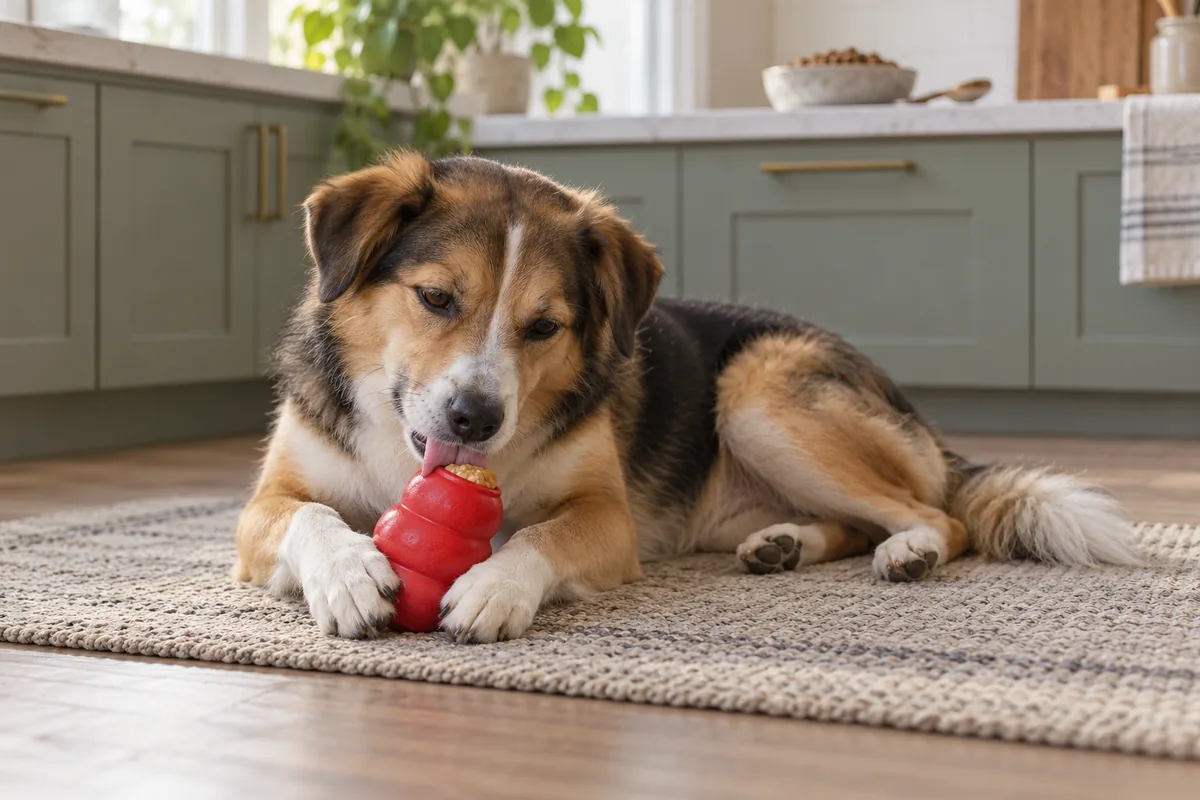
KONG Classic combines giving rubber with a stuffable cavity, offering many dogs an accessible food activity during calm practice.
Check price on AmazonWe earn a small commission if you buy through this link, at no extra cost to you. Disclosure
Choosing the right KONG
Choose by your dog's mouth size and chewing behavior, using the current product size chart. A toy small enough to fit entirely inside the mouth can become a choking or swallowing hazard.
- KONG Classic: red natural rubber with some give, suitable for many moderate chewers.
- KONG Extreme: black rubber intended for stronger chewers; a sensible alternative when Classic is not durable enough.
- KONG Puppy: softer rubber designed for puppy mouths and age-appropriate chewing.
No rubber toy is beyond destruction. Supervise new toys and inspect them before every use. If your dog bites pieces off, that particular toy is unsuitable for unattended use.
Avoid choosing a smaller toy just because its cavity holds the desired food portion. Use the correct toy size and fill it partly instead. Our Best Chew Toys for Aggressive Chewers guide covers durability and chewing styles.
Safe vs unsafe fillings
“OK” means potentially suitable in modest amounts for a dog who tolerates the ingredient. It does not override a prescribed diet or individual medical advice.
| Filling | OK? | Notes |
|---|---|---|
| Your dog's regular kibble | Yes | Set aside part of the normal meal |
| Your dog's usual wet food | Yes | Useful as a familiar binder |
| Kibble softened with water | Yes | Serve promptly or refrigerate |
| Plain pumpkin puree | Usually | Choose pumpkin only, not sweetened pie filling |
| Plain cooked carrot | Usually | Mash or chop finely; no seasoning |
| Mashed banana | Usually | Use a small amount |
| Plain cooked chicken | Usually | Boneless, skinless, unseasoned; avoid with chicken allergy |
| Plain unsweetened yogurt | Sometimes | Only if tolerated; check sweeteners and fat content |
| Peanut butter | Sometimes | Xylitol-free only; use sparingly because it is rich |
| Xylitol or birch sugar | Never | Toxic to dogs; inspect peanut butter and spread labels |
| Grapes or raisins | Never | Can cause serious poisoning |
| Onion or garlic | Never | Includes powders and seasoned leftovers |
| Chocolate or cocoa | Never | Toxic; keep desserts and spreads out |
| Macadamia nuts | Never | Unsafe for dogs |
| Cooked bones | Never | Can splinter, obstruct, or injure |
Swipe the table sideways to see every column.
The FDA warns that xylitol may also be called birch sugar or wood sugar. Suspected ingestion needs immediate veterinary advice, even before symptoms appear.
Go easy with fatty foods. Ask your vet before changing fillings if your dog has allergies, pancreatitis, weight concerns, digestive problems, or a special diet.
How to stuff a KONG in layers
KONG's stuffing guidance describes a small-opening plug, layered food, and a soft topping. Adapt the firmness to your dog's experience.
- Measure the food first. Set aside a portion of your dog's meal and choose one familiar extra, if appropriate. This prevents a stuffed toy from becoming an unplanned additional meal.
- Inspect the clean toy. Check the rubber, openings, and interior for damage or old food. Select an easy, unfrozen version for a beginner.
- Manage the small hole. If needed during preparation, lightly seal it with a small edible smear to reduce leakage. Avoid a hard, wedged plug. Clear the small opening before offering the toy; generic toys may have different instructions.
- Add a loose layer. Drop in some kibble so food comes out readily when the toy moves. Early success helps your dog understand the activity.
- Add a softer packed layer. Spoon in usual wet food or softened kibble. For beginners, press lightly rather than compressing it into a dense mass.
- Finish with an inviting plug. Add a thin topping of familiar wet food at the large opening. Keep it accessible instead of pushing every appealing ingredient deep inside.
- Serve and observe. Offer it on a washable mat while you remain nearby. Make the next version easier if your dog repeatedly gives up, becomes tense, or starts attacking the rubber.
Do not leave preparation tools inside the toy.
KONG difficulty levels
Difficulty comes from packing, texture, freezing, and access—not simply the amount of food.
| Level | How to stuff it | Good for |
|---|---|---|
| 1: Discover | Loose dry kibble with an accessible soft smear | Dogs learning how the toy works |
| 2: Easy mix | Loose kibble lightly mixed with familiar wet food | Beginners ready for gentle licking |
| 3: Soft layers | Alternate softened kibble and wet food without tight compression | Dogs who comfortably empty easier versions |
| 4: Lightly frozen | Partly freeze a familiar soft filling | Experienced dogs who enjoy a modest challenge |
| 5: Fully frozen | Freeze familiar layers thoroughly without overpacking | Confident users comfortable with frozen food |
Swipe the table sideways to see every column.
Move up only if your dog remains engaged without frustration. A nervous dog may benefit most from Level 1 or 2 indefinitely.
A lick mat can provide easier access when reaching inside a cavity is discouraging. Supervise it closely, particularly with dogs who chew silicone.
7 KONG recipes
Use your dog's own food as the main ingredient. Introduce extras individually so you can identify anything that causes digestive upset.
- Everyday meal mix Ingredients: regular kibble, a little water, and usual wet food. Soften some kibble and mix loosely, leaving dry pieces near the opening for an easy reward.
- Pumpkin meal layers Ingredients: regular food and a small amount of plain pumpkin puree. Alternate loose food with thin pumpkin layers; avoid a solid, tightly packed center.
- Carrot dinner Ingredients: usual wet food, kibble, and plain cooked mashed carrot. Stir the carrot through a meal portion and add an accessible wet-food topping.
- Chicken comfort Ingredients: regular food and a little plain cooked, finely shredded chicken. Distribute the chicken near accessible areas rather than burying it beneath difficult stuffing.
- Banana breakfast Ingredients: regular kibble, usual wet food, and a small smear of mashed banana. Use banana as a topping rather than filling the entire cavity.
- Yogurt meal swirl Ingredients: regular food and a little plain unsweetened yogurt, if tolerated. Stir through softly; skip yogurt if dairy causes loose stool or conflicts with your dog's diet.
- Peanut butter starter Ingredients: regular kibble, familiar wet food, and a thin smear of xylitol-free peanut butter. Keep the peanut butter modest and use it to introduce an otherwise familiar meal.
Any recipe can remain unfrozen. Novelty is optional; a dog who enjoys their ordinary food does not need a complicated menu.
Freezing a KONG
Start unfrozen so your dog learns that food is accessible. Once they comfortably empty it, try a lightly frozen version before a fully frozen one.
Allow a few hours in the freezer for a firm filling; larger toys and wetter recipes may need longer, sometimes overnight. There is no universal freezing time because food composition and freezer conditions differ.
Use a clean container to catch drips. Before serving, check the toy, remove any preparation aids, and clear the small opening.
If the frozen filling is too difficult, let it soften and make the next batch less dense. Do not add harder challenges merely to extend occupation.
Refrigerate or freeze prepared perishable fillings promptly. Discard food left sitting warm, and follow storage instructions for the ingredients used.
Using a KONG for alone time
First confirm your dog enjoys the toy while you are home and handles it safely. Then introduce it during a departure practice your dog already manages comfortably.
Give your dog space to engage without hovering. Watch on camera after leaving, including after the food runs out. A relaxed start does not establish comfort for the whole absence.
Keep offering the toy during non-departure rest periods too. Our Departure Cues guide explains how departure-related objects and routines can acquire emotional meaning.
Do not use a toy to justify a longer absence or replace a potty break. Arrange company when necessary absences exceed your dog's current tolerance.
For actual absence progression, follow our Separation Anxiety Training Plan rather than trying to make each recipe last longer.
If your dog won't touch the KONG when alone
Compare behavior before and after you leave. Does your dog stop licking immediately, carry the toy to the door, or only start eating when you return?
That pattern may indicate separation distress. It is useful information, not evidence that your dog is stubborn or that you need richer food.
Other explanations include fullness, an unfamiliar recipe, excessive difficulty, mouth pain, or general appetite loss. Try an easier familiar filling while home and consider the wider picture.
If refusal occurs with pacing, panting, drooling, whining, or exit scratching, shorten the absence and seek guidance. Do not respond by packing the toy more tightly or leaving your dog to struggle.
KONG log
Use the log to adjust enjoyment and safety, not to compete for the longest duration. These are examples, not expected results.
| Date | Recipe/level | How long it lasted | Next step |
|---|---|---|---|
| Example: Monday | Everyday meal mix, Level 1 | About 4 minutes while owner stayed home | Repeat; dog remained relaxed and emptied it |
| Example: Tuesday | Same recipe during brief departure | Stopped eating as owner left | Make absence easier; review camera footage |
Swipe the table sideways to see every column.
Also note damaged rubber, frustration, leftovers, or digestive changes.
Helpful products
Picks on this page are a research-based assessment of features and intended use — not hands-on testing. We earn a small commission if you buy through the Amazon links on this page, at no extra cost to you. Affiliate disclosure
| Product type | Why it helps | Notes |
|---|---|---|
| KONG Classic | Stuffable rubber offers a manageable food activity | Top pick for many moderate chewers; choose the correct size. Limitation: strong chewers can wear it down, and it must be the right size for your dog's mouth. Alternative: a KONG Extreme for power chewers. |
| KONG Extreme | Provides tougher rubber for stronger chewing | Still needs inspection; no toy withstands every dog. Limitation: the firmer rubber can be harder for some dogs to work, so start with easy fillings. Alternative: a KONG Classic for average chewers. |
| Lick mat: LUKITO lick mat | Offers easier access to spread food | Alternative for dogs who give up; supervise chewers. Limitation: strong chewers can damage it, so use it for short supervised sessions only. Alternative: a loosely stuffed KONG Classic. |
| Pet camera: Furbo 360° camera | Confirms whether eating continues after departure | Observation support, not anxiety treatment. Limitation: it shows you whether your dog eats when alone but does not train your dog; needs 2.4GHz Wi-Fi. Alternative: a spare phone or laptop on a free video call app. |
| Bottle brush: OXO Good Grips | Reaches food residue inside the cavity | Use a suitable size and rinse thoroughly. Limitation: it is a general bottle brush, not shaped for KONG toys, so it may miss the narrow end of small sizes. Alternative: an old toothbrush and a soak in warm soapy water. |
Swipe the table sideways to see every column.
Classic can wear down under strong chewing. Extreme is the alternative when greater durability is appropriate, but damaged toys still need replacement.
Cleaning and replacing
Wash after each food use. Soak to loosen residue, scrub the cavity and openings with a bottle brush, rinse, and dry thoroughly.
KONG states that most rubber toys can go on the dishwasher's top rack, but check your specific product's instructions. Other brands and attached materials may differ.
Replace the toy if rubber is missing, cracks deepen, openings tear, or the surface becomes sticky or degraded. Stop use if your dog can remove chunks.
Do not patch damaged rubber with glue or keep using a toy because most of it remains intact.
Mistakes to avoid
- Starting with tightly packed, fully frozen stuffing.
- Using rich extras instead of meal portions.
- Assuming all peanut butter is safe.
- Adding seasoned leftovers or cooked bones.
- Offering a new toy unattended immediately.
- Treating food refusal as a reason to prolong departure.
- Leaving perishable leftovers warm for later.
- Assuming a finished toy means an anxiety problem is resolved.
Keep the goal simple: a safe, enjoyable activity your dog can manage comfortably.
When to get extra help
Talk to your vet about sudden appetite changes, mouth discomfort, vomiting, diarrhea, or dietary restrictions.
Suspected toxic-food ingestion needs immediate veterinary advice. Trouble breathing, choking, or suspected swallowed rubber also requires urgent attention.
For panic during absences, involve your vet and a qualified separation anxiety professional. Food enrichment can support the plan, but cannot replace gradual training.
Bottom line
Stuff a correctly sized toy with familiar meal food, keep the first attempts easy, and add difficulty only when your dog enjoys it.
A stuffed KONG can make quiet time more pleasant. If your dog stops eating when you leave, use that observation to improve the absence plan rather than searching for a stronger distraction.