On this page
If your dog dismantles toys quickly, buying the hardest object available can seem sensible. Unfortunately, resistance to damage is only one part of safety. A chew that survives strong jaws may still put teeth at risk.
We are dog owners, not vets. These picks are a research-based assessment of materials, design, and limitations rather than our own product testing. The aim is an appropriate chewing outlet—not a promise that any toy will withstand every dog.
What makes a dog an aggressive chewer
“Aggressive chewer” usually describes chewing strength or persistence, not aggression toward people. A small dog can be a determined destroyer, while a large dog may carry toys gently.
A tough rubber toy becomes far more useful once it holds food. Our guide on how to stuff a KONG explains sizing, KONG Classic vs Extreme, and safe recipes for strong chewers.
Jaw size, individual behavior, age, and breed tendencies can influence how a dog uses objects. Puppies explore and chew during teething; adolescents may continue enthusiastic investigation.
Boredom, insufficient suitable activity, or frustration can increase interest in household items. Some dogs also chew during stress.
Those motivations need different responses. A dog peacefully gnawing a toy needs equipment suited to that behavior. A dog biting doors or crate bars while panicking needs an assessment and care plan, not simply tougher rubber.
For departure-related damage, see our dog destructive when left alone guide.
KONG Extreme Dog Toy
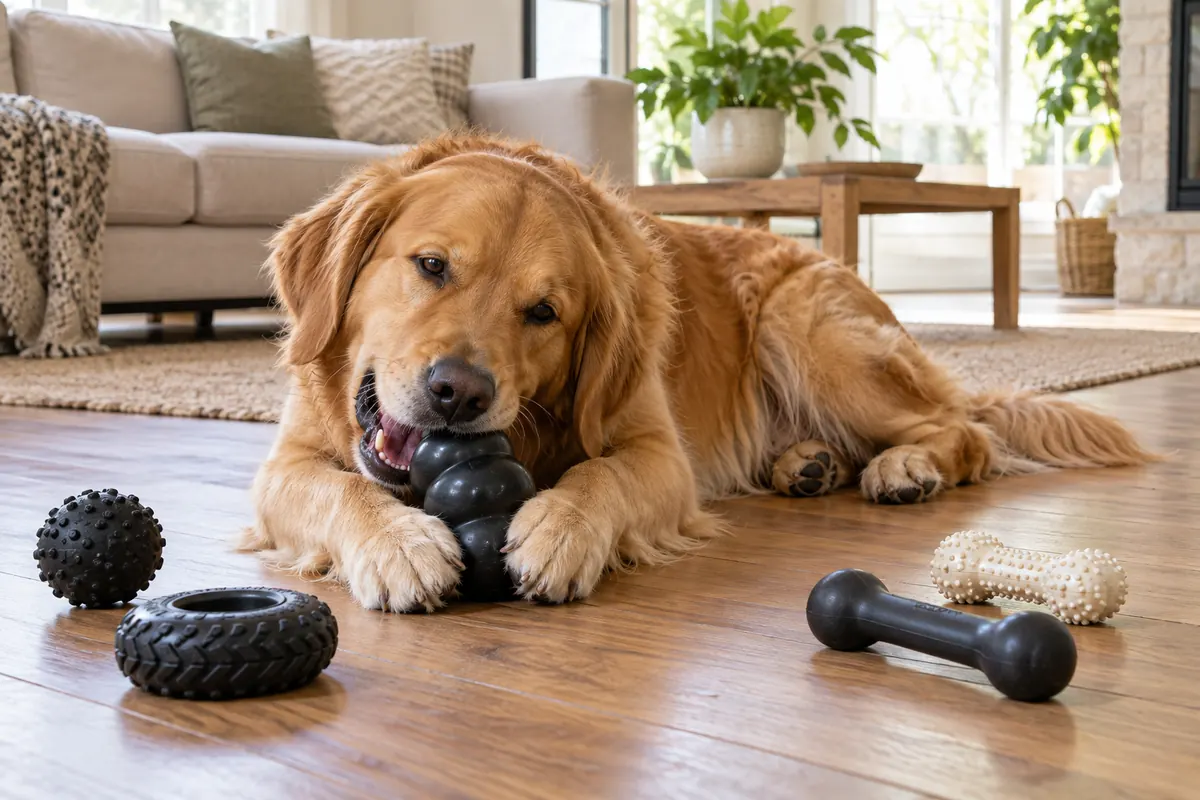
KONG Extreme combines durable natural rubber with some give and a stuffable design, offering many power chewers a practical starting option.
Check price on AmazonWe earn a small commission if you buy through this link, at no extra cost to you. Disclosure
Chew toy safety rules
Start with material that has some give. Firm natural rubber is a sensible first category for many power chewers, although individual products vary and rubber can still be torn apart.
Use the fingernail test as a rough screening tool: try pressing a thumbnail into the surface. A completely unyielding chew raises concern about dental hardness.
The kneecap test asks whether gently tapping the object against your kneecap would feel unpleasant. Do not strike yourself; this is a cautionary comparison, not a formal safety test.
Neither check proves a toy safe. Shape, jaw leverage, existing dental disease, and how the dog bites also matter.
Avoid antlers, bones, hooves, and hard nylon you cannot dent with a fingernail because of tooth-fracture concerns. Raw bones are not automatically safer than cooked bones.
Choose by mouth dimensions as well as weight. The toy must not fit wholly into the mouth or become small enough to swallow. Size up when needed, while preserving comfortable use.
Supervise new toys and inspect throughout use. No material label removes choking, tooth, or ingestion risks.
Chew toy material comparison
| Material | Good for | Watch out for |
|---|---|---|
| Natural rubber with some give | Gnawing, food stuffing, and appropriate chew enrichment | Thickness and formulation vary; determined dogs can remove chunks. |
| Nylon | Persistent gnawing in dogs for whom the specific product is appropriate | Many products are too hard under conservative dental-safety checks; wear can create rough edges or fragments. |
| Rubber-nylon combinations | Some interactive designs combining textures | Assess each component separately; a yielding outer section does not make a hard insert safe. |
| Flexible TPE, including Zogoflex-style materials | Chewing, carrying, and some food-enrichment formats | Flexibility and durability vary; shredders may still damage them. |
| Rope | Supervised interactive play for suitable dogs | Fibers and strands can be swallowed; unsuitable as an unattended shredding outlet. |
| Plush | Gentle carrying and supervised play | Seams, squeakers, fabric, and stuffing can become ingestion hazards. |
| Edible chews | A supervised food-based activity chosen for the individual dog | Hardness, calories, choking, large swallowed pieces, and dietary suitability vary. |
| Antlers, bones, and hooves | Not our choice for power-chewing sessions | Excessive hardness, fragments, and tooth-injury concerns outweigh durability appeal. |
Swipe the table sideways to see every column.
A product's category does not establish its safety. Compare the actual surface, size, construction, and your dog's behavior.
Which toy for which chewer
| Chewing style | What to look for | Avoid |
|---|---|---|
| Gnawer: works steadily on one area | Substantial yielding rubber, accessible shape, regular surface checks | Unyielding material chosen merely to resist wear. |
| Shredder: tears off fabric or edges | Smooth, substantial rubber without easy-to-grab attachments | Rope, plush, thin silicone, seams, and detachable pieces. |
| Crusher/destroyer: bites down forcefully | Large, thick rubber with some give and minimal protrusions | Brittle components, undersized toys, and very hard chews. |
| Food-focused manipulator | Easy-to-fill rubber toy with accessible food openings | Overly difficult fillings that prompt destructive biting or frustration. |
Swipe the table sideways to see every column.
Watch actual use rather than relying on a breed description. Your dog may use different styles with different shapes.
Chew toy safety checklist
Best Chew Toys for Aggressive Chewers: How to Choose Durable, Safe Toys: chew toy safety checklist
- Check that the toy cannot fit wholly into your dog's mouth.
- Assess surface give rather than selecting by toughness claims alone.
- Avoid excessively hard materials and ask your vet about dental concerns.
- Check openings, rings, and shapes for possible mouth or jaw entrapment.
- Supervise introduction and inspect during each chewing session.
- Remove toys with cracks, sharp edges, loose parts, or missing material.
- Keep smaller pets' toys away from dogs who could swallow them.
- Count food fillings within daily intake and use xylitol-free ingredients.
- Follow cleaning instructions and reassess safety as chewing behavior changes.
If your dog swallows material, contact your vet promptly. Do not wait for symptoms to determine whether a missing piece matters.
Our picks for power chewers
Picks on this page are a research-based assessment of features and intended use — not hands-on testing. We earn a small commission if you buy through the Amazon links on this page, at no extra cost to you. Affiliate disclosure
| Product | Best for | Limitation | Alternative |
|---|---|---|---|
| KONG Extreme black rubber toy | Many power chewers needing a substantial, stuffable rubber option | Some dogs still destroy it; sizing and supervision remain essential. | Appropriately sized West Paw Zogoflex Hurley or Tux. |
| Classic red KONG | Moderate chewers who enjoy food stuffing and rubber chewing | May be too easily damaged by a determined power chewer. | Correctly sized KONG Extreme. |
| Benebone wishbone-style nylon chew | A design some steady gnawers can hold easily, subject to dental suitability | Hard nylon may fail the fingernail test; not our default choice for forceful crushers. | Yielding natural-rubber chew. |
| Nylabone Power Chew | Owners assessing a specific nylon product with their dog's dental needs in mind | Hardness and worn edges require caution; non-edible pieces should not be swallowed. | Appropriately sized rubber chew. |
| West Paw Zogoflex Hurley/Tux | Dogs suited to flexible chew or food-enrichment designs | Shredders can still damage them; individual models have different uses. | KONG Extreme with suitable sizing. |
| Goughnuts-style ring with safety indicator | Supervised chewing where a substantial ring shape suits the dog | Not every model has an indicator; it does not detect every hazard. | Substantial, appropriately sized stuffable rubber toy. |
Swipe the table sideways to see every column.
KONG Extreme is our top pick because it combines durable natural rubber with some give and food-enrichment potential. That is an editorial starting choice, not evidence that it is safest for every dog.
Hurley and Tux offer alternative shapes in West Paw's Zogoflex material; selected models float. Choose the specific model for its intended use rather than assuming all flexible toys have identical toughness.
The nylon products are included because owners commonly compare them with rubber. Inclusion is not a blanket recommendation: if a particular chew is unyielding, choose a more forgiving alternative.
For indicator rings, verify the exact listing. Remove the toy immediately if its warning layer appears, and still inspect for other damage before that happens.
How to make chew toys last
Rotate a small number of suitable toys instead of leaving every option available continuously. Rotation can maintain interest, but never return damaged equipment to use.
Stuffing can shift activity toward licking and food access rather than relentless surface destruction. Begin with an easy filling so your dog does not become frustrated.
Where the manufacturer permits it, freezing suitable food inside a rubber toy can extend the activity. Start with a manageable amount and allow softening if your dog struggles or bites aggressively at inaccessible food.
Freezing does not improve damaged rubber or make unsuitable equipment safe. Keep openings clear as directed and never leave filling accessories in place unless intended for the dog's use.
Clean food residue thoroughly after each use and dry according to instructions. Follow the specific product's dishwasher guidance rather than assuming every rubber toy tolerates the same treatment.
Provide appropriate exercise, sniffing, training, and rest too. For broader activity ideas, see our enrichment for anxious dogs guide.
When to replace a chew toy
Best Chew Toys for Aggressive Chewers: How to Choose Durable, Safe Toys: when to replace a chew toy
- Cracks or splits appear, including around food openings.
- Pieces are missing or can be pulled away from the surface.
- Sharp edges, substantial gouges, or projecting fragments develop.
- Wear makes the toy small enough to fit wholly inside the mouth.
- Internal parts or a model's warning indicator become visible.
- The surface becomes brittle, unusually sticky, or otherwise changes.
- Your dog changes from comfortable gnawing to tearing off material.
There is no universal safe wear allowance. Follow the manufacturer's replacement instructions and take a conservative approach when uncertain.
Tiny surface marks differ from chunks detaching, but do not assume fragments are harmless because they are small. Stop use and seek advice if you cannot judge the damage.
Mistakes to avoid
Do not equate hardness with quality. A very hard object can transfer force to teeth instead of yielding under a bite.
Avoid relying on labels such as “indestructible,” a replacement policy, or a safety indicator as proof of safety. No toy is truly indestructible, and a replacement cannot undo an injury.
Do not buy a smaller size to save money or make food harder to obtain. Reassess mouth fit as puppies grow and toys wear down.
Avoid unsupervised rope or plush shredding for dogs who swallow material. “They have always passed it before” is not a reliable safety assessment.
Do not forcibly grab toys from a guarding dog. Use a safe management plan and qualified help rather than repeatedly testing the response.
Finally, do not assume an intact chew solves alone-time anxiety. Eating can delay visible distress, and some frightened dogs will ignore food entirely.
When chewing may signal a problem
Arrange veterinary advice for sudden changes in chewing, difficulty eating, mouth bleeding, broken teeth, drooling, or signs of pain. Do not continue offering harder objects to a dog whose chewing seems uncomfortable.
Repeated swallowing of nonfood material also needs assessment. Vomiting, appetite loss, abdominal discomfort, or unusual lethargy after possible ingestion warrants prompt veterinary attention.
Chewing mainly around departures—particularly exit damage with pacing, howling, drooling, or escape attempts—may involve separation distress. A tougher toy is not an adequate response to panic.
Seek a certified trainer using reward-based methods for management and skill-building. Severe fear, guarding, or separation problems may require a veterinary behaviorist.
A suitable toy supports a comfortable routine. It cannot replace healthcare, companionship, or gradual training.
Bottom line
For many power chewers, appropriately sized rubber with some give is a sensible starting category. KONG Extreme is our top pick within that approach, with flexible alternatives worth considering according to chewing style.
Avoid excessive hardness, supervise, and replace worn equipment promptly. Durability matters only when the toy also suits your dog's teeth, mouth, behavior, and safety needs.