On this page
Coming home to a chewed doorframe or shredded cushion is upsetting—and potentially dangerous for your dog. Before deciding how to protect the furniture, check your dog's safety and investigate what happened while you were away.
We are dog owners, not vets. This guide focuses on destruction during absences rather than every chewing problem. Our product suggestions reflect intended uses and limitations; we have not tested these products ourselves.
Why dogs get destructive when left alone
Chewing is normal behavior. Puppies explore with their mouths and may seek chewing opportunities while teething. An inexperienced young dog may not yet understand which household items are appropriate.
If the damage is mostly at the door you left through, read our guide to dog scratching the door when left alone: a distress-or-boredom table, a safer set-up away from the exit and a 5-step plan.
Chewing at 8 to 10 months can be a second chewing phase. Our guide to separation anxiety in adolescent dogs shows how to tell it apart from separation distress.
Is most of the damage at doors, windows or the crate? That often points to escape attempts rather than boredom. See our guide on dog escaping the crate or room when left alone for a panic-or-boredom table and a safe room checklist.
Broken teeth or nails, bleeding paws or a damaged window or door frame mean your dog may be panicking, not misbehaving. See our separation anxiety red flags and when to call the vet.
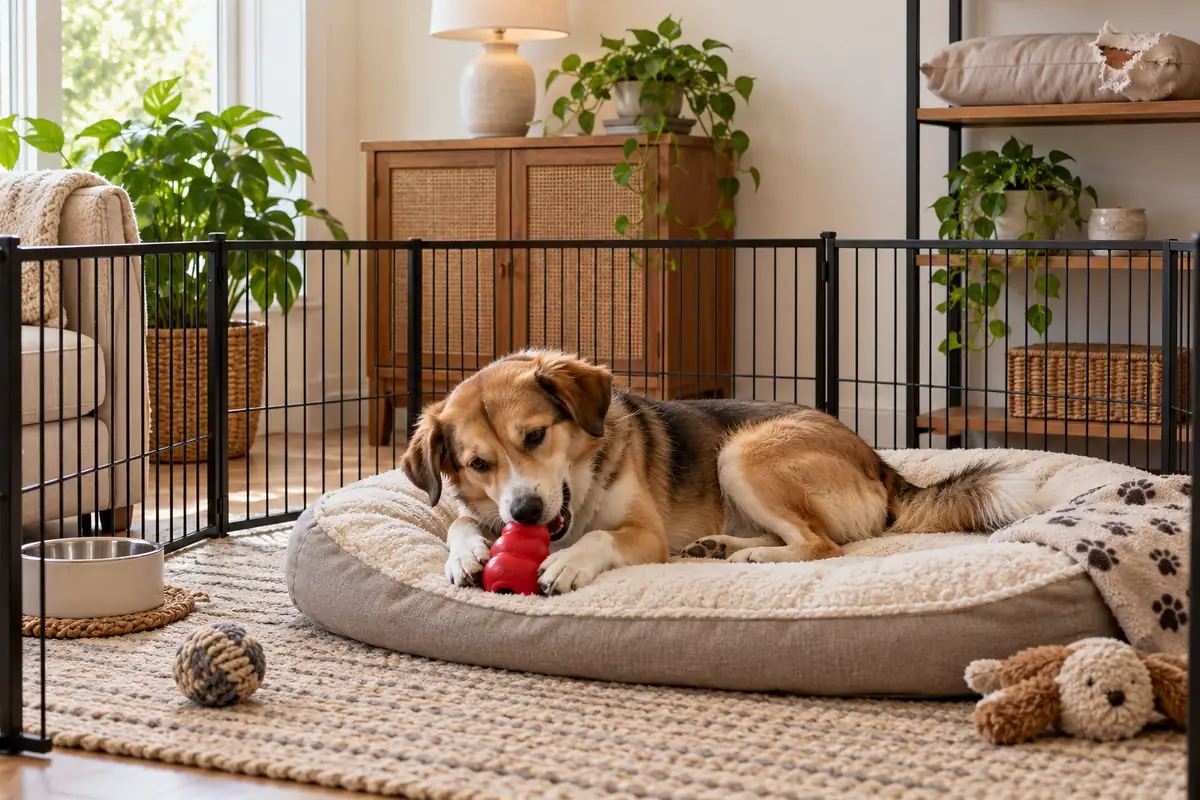
Giving your dog a legal thing to chew and lick when you leave can take some pressure off your furniture. See our guide on how to stuff a KONG for safe fillings, layering and what it means if your dog ignores it when alone.
If your dog shreds ordinary toys in minutes, our guide to the best chew toys for aggressive chewers explains how to choose by size, material and chewing style, and which hard chews to avoid because of tooth fracture risk.
Boredom or unmet needs can also contribute. A dog without suitable activity may find cushions, packaging, or furniture interesting.
Separation-related distress is different. A frightened dog may chew doors, scratch windows, or bite crate bars while attempting to regain access to people or escape confinement.
Outside triggers matter too. A delivery, construction noise, or passing animal may produce a reaction during an otherwise manageable absence.
Pain or illness can change behavior and restlessness, particularly when destruction begins suddenly.
Do not interpret damage as spite. A lowered head or withdrawn posture when you return does not prove guilt about earlier chewing; your dog may be responding to your current behavior or anticipating an unpleasant interaction.
KONG Classic Stuffable Dog Toy
A suitably sized stuffable toy offers an appropriate food-and-chewing activity during manageable departures, but cannot resolve panic or replace care.
Check price on AmazonWe earn a small commission if you buy through this link, at no extra cost to you. Disclosure
What the damage may mean
| What you find | What it may mean | First step |
|---|---|---|
| Chewed doorframe or scratched exit | Separation distress, confinement difficulty, or another exit-related trigger | Check injuries and review departure footage. |
| Bent crate bars or damaged latches | Forceful escape attempts and a significant safety concern | Stop unsafe crating and arrange assessment. |
| Shredded cushions with otherwise relaxed behavior | Exploratory chewing, boredom, or an established activity | Remove access and provide appropriate supervised chewing practice. |
| Torn blinds or damage beside a window | Reaction to outside activity, escape attempts, or both | Reduce the view and investigate the surrounding behavior. |
| Chewed laundry, socks, or missing fabric | Access to tempting objects with possible ingestion | Contact your vet if swallowing is suspected. |
| Scattered trash or damaged food packaging | Scavenging or food seeking | Check for toxic contents and secure waste. |
| Newly damaged objects alongside restlessness or appetite changes | Health or environmental changes may contribute | Arrange veterinary advice before treating it only as training. |
Swipe the table sideways to see every column.
Location provides clues, not a diagnosis. A damaged door alone cannot tell you whether the trigger was departure, confinement, or a frightening sound.
For a broader comparison, see our separation anxiety signs guide, Separation Anxiety or Boredom? 10 Signs.
Safety check first
Before cleaning, locate your dog and look for bleeding, limping, damaged nails, mouth injuries, or difficulty breathing. Do not force open a painful mouth or put your hands near a distressed dog's teeth.
Broken teeth, bloody paws, or injured nails need prompt veterinary attention. Collapse, breathing difficulty, or serious bleeding requires emergency care.
Check what is missing as well as what is damaged. Fabric, foam, rubber, batteries, medication packaging, and sharp fragments can create ingestion risks. Contact your vet promptly when swallowing or poisoning is suspected; do not wait for obvious illness.
Cornell's guidance on gastrointestinal foreign-body obstruction describes signs including vomiting, appetite loss, abdominal pain, and lethargy. An apparently normal dog may still need advice after suspected ingestion.
If an electrical cord is damaged, keep everyone away from exposed wiring and disconnect power safely before approaching. Seek veterinary advice for possible electrical contact, even if external injury seems minor.
Do not induce vomiting or give home remedies unless a veterinary professional directs you.
Dog-proofing checklist before you leave
Dog Destructive When Left Alone? Causes and a Humane Plan: dog-proofing checklist before you leave
- Remove laundry, socks, shoes, children's toys, and other swallowable objects.
- Secure trash, food, medications, cleaning products, and batteries.
- Route cords beyond reach and prevent access to electrical equipment.
- Remove damaged toys, loose stuffing, and bedding your dog shreds.
- Check doors, windows, blind cords, gates, and pen connections.
- Provide fresh water, comfortable temperature, and an accessible resting place.
- Offer toileting, suitable exercise, sniffing, and time to settle beforehand.
- Leave only familiar enrichment appropriate to your dog's chewing behavior.
- Check the camera view and confirm any caregiver arrangements.
A dog-proofed room must also be emotionally tolerable. Removing hazards does not make it suitable if your dog panics behind the door.
Crate, pen or dog-proofed room?
A crate may help manage access for a dog who already enters voluntarily and rests comfortably with the door closed. It should allow natural standing, turning, sitting, and comfortable lying.
Remove collars, tags, and harnesses before crating because they can snag. Never use a crate to force a dog through panic.
A pen offers more movement space, but check climbing, jumping, pushing, and chewing while you are present. A barrier that increases frustration or escape attempts is not a useful solution.
A familiar dog-proofed room may suit a dog who dislikes close confinement. However, some dogs struggle with any closed boundary and need company while a plan develops.
Heavy-duty crates are only a possible equipment choice for dogs already comfortable with crating. Bent wire, frantic bar chewing, or injuries are reasons to stop and seek help, not simply upgrade the enclosure.
See our crates for anxious dogs guide for a fuller comparison.
Alone-time plan
These stages lead toward a workable daily arrangement, not a promise that every dog can spend a normal workday alone. Progress according to behavior.
- Identify the starting problem. Review recordings and note when destruction begins, what precedes it, and whether relaxed rest occurs. Arrange veterinary assessment for injuries, physical changes, or panic.
- Meet needs and manage hazards. Offer appropriate exercise, sniffing, toileting, and a calm recovery period. Choose a safe resting area your dog already tolerates rather than introducing unfamiliar confinement at departure.
- Practice relaxed nearby independence. Reward comfortable resting while you remain in the room. Stand or move a small distance away, beginning with seconds rather than demanding a prolonged stay.
- Add brief out-of-sight moments. Step around a doorway and return before worry. Reduce distance or duration if your dog becomes tense, repeatedly follows, or cannot resume resting.
- Make departure cues manageable. Pick up keys or put on shoes, then continue ordinary activity. Practice mild versions without repeatedly triggering vigilance or frantic following.
- Try very short actual absences. Start recording and step outside briefly, staying close enough to return promptly. Use familiar enrichment if appropriate, but watch what happens when it finishes.
- Build comfortable duration gradually. Mix easy repetitions with modest increases toward minutes and longer periods only when behavior supports it. If distress occurs, make future practice easier rather than waiting for exhaustion or silence.
- Build a supported workday. Arrange a sitter, walker, trusted caregiver, or other suitable company whenever necessary absences exceed current comfort. Longer work periods may require extended companionship rather than one brief visit.
For a full departure-training framework, read our separation anxiety guide. If vocalizing accompanies damage, our dog barking when left alone guide can help you examine that pattern.
Make departures and returns boring
“Boring” means predictable and low pressure, not withholding affection.
Prepare food enrichment calmly and introduce it during ordinary home time too. Otherwise, a special toy may become a reliable warning that you are about to disappear.
Offer a familiar stuffable toy during a manageable departure if your dog uses it safely. For some dogs, the opening minutes are difficult, but distress can also begin later.
Keep greetings comfortable and ordinary. Allow contact if your dog wants it, then provide a toilet opportunity and return to routine.
If you also find urine or stool when you get home, see our guide to a dog peeing or pooping when left alone for what the accident may mean, how to clean it so the smell does not draw your dog back, and when to see the vet.
You do not need to ignore a frightened dog on return. The priority is reducing future difficulty rather than enforcing an emotional distance.
When you come home to damage
Pause before reacting. Secure your dog away from sharp pieces or exposed hazards, assess safety, and arrange care if needed.
Clean up calmly. Do not show the damaged object to your dog, scold, or bring them back to the scene.
Take photographs and save camera footage if useful. Note what was damaged, whether pieces are missing, and any accompanying physical signs.
Then adjust the next absence. That may mean removing access, providing suitable activity, shortening separation, or arranging a caregiver.
Repeated damage is information that the current arrangement needs changing. It is not evidence that your dog needs a more frightening consequence.
Helpful products
Picks on this page are a research-based assessment of features and intended use — not hands-on testing. We earn a small commission if you buy through the Amazon links on this page, at no extra cost to you. Affiliate disclosure
| Product type | Why it helps | Notes |
|---|---|---|
| Durable stuffable chew toy like a KONG: KONG Classic | Offers an appropriate food-and-chewing activity during manageable departures. | Our top pick; size correctly, supervise initially, and choose an extra-tough version when appropriate. Power chewers: KONG Extreme. Limitation: some anxious dogs ignore food when they panic, and power chewers need the extra-tough version. Alternative: a lick mat or frozen food bowl. |
| Lick mat: LUKITO lick mat 2-pack | Provides accessible licking with suitable food. | Alternative for supervised use; remove if shredded and use xylitol-free ingredients. Alternative: a stuffed KONG Classic. |
| Frozen food bowl | Offers another manageable food activity in a sturdy container. | Use suitable food and equipment; begin easy and supervise introduction. |
| Snuffle mat: AWOOF snuffle mat | Adds scent searching before departure. | Supervised only; remove if fabric is chewed or swallowed. Alternative: a stuffed KONG for time alone. |
| Exercise pen or baby gate: MidWest exercise pen | Manages access to a familiar dog-proofed area. | Suitable only when barriers are tolerated; check stability and climbing. Alternative: a baby gate across a dog-proofed room. |
| Pet camera: Furbo 360° camera | Shows when destruction begins and the behavior around it. | Secure cables; recordings support assessment, not diagnosis. Limitation: it shows you when the trouble starts but does not calm your dog; needs 2.4GHz Wi-Fi. Alternative: a laptop or old phone video call. |
| Heavy-duty crate | May address equipment needs for a dog already comfortable with crating. | Never use stronger confinement to contain panic. See our crates and pens guide; we do not link a crate product. Alternative: a dog-proofed room or exercise pen. |
| Optional pheromone diffuser: ThunderEase diffuser | May provide background support in a familiar room. | Evidence is mixed; combine with care and training. Alternative: a predictable routine and a quiet resting room. |
Swipe the table sideways to see every column.
A stuffable toy has limits: some distressed dogs ignore food, while others eat and then panic afterward. Power chewers may damage even durable toys, so inspection and individual safety assessment remain necessary.
Mistakes to avoid
Do not punish, use shock or spray devices, or rely on bark collars. Reduced vocalizing would not establish reduced distress or stop every destructive behavior.
Bitter spray is not a complete plan. It does not meet chewing needs, teach comfortable separation, or address fear.
Avoid leaving longer to see whether your dog eventually settles. Repeated panic and escape attempts can create injury risks.
Do not assume more intense exercise fixes separation anxiety. Appropriate activity matters, but an exhausted dog can still be frightened.
Avoid choosing harder food puzzles simply to occupy your dog longer. Frustration and inaccessible food are not useful substitutes for achievable enrichment.
Finally, do not use a camera to watch a dangerous situation continue. Monitoring needs a response plan.
When to get extra help
Dog Destructive When Left Alone? Causes and a Humane Plan: when to get extra help
- Your dog has broken teeth, damaged nails, bloody paws, or other injuries.
- Material is missing and swallowing or poisoning is possible.
- Exit damage occurs alongside pacing, drooling, panting, or persistent vocalizing.
- Confinement triggers frantic biting, digging, or forceful escape attempts.
- Destruction begins suddenly with appetite, toileting, movement, or sleep changes.
- You cannot find a comfortable starting point for separation practice.
- Necessary absences exceed what your current care arrangements can safely cover.
Start with your vet for health concerns or panic. Ask about anti-anxiety medication when appropriate; any prescription plan should come from your vet and support, rather than replace, behavioral care.
A certified trainer using reward-based methods can help with skills and management. Severe fear, aggression, or complex separation distress may require a veterinary behaviorist.
Bottom line
Destruction while alone can reflect normal chewing, unmet needs, outside triggers, confinement difficulty, or separation distress. The pattern matters more than the cost or location of the damage alone.
Check safety first, use a tolerated managed space, provide appropriate enrichment, and build absences gradually. Panic and injuries call for help—not punishment or stronger bars.