On this page
- How each one works
- Side-by-side comparison
- Which one for your dog?
- Lick mats: best for settling
- Snuffle mats: best for sniffing and mental energy
- Puzzle feeders: best for confident problem-solvers
- Safety first
- Getting started checklist
- A 7-day enrichment rotation
- Helpful products
- Mistakes to avoid
- When enrichment is not enough
- Bottom line
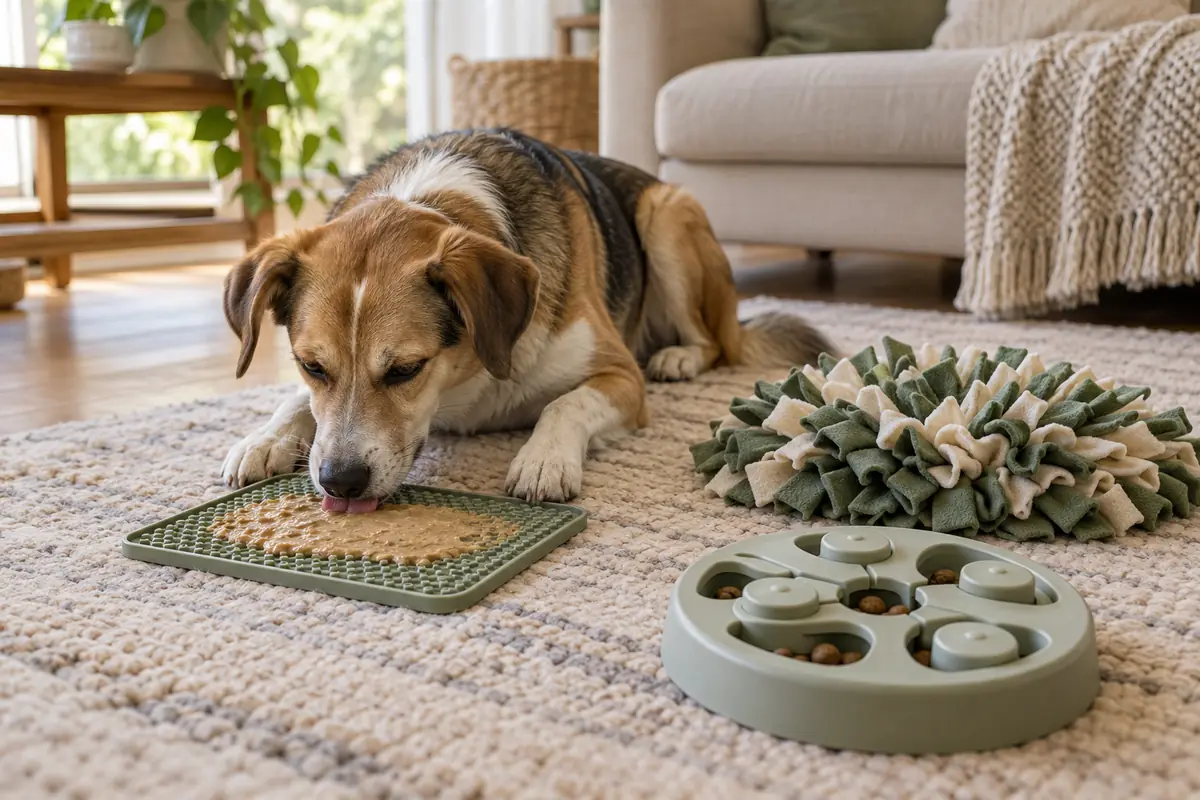
Your dog needs something to do, but the choices look similar: textured silicone, folded fabric, or a puzzle covered in sliding pieces. The best choice depends on whether your dog wants to lick, search, or solve—and whether the task feels comfortable.
We are dog owners, not vets, and these picks are a research-based assessment rather than our own product testing. This head-to-head guide focuses on choosing between tools. For broader feeding advice, see our slow feeders and lick mats guide.
How each one works
A lick mat holds a thin layer of suitable soft food across a textured surface. Your dog removes it through repeated licking, with little equipment manipulation.
If your dog likes licking and chewing, a stuffed rubber toy sits somewhere between a lick mat and a puzzle feeder. Our guide on how to stuff a KONG walks through layering, freezing and seven simple recipes.
A snuffle mat hides dry food among fabric folds. It encourages nose-led searching, turning part of a meal into a manageable foraging activity.
A puzzle feeder requires actions such as nudging a slider, lifting a cover, or moving an object to release food. Designs range from straightforward to demanding.
The categories overlap. A stuffable rubber toy can provide licking and problem-solving, while a slow feeder mainly changes food access.
If your dog chews through mats and feeders, a durable rubber toy may be the safer starting point. Our guide to the best chew toys for aggressive chewers compares materials and explains how to size a toy so it cannot be swallowed.
Think about the experience rather than the marketing label. A dog who calmly searches is getting something different from one frantically pawing at inaccessible food.
LUKITO Lick Mat with Suction Cups (2-pack)
A lick mat offers an easy start and repetitive licking that some dogs find soothing; supervise because silicone can tear.
Check price on AmazonWe earn a small commission if you buy through this link, at no extra cost to you. Disclosure
Side-by-side comparison
| Feature | Lick mat | Snuffle mat | Puzzle feeder |
|---|---|---|---|
| Best for | Accessible licking and settling | Nose-led searching and foraging | Confident food-motivated problem-solving |
| Calming vs thinking | Repetitive activity some dogs find soothing | Searching that can provide manageable mental engagement | More deliberate manipulation; may increase excitement |
| Starting difficulty | Thin spread on shallow texture | Visible food on top of loose folds | Open compartments or partially moved covers |
| Building difficulty | Slightly deeper texture or permitted chilling | Gradually hide food farther into folds | Introduce one simple action at a time |
| Mess | Smears and saliva; surface protection may help | Crumbs caught in fabric | Food and saliva around compartments |
| Cleaning | Scrub grooves, edges, and suction cups | Remove crumbs, then wash and dry as directed | Open permitted components and clean recesses |
| Chewer safety | Silicone can tear and be swallowed | Fabric strips or backing can be ingested | Plastic pieces or removable parts may be damaged |
| Supervision | Especially important for biting or folding | Essential for fabric chewers | Needed for unfamiliar mechanisms and loose parts |
| Good first choice for | A cautious dog who enjoys soft food | A dog who already enjoys sniffing | A comfortable dog who enjoys manipulating objects |
| Main limitation | Not a substitute for reducing fear | Can become a shredding activity | Excess difficulty can create frustration |
Swipe the table sideways to see every column.
No format is inherently calming for every dog. Comfortable engagement and the ability to rest afterward matter more than session length.
Which one for your dog?
| If your dog... | Start with | Why |
|---|---|---|
| Needs an easy activity during a quiet wind-down | Simple lick mat | Requires little problem-solving and offers repetitive licking. |
| Is noise-sensitive but can still engage comfortably | Familiar easy lick mat in a safe retreat | Provides a pleasant focus without demanding much effort. |
| Struggles with separation | A familiar supervised activity alongside a behavior plan | Tool choice is secondary to keeping absences manageable. |
| Has energy after an appropriate walk | Easy snuffle mat | Adds scent work rather than more high-arousal movement. |
| Is confident and food-motivated | Beginner puzzle feeder | Offers achievable manipulation and learning. |
| Is a senior with movement limitations | Accessible lick mat or shallow puzzle | Can reduce bending or vigorous movement when positioned comfortably. |
| Is a young puppy | Easy, age-appropriate lick or search activity | Builds confidence without requiring complex actions. |
| Gulps meals | Suitable slow feeder bowl | Directly targets rapid food access rather than adding unrelated difficulty. |
| Shreds flexible materials | Suitably sized stuffable rubber toy | May be sturdier, although supervision and inspection remain necessary. |
Swipe the table sideways to see every column.
Lick mats: best for settling
A simple silicone lick mat is our top pick as a starting option for many anxious dogs. A thin spread is easy to understand, and repetitive licking can be soothing for some individuals.
It may fit grooming preparation, bath-time practice, a quiet storm retreat, or preparation for veterinary visits. Introduce it during calm periods first.
Food does not make uncomfortable handling acceptable. Pause grooming or other activity if your dog becomes tense, even if they continue licking. Follow your clinic's instructions if food must be restricted before an appointment.
Start with familiar wet food spread thinly over shallow texture. Avoid tightly packed grooves or freezing immediately; both can make access harder.
The limitation is material safety. A dog who bites and folds silicone may tear it. A suitably sized stuffed KONG can be an alternative, but no rubber toy is indestructible.
Snuffle mats: best for sniffing and mental energy
Snuffle mats use natural searching behavior to make food interesting. They can fit after a walk or before an already manageable period of alone time.
They provide mental engagement, but do not replace physical activity, rest, or companionship. There is no dependable conversion between sniffing time and exercise.
Begin by scattering some of the usual dry food visibly across the top. Once searching is comfortable, tuck pieces loosely between folds.
Do not hide everything deeply on the first attempt. If your dog shakes the mat, grabs fabric, or gives up, simplify or choose another activity.
Remove crumbs after use and wash according to the label, allowing the mat to dry fully. Wet food usually makes fabric cleaning less practical.
Puzzle feeders: best for confident problem-solvers
A beginner puzzle can suit a comfortable, curious dog who enjoys using their nose or paws. It is not automatically the best choice for a highly intelligent breed or energetic dog.
For a worried or newly arrived dog, complicated mechanisms may add frustration. Begin with open compartments and clearly accessible food.
Introduce one action at a time. For example, leave a slider partly open before expecting your dog to move it independently.
“Level 1” and “level 2” are manufacturer descriptions, not universal standards. Examine actual mechanisms and removable parts.
Stop if your dog starts biting the whole board, repeatedly slamming it, freezing, or guarding access. Progress means comfortable participation, not completing the most difficult configuration.
Safety first
Supervise new activities and continue supervision where material or behavior requires it. Fabric, silicone, and plastic can all become ingestion hazards.
Inspect seams, backing, edges, suction cups, and moving parts. Discard equipment that is shredded or damaged, and contact your vet promptly if swallowing material is suspected.
Use suitable food and include it in daily calories. Your dog's regular diet can often provide enrichment without adding rich extras.
Check peanut butter labels for xylitol, which is toxic to dogs. Do not assume a familiar brand's ingredients remain unchanged.
Feed dogs separately when competition is possible. If guarding appears, stop approaching or reaching for the item; use space and seek qualified help rather than testing the response.
Wash after use. Follow dishwasher instructions for the exact product, scrub trapped residue, and dry thoroughly.
Getting started checklist
Lick Mat vs Snuffle Mat vs Puzzle Feeder: Which Calms an Anxious Dog?: getting started checklist
- Choose one tool that matches your dog's current interests and chewing behavior.
- Check size, materials, removable components, and cleaning instructions.
- Use familiar food counted within the daily allowance.
- Begin in a quiet location with nonslip footing and no competition.
- Make the first food easy to see or access.
- Supervise without hovering or repeatedly reaching toward the activity.
- Stop if biting, frustration, tension, or guarding replaces comfortable engagement.
- Inspect, clean, and dry equipment after the session.
- Record how your dog settles afterward, not merely how long eating takes.
You do not need all three formats. Start with one, then add another only if it offers a useful, enjoyable alternative.
A 7-day enrichment rotation
This is a sample introduction, not a requirement to use equipment daily or increase difficulty on schedule. Repeat easy days whenever needed.
- Day one: Try easy licking. Offer a thin smear of familiar food on a shallow lick mat while you remain nearby. Note posture, access, and whether your dog licks rather than chews.
- Day two: Repeat the comfortable option. Use the same easy setup during a quiet wind-down. Avoid pairing it with grooming, separation, or another challenge yet.
- Day three: Introduce visible searching. If fabric is appropriate, scatter dry food across the top of a snuffle mat. Let your dog investigate without hiding food deeply.
- Day four: Choose by preference. Repeat whichever activity produced relaxed engagement. A gentle sniff walk followed by easy searching may suit one dog; another may prefer licking and rest.
- Day five: Offer an open beginner puzzle. Make food accessible without requiring a new mechanism. If your dog remains comfortable, demonstrate one small action; otherwise return to the preferred tool.
- Day six: Rotate two suitable options. Use one activity at a time rather than presenting a demanding assortment. Keep portions modest and allow ordinary meals and uninterrupted rest.
- Day seven: Review the fit. Compare enjoyment, frustration, chewing, cleanup, and recovery. Keep the useful pair, simplify difficult tasks, and discard the idea that every dog needs a puzzle challenge.
Only later consider familiar enrichment during training situations. For separation practice, the absence must remain comfortable independently of how much food the tool holds.
Helpful products
Picks on this page are a research-based assessment of features and intended use — not hands-on testing. We earn a small commission if you buy through the Amazon links on this page, at no extra cost to you. Affiliate disclosure
| Product type | Why it helps | Notes |
|---|---|---|
| Silicone lick mat with suction cups: LUKITO lick mat 2-pack | Provides accessible repetitive licking that may support settling. | Our top pick for an easy start; supervise because silicone can tear. Alternative: a stuffed KONG Classic. |
| Snuffle mat: AWOOF snuffle mat | Encourages nose-led searching through part of a meal. | Start with visible food; unsuitable for fabric ingestion. Alternative: scatter kibble on clean grass or a towel. |
| Beginner puzzle feeder, level 1–2: Outward Hound Nina Ottosson Dog Brick | Offers manageable manipulation for a confident problem-solver. | Levels vary; start with open compartments and inspect loose parts. Limitation: the Dog Brick is rated Level 2 and can frustrate a new or very anxious dog, so start with the bone covers off. Alternative: a snuffle mat. |
| KONG Classic | Offers a sturdier stuffable alternative to flexible mats. | Match size and chewing strength; supervise and remove damage. Alternative: a lick mat for dogs who prefer licking. |
| Slow feeder bowl: Outward Hound Fun Feeder Slo Bowl | Slows access for dogs who gulp regular meals. | Choose accessible channels; not a solution for medically driven gulping. Alternative: a snuffle mat or scatter feeding. |
| Optional pheromone diffuser: ThunderEase diffuser | May provide additional background support. | Evidence is mixed; it does not replace training or appropriate care. Alternative: a predictable routine, enrichment, and a quiet resting room. |
Swipe the table sideways to see every column.
For broader context, read our enrichment for anxiety guide. Our slow feeders and lick mats guide covers feeding routines, while the separation anxiety guide addresses departure-related distress.
Mistakes to avoid
Do not assume harder means better. A successful activity should offer achievable access rather than force persistence.
Avoid freezing every filling from the start. Increased duration is not useful if the dog becomes frustrated or bites at the equipment.
Do not introduce a new tool immediately before leaving for work. Safe use and emotional comfort both require observation.
Avoid combining enrichment with exposure your dog already fears, then interpreting continued eating as permission to continue.
Finally, do not replace balanced nutrition or needed companionship with elaborate treats. Enrichment belongs within the routine, not in place of it.
When enrichment is not enough
Lick Mat vs Snuffle Mat vs Puzzle Feeder: Which Calms an Anxious Dog?: when enrichment is not enough
- Departures trigger panic, persistent vocalizing, or forceful escape attempts.
- Your dog cannot settle after the food ends.
- Fear prevents normal eating, sleeping, or use of familiar spaces.
- Repetitive behavior continues outside food activities.
- Guarding or snapping makes feeding interactions unsafe.
- Material swallowing, dental discomfort, or other physical symptoms appears.
- You cannot find an enjoyable, manageable starting activity.
Start with your vet for physical symptoms or significant changes. A qualified, reward-based behavior professional or veterinary behaviorist can help with recurring fear, guarding, or separation distress.
Do not keep escalating food value or puzzle complexity while the underlying problem worsens.
Bottom line
Choose a lick mat for accessible settling, a snuffle mat for searching, and a beginner puzzle for a comfortable dog who enjoys solving tasks. Many dogs benefit from rotating two suitable activities.
The best enrichment is safe, manageable, and enjoyable. None independently treats separation anxiety or fear, and a dog who remains distressed needs a broader plan.