On this page
- Before the first time you leave
- Puppy, rescue or adult dog: what changes
- Before you leave the first time
- Your first day
- First-week alone-time plan
- Keep leaving and coming back low-key
- Calm or stressed? What to look for on camera
- When to slow down
- Covering longer absences in the first weeks
- Mistakes to avoid
- When to get extra help
- Helpful products
- Bottom line
The first departure can feel like a milestone: your puppy is asleep, your rescue has found a favorite bed, and you wonder whether now is the right moment to step outside. There is no universal first-day duration that fits every dog.
We are dog owners, not vets or trainers, and the products below are chosen from research, not from personal testing. This plan helps you prepare and observe carefully, without treating the first week as a deadline for independent living.
Before the first time you leave
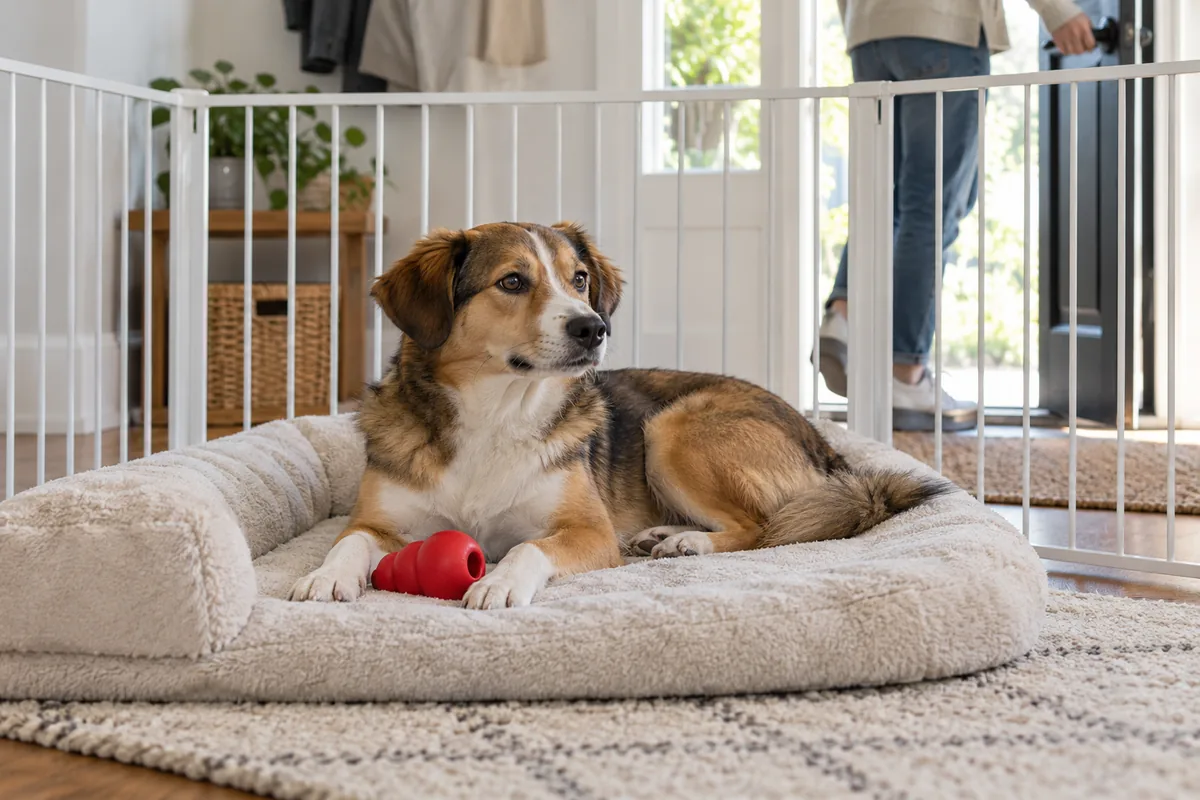
Choose a familiar room or gated area where your dog already rests comfortably. Let them explore it while you remain nearby before closing a barrier or stepping away.
Provide fresh water, a suitable bed, comfortable temperature, and an unhurried potty opportunity. Offer age-appropriate movement and sniffing, then time to settle rather than departing immediately after exciting play.
A food toy can be useful only after you have checked that your dog enjoys it and uses it safely while supervised. Do not introduce new equipment, unfamiliar food, and the first departure together.
Dogs Trust's separation anxiety advice recommends starting with a few minutes and building slowly only while the dog is relaxed. It also recognizes that puppies commonly need support for their first days or weeks and that older newcomers may initially follow their person between rooms.
If even a few minutes looks difficult, begin much smaller.
Furbo 360° Dog Camera
A pet camera shows how your new dog responds during brief departures, helping you adjust before small concerns become overwhelming.
Check price on AmazonWe earn a small commission if you buy through this link, at no extra cost to you. Disclosure
Puppy, rescue or adult dog: what changes
Age and history provide context, but neither establishes how your individual dog will cope.
| Dog | What to expect at first | How to start | Watch out for |
|---|---|---|---|
| Very young puppy | Frequent toilet, sleep, and reassurance needs | Tiny gaps while needs are met | Long waits for care or escalating crying |
| Older puppy | Increasing curiosity and chewing | Easy practice in a safely introduced area | Swallowable items and frustration behind barriers |
| Newly adopted adult rescue | Unfamiliar routines and possible close following | Establish comfort, then brief separations | Assuming their previous home predicts this one |
| Adult dog moving with their family | Familiar people but a new environment | Rehearse easy absences in the new space | New sounds and unfamiliar confinement |
| Adult with a history of comfortable alone time | Existing skills may help | Confirm comfort before extending | Jumping straight to the old workday routine |
| Senior or medically vulnerable newcomer | Possible mobility, sensory, or toilet needs | Plan care around health and accessibility | New symptoms or difficulty reaching water and exits |
Swipe the table sideways to see every column.
Our Puppy Separation Anxiety guide covers young dogs in more detail. For general life-stage planning, read How Long Can a Dog Be Left Alone? Those ranges are not targets for a new arrival.
Before you leave the first time
Print or copy this checklist.
Leaving Your Dog Alone for the First Time: A Calm First-Week Plan: before you leave the first time
- My dog has had time to explore and rest in the chosen area.
- Any gate or closed door has been introduced without distress.
- My dog has had a recent potty opportunity.
- Appropriate activity and settling time have been provided.
- Fresh water is accessible.
- The room temperature and ventilation are comfortable.
- Cords, cleaners, medications, and unsafe food are inaccessible.
- Blind cords, windows, stairs, and exit routes are secured.
- Small objects and swallowable materials have been removed.
- Bedding and toys are suitable for this dog's chewing behavior.
- Any food toy has been introduced under supervision.
- The camera view, sound, and connection have been checked.
- I can return promptly if concern develops.
- Longer necessary absences have suitable care coverage.
If crate confinement is being considered, check that nothing your dog wears can snag on gate bars, wire, or furniture. Our Crates for Anxious Dogs guide explains why comfort with confinement matters more than simply containing the dog.
Your first day
Prioritize orientation, toilet opportunities, food, sleep, and calm company. There is no requirement to leave home on arrival day.
Notice whether your dog can rest while you move nearby. Try standing, taking a small step, or briefly moving toward an interior doorway without making every movement a formal exercise.
If your dog remains comfortable, you may try a moment out of sight and then a very brief departure. Stay close enough to return, using live observation where possible.
Do not wait outside to find the longest duration your dog can endure. The first observation should help you choose an easy starting point.
Following you initially does not automatically establish a separation problem. Equally, being quiet from exhaustion or uncertainty does not prove readiness for a long absence.
First-week alone-time plan
This is a flexible organizer, not a required progression. A dog may repeat one stage throughout the week or need professional help before departure practice.
| Day | Goal | What to do | Move on when |
|---|---|---|---|
| Day 1 | Establish comfort | Provide company, routine, toilet access, and a familiar rest area | Dog can rest comfortably while you are nearby |
| Day 2 | Make small movements ordinary | Stand, step away, and return during relaxed moments | Rest continues without increasing vigilance |
| Day 3 | Introduce brief separation | Try a tiny indoor gap or familiar barrier if comfortable | Dog stays relaxed and readily resumes resting |
| Day 4 | Observe a first short departure if ready | Start with seconds or a few minutes according to comfort | No meaningful worry appears during the observation |
| Day 5 | Repeat easy experiences | Use several manageable opportunities with recovery between them | Comfortable responses are reasonably consistent |
| Day 6 | Add a small variation if appropriate | Slightly change duration or preparation, not everything together | Dog remains comfortable through the change |
| Day 7 | Review and plan care | Compare observations and organize the next week's coverage | Next steps reflect behavior rather than a deadline |
Swipe the table sideways to see every column.
Do not skip ahead because you need to return to work. Arrange care while practice continues at an appropriate level.
Keep leaving and coming back low-key
Use an ordinary, friendly goodbye and return calmly. You do not need to ignore your dog or withhold affection.
Avoid turning departures into an exciting ritual, but also avoid trying to sneak away as a substitute for teaching comfortable separation. The dog still experiences your absence once you are gone.
If shoes, keys, or bags trigger concern before departure, simplify that preparation. Our Departure Cues guide explains how to make these actions less significant.
If worry appears during a test, return calmly and make the next practice easier. Do not wait for a frightened dog to become silent.
Calm or stressed? What to look for on camera
Look at the whole pattern rather than one sound or movement.
| What you see | What it may mean | What to do next |
|---|---|---|
| Loose posture and ordinary resting | May indicate comfort during that period | Keep the next practice easy |
| Brief glance toward the door, then settling | Often ordinary awareness | Observe without automatically increasing time |
| Eating comfortably, then resting | May be an encouraging response | Check behavior after the food finishes |
| Repeated pacing between exit and resting area | May indicate growing concern | Return and shorten the next exercise |
| Persistent whining, barking, or howling | May reflect distress or another unmet need | End the difficult separation and reassess |
| Panting or drooling without an obvious physical explanation | May reflect stress or a medical concern | Return, assess needs, and contact your vet when appropriate |
| Scratching, climbing, biting, or forcing a barrier | Injury risk and possible panic | Stop that setup and seek help |
| Rigid stillness facing the exit | May be vigilance rather than relaxed quietness | Avoid increasing based on silence alone |
| Refusing familiar food after departure | May accompany worry, though appetite has other causes | Simplify and consider the wider pattern |
Swipe the table sideways to see every column.
Our How to Record Your Dog When You Leave guide covers placement and recording limitations. A camera provides information, not physical protection.
When to slow down
Stop increasing time if signs appear earlier, become more intense, or take longer to resolve. Return to an easier stage after your dog has fully settled.
Check basic needs again: a puppy may need the toilet, an adult may be uncomfortable in the room, or outside noise may have changed the exercise.
Do not automatically diagnose separation anxiety from one difficult observation. However, repeated inability to settle deserves support rather than more challenging tests.
Dogs Trust notes that it is never too late to help an older newcomer feel calmer when left. Progress depends on the individual, not whether you started perfectly.
For persistent concerns, use our Separation Anxiety Training Plan with appropriate professional guidance.
Covering longer absences in the first weeks
Plan real cover before workdays, appointments, or travel. Family, a trusted friend, or a suitable sitter may provide company while your dog settles and learns.
Introduce the caregiver while you are present, then check that your dog can relax with them. Some dogs remain worried when one particular person leaves.
Confirm actual coverage hours, including commuting and handovers. A quick midday visit does not cover hours of distress before and afterward.
If possible, adjust the first weeks to reduce unavoidable absences. That may mean sharing household responsibilities, changing an errand, or arranging someone to stay.
Support at the beginning is normal. It does not prevent gradual independence practice.
Mistakes to avoid
- Leaving for a full workday to see what happens.
- Assuming a rescue dog's history explains every behavior.
- Introducing a crate and departure simultaneously.
- Shutting away a distressed dog to force adjustment.
- Using food to distract from an overwhelming absence.
- Increasing time after one quiet recording without checking posture.
- Scolding or punishing accidents, damage, or vocalizing, which can make worry worse; use reward-based methods instead.
- Leaving new toys unattended without safety assessment.
- Treating the seventh day as a required milestone.
Keep the next step small enough to be useful.
When to get extra help
Contact your vet for sudden behavior changes, illness signs, reduced appetite, unusual panting, or new toilet problems.
Seek prompt help for self-injury or dangerous escape attempts. Do not repeat the confinement or absence that caused them.
A qualified, reward-based behavior professional can help if your dog cannot tolerate tiny separations or repeatedly becomes distressed. Ask your rescue or adoption organization about available support too.
Bring existing video and notes without provoking another episode.
Helpful products
Picks on this page are a research-based assessment of features and intended use — not hands-on testing. We earn a small commission if you buy through the Amazon links on this page, at no extra cost to you. Affiliate disclosure
These tools support observation and comfortable routines; they are chosen from research, not from personal testing.
| Product type | Why it helps | Notes |
|---|---|---|
| Pet camera with two-way audio: Furbo 360° camera | Shows behavior during the first short absences | Limitation: it shows behavior but does not fix it, and talking through the speaker can upset some dogs. Alternative: an old phone or laptop with a free video call app. |
| Stuffable rubber food toy: KONG Classic | Offers a familiar, enjoyable rest activity | Limitation: some worried dogs won't eat when alone, which is itself a useful sign. Alternative: a lick mat or scatter feeding. |
| Walk-through pet gate: Carlson walk-thru pet gate | Creates a boundary for dogs comfortable with it | Limitation: some determined dogs jump or push gates, and it needs a doorway it fits. Alternative: a closed door or an exercise pen. |
Swipe the table sideways to see every column.
Keep the camera speaker off during the first observations, and use a closed door or exercise pen instead of a gate only if your dog already accepts it comfortably.
Bottom line
Prepare a safe, familiar space and begin with short experiences your new dog can manage comfortably. A few minutes may suit one dog; another needs seconds and more support first.
Use the week to learn rather than meet a deadline. Arrange company for longer absences and seek help when distress persists.