On this page
- What real progress looks like
- Getting better or not yet?
- What to measure on video
- What to film and measure
- Why a quiet dog is not always a calm dog
- Weekly progress review checklist
- Plateaus: why progress stalls
- Setbacks: why they happen
- Plateau, setback or red flag?
- How to recover from a setback
- Setback recovery checklist
- Changing the plan in 5 steps
- How long it can take
- Mistakes to avoid
- When to get extra help
- Helpful products
- Bottom line
When you are working on separation anxiety, a quiet departure can feel encouraging—and the next difficult session can make you question everything. Progress is rarely a straight line, and counting minutes alone can miss meaningful changes.
We are dog owners, not vets or trainers. This guide helps you review what your dog actually does, recognize when the plan needs adjusting and respond to setbacks without treating them as failure. Comfortable repetitions matter, even when they do not produce a new longest absence.
What real progress looks like
Real progress means your dog is increasingly comfortable during separation. They may disengage from the door more easily, rest sooner, respond less strongly to your preparations or remain relaxed through a previously difficult moment.
You may see less pacing, whining, barking, panting or exit scratching. Comfortable eating followed by rest can be encouraging too.
These changes should repeat across comparable absences. Over time, comfortable duration may grow, but a longer absence with more distress is not the goal.
The ASPCA’s separation anxiety advice describes gradually building tolerance through short absences. The aim is a dog who is comfortable being alone, not one who simply endures more time.
Furbo 360° Dog Camera
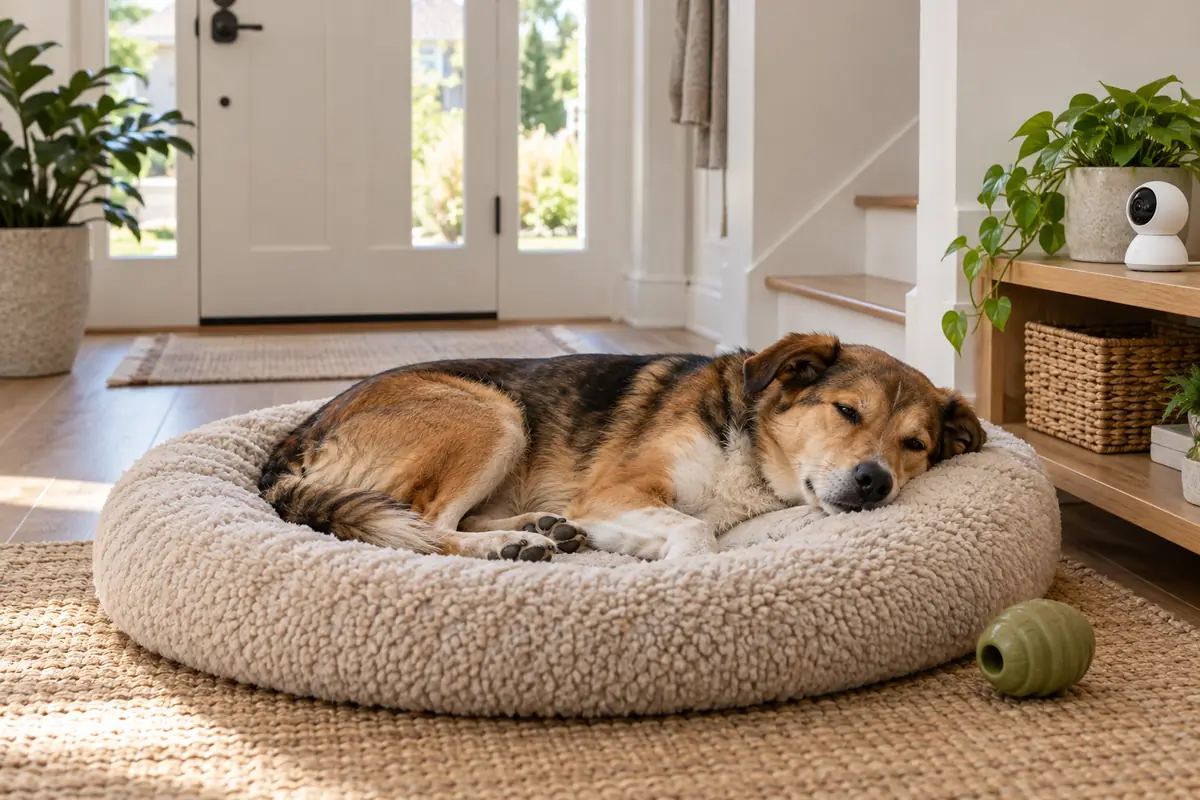
A pet camera lets you compare settling, body language and stress signs across absences, making progress easier to assess honestly.
Check price on AmazonWe earn a small commission if you buy through this link, at no extra cost to you. Disclosure
Getting better or not yet?
Look at several signs together. No single behavior establishes that your dog feels safe.
| What you see | A sign of real progress | Not yet, slow down |
|---|---|---|
| Departure preparations | Brief attention, then ordinary activity | Pacing or trembling begins with your shoes |
| Settling | Loose posture and comfortable rest repeat | Lies down but remains tense and watchful |
| Pacing | Less repetitive movement during similar absences | Repeated routes continue or begin earlier |
| Vocalizing | Fewer sounds alongside relaxed behavior | Silence accompanies freezing or hiding |
| Panting | Ordinary breathing during comfortable rest | Persistent panting without an obvious physical explanation |
| Exit attention | Can turn away and rest elsewhere | Repeated door checking or scratching |
| Food toy | Eats comfortably and remains settled afterward | Eats briefly, then becomes distressed |
| Sleep | Appears comfortably asleep and changes position naturally | Remains rigid or repeatedly startles awake |
| Duration | Repeatedly comfortable at the same or slightly longer level | A longer absence is achieved through escalating worry |
| Recovery | Returns to ordinary activity comfortably | Remains highly agitated after your return |
Swipe the table sideways to see every column.
What to measure on video
The first 10–30 minutes can be especially informative, but never extend a short training absence to fill that window. If your dog comfortably manages only seconds, that is the footage to review.
Watch live so you can return before distress builds. For longer absences, check later periods too; a calm beginning does not establish comfort throughout.
Record actual departure time, first worry, settling and any outside trigger. Compare similar durations and circumstances. A quieter morning and a noisy delivery afternoon are not identical tests.
Your dog’s greeting adds context, but cannot reliably describe what happened while you were away.
What to film and measure
Is My Dog's Separation Anxiety Getting Better? Progress Signs, Plateaus and Setbacks: what to film and measure
- Start recording before departure preparations.
- Include the exit and resting area.
- Capture the whole body and sound.
- Record the actual time you left.
- Note the complete absence length.
- Mark the first visible sign of worry.
- Note pacing, vocalizing, panting or scratching.
- Record approximate duration of those signs.
- Note comfortable resting and when it begins.
- Record food interest and behavior afterward.
- Note outside noises or interruptions.
- Record any setup or routine changes.
- Note behavior after your return.
- Mark missing footage as unknown.
Our best pet camera guide covers recording options. Use our separation anxiety log to keep notes brief and consistent.
Why a quiet dog is not always a calm dog
A dog may stop barking while remaining frightened. Freezing, trembling, hiding or sitting rigidly near the exit can all look quiet on a small screen.
Look for a loose body, ordinary position changes and the ability to disengage from the door. Compare with how your dog rests comfortably when you are home.
If you cannot tell whether your dog is sleeping or remaining tense, save a short clip for professional review. Our separation anxiety signs guide helps you recognize subtler concerns.
Weekly progress review checklist
Is My Dog's Separation Anxiety Getting Better? Progress Signs, Plateaus and Setbacks: weekly progress review checklist
- How many days and absences were actually logged?
- Which recordings are complete enough to compare?
- Were the absence lengths reasonably similar?
- Did departure cues cause less concern?
- Did comfortable resting become easier?
- Were stress signs fewer, shorter or less intense?
- Did worry begin earlier or later?
- Did comfort continue after food was finished?
- Did any new stress signs appear?
- Were there unsupported absences beyond current ability?
- Did health, sleep or routine change?
- What should stay the same next week?
- What single adjustment would make practice easier?
Blank days are not successful days or failures. They are missing information.
Plateaus: why progress stalls
A plateau may mean duration is staying steady while comfort improves. That can still be useful progress.
If comfort is not improving, review whether increases are too large, sessions continue too long or every repetition asks for more. Several demanding sessions without enough recovery may also make practice harder.
Real-life absences beyond your dog’s ability can undermine the easier practice. Check care gaps as carefully as training notes.
Also consider changing conditions: a new barrier, different departure time, disrupted sleep or discomfort. Adjust the relevant factor rather than assuming your dog needs more determination.
Setbacks: why they happen
A long unexpected absence, frightening noise, move, illness or schedule change can make previously manageable departures difficult again. A different room or caregiver may also change the experience.
One difficult session does not erase earlier learning. It does tell you that the next attempt should be easier and that possible causes deserve review.
Avoid interpreting every fluctuation as a major setback. Look for a repeated change, while responding promptly to severe distress or physical warning signs.
Plateau, setback or red flag?
| Sign | What to do |
|---|---|
| Duration stays steady but resting looks easier | Recognize improving comfort; avoid forcing a longer absence |
| Worry appears after each attempted increase | Reduce the size of increases and add easier repetitions |
| Practice is comfortable but workday absences are distressing | Repair care coverage before extending training |
| A difficult session follows a clear disruption | Return to an easier level and review the trigger |
| Worry starts earlier across several sessions | Reduce difficulty and seek a plan review |
| New appetite, mobility, sleep or toilet changes appear | Contact your vet rather than assuming a training setback |
| Panic worsens despite adjustments | Involve your vet and a qualified, reward-based behavior professional |
| Injury or dangerous escape attempts occur | Stop the unsafe arrangement and seek prompt veterinary help |
Swipe the table sideways to see every column.
How to recover from a setback
First check safety and health. A sudden change should not automatically be explained by training.
Return to a level that was reliably comfortable, or easier if needed. Repeat manageable practice for a few sessions and let observations guide the next increase. You usually do not need to discard the entire plan.
If distress appears, return calmly rather than waiting for silence. Do not remain outside while your dog panics to test whether they recover.
Arrange care for longer gaps. Our care options guide helps protect practice while everyday responsibilities continue.
Setback recovery checklist
Is My Dog's Separation Anxiety Getting Better? Progress Signs, Plateaus and Setbacks: setback recovery checklist
- Check for injuries and physical symptoms.
- Note what changed before the difficult session.
- Review footage without repeatedly provoking distress.
- Reduce absence difficulty.
- Choose a familiar resting setup.
- Keep ordinary care and potty needs covered.
- Protect comfortable rest between sessions.
- Include easy repetitions.
- Avoid testing the previous maximum immediately.
- Confirm company for longer necessary absences.
- Arrange backup care for delays.
- Record the next attempt honestly.
- Seek help if worry persists or worsens.
Changing the plan in 5 steps
Change one manageable element at a time where possible.
| Step | What you do | Move on when |
|---|---|---|
| 1. Review safety and health | Check new symptoms, injuries and recent changes | Immediate concerns are addressed |
| 2. Compare observations | Review similar absences and identify the earliest worry | You have a clearer picture without guessing |
| 3. Make practice easier | Reduce duration or simplify the difficult cue or setting | Your dog remains comfortable throughout |
| 4. Protect repetition | Add easy sessions, appropriate rest and reliable care cover | Comfortable behavior repeats |
| 5. Adjust cautiously | Make a small change while continuing observation | Comfort supports another manageable step |
Swipe the table sideways to see every column.
Use our separation anxiety training plan for the detailed method. If preparations themselves have become difficult, review the departure cues guide.
How long it can take
There is no honest completion date that fits every dog. Progress can unfold over weeks or months, and more complex difficulties may require longer support.
Starting ability, health, household changes, care coverage and the suitability of the plan all matter. Faster progress in another dog does not establish what your dog should achieve.
Set practical goals around comfort: repeat an easy departure, rest during a familiar absence or tolerate preparations without worry. Increasing duration comes when the behavior supports it.
Mistakes to avoid
Do not use the longest absence as your only measure. Avoid comparing unlike sessions or counting missing footage as success.
Do not treat food eaten, silence or lack of damage as proof of relaxation. Never shut a panicking dog in a crate to contain the problem.
Avoid punishment, aversive collars and leaving your dog to cry until exhausted. Worsening distress is information to change the plan, not a necessary stage to push through.
Do not remove all affection or make every session harder in pursuit of faster progress.
When to get extra help
The ASPCA recommends veterinary assessment to rule out medical issues. Dogs Trust also notes that physical health can influence behavior and advises veterinary attention when behavior has recently changed.
Contact your vet for sudden deterioration, appetite changes, pain concerns or persistent worsening. Injury and dangerous escape attempts need prompt attention; see our separation anxiety red flags guide.
A qualified, reward-based professional experienced in separation difficulties can help interpret a plateau and adjust the plan. Bring comparable clips and notes using our vet visit preparation guide.
Helpful products
Picks on this page are a research-based assessment of features and intended use — not hands-on testing. We earn a small commission if you buy through the Amazon links on this page, at no extra cost to you. Affiliate disclosure
These picks are chosen from research, not from personal product testing. They are practical support options, not a fix on their own, and none of them replaces a vet check, a gradual training plan or care cover.
| Product type | Why it helps | Notes |
|---|---|---|
| Pet camera: Furbo 360° camera | Makes behavior across absences easier to compare | Limitation: it needs Wi-Fi and only shows what happens; it cannot comfort your dog or tell you why. Alternative: an old phone or laptop recording or on a video call. |
| Stuffable rubber food toy: KONG Classic | Food interest can offer one clue alongside body language | Limitation: an anxious dog may ignore food, so whether they eat it is a useful progress clue, but the toy will not fix distress. Alternative: scatter feeding. |
| Calming donut dog bed with raised sides: Best Friends by Sheri calming donut bed | Offers a familiar resting spot where settling is easier to observe | Limitation: a cozy resting spot makes settling easier to see, but it does not fix distress about being alone, and some dogs chew beds. Alternative: a folded blanket in a quiet corner. |
Swipe the table sideways to see every column.
Bottom line
Judge progress by repeated comfortable behavior, not a single record-breaking absence. Review trends, make practice easier after setbacks and protect progress with suitable care. Asking for help is a sensible adjustment, not evidence that your dog or your efforts have failed.