On this page
- Why dogs pace and pant when left alone
- Pacing and panting: stress or something physical?
- Signs that need the vet today
- Call the vet now or book a visit?
- First, rule out heat and comfort
- What to film
- A calmer set-up
- Calm set-up checklist
- Pacing and panting plan in 5 steps
- What to do when you get home
- Absences you can't avoid
- Mistakes to avoid
- When to get extra help
- Helpful products
- Bottom line
Watching your dog walk the same route between the sofa and front door can be unsettling. Add panting, and it is hard to know whether they miss you, feel too warm or need medical attention.
Start with safety rather than assuming anxiety. We are dog owners, not vets or trainers. This guide helps you record useful observations, recognize reasons to call your vet and rebuild comfortable alone time once physical needs and health concerns have been addressed.
Why dogs pace and pant when left alone
Dogs pant to release heat, including after exercise. They may also pant when frightened, uncomfortable or unwell. Pacing can reflect worry, pain, a toilet need or difficulty finding a comfortable resting position.
Pacing and panting often come with drooling. Our guide to dog drooling when left alone explains how to tell distress from nausea, mouth pain or something swallowed.
Departure timing matters. Pacing that begins with your shoes and keys, followed by whining, drooling or exit scratching, raises concern about separation distress.
The ASPCA’s separation anxiety advice describes dogs repeatedly walking or trotting along a fixed path, either in circles or back and forth. It also advises ruling out medical problems before behavior work.
Furbo 360° Dog Camera
A pet camera shows when pacing and panting begin, what happens beforehand and whether your dog ever settles.
Check price on AmazonWe earn a small commission if you buy through this link, at no extra cost to you. Disclosure
Pacing and panting: stress or something physical?
These are clues rather than diagnostic rules. Stress and physical discomfort can occur together, and improving after your return does not exclude illness.
| What you see | More likely stress about being left | More likely heat, pain or illness, ask your vet |
|---|---|---|
| Start time | Begins with departure preparations | Also happens during ordinary time together |
| Pacing pattern | Repeated trips between exit and resting area | Repeated position changes or apparent discomfort |
| Panting after activity | Departure adds worry after recovery | Panting persists unusually or seems excessive |
| Room conditions | Happens despite a comfortable environment | Warm room, direct sun or poor airflow |
| Other behavior | Whining, exit scratching and vigilance | Coughing, weakness, limping or reluctance to lie down |
| Food interest | Refuses food during separation but eats comfortably later | Appetite is reduced when you are home too |
| Water | Drinking access is normal | Empty bowl, unusual thirst or difficulty drinking |
| Resting | Cannot disengage from the exit | Cannot get comfortable even with company |
| Age and onset | Follows a change in absence routine | Sudden new restlessness, especially in an older dog |
| Your return | Worry eases with company | Panting or restlessness continues |
Swipe the table sideways to see every column.
Our Separation Anxiety Signs guide covers the broader behavior pattern.
Signs that need the vet today
Call your vet about new, unexplained or persistent panting and pacing, particularly at rest or when you are home. Mention coughing, reduced appetite, unusual thirst, toilet changes or difficulty moving.
Dogs Trust’s separation anxiety advice notes that physical health can influence behavior even without obvious pain or illness, and recommends a vet check for recent changes.
Some signs need immediate emergency care. Do not assume that heavy breathing, abnormal gums or retching is anxiety because your dog was alone when it started.
Call the vet now or book a visit?
If you are unsure which category fits, call your vet or emergency clinic for guidance.
| Sign | What to do |
|---|---|
| Labored breathing, gasping or obvious effort to breathe | Seek emergency veterinary care now; minimize exertion |
| Collapse, inability to stand or marked weakness | Seek emergency care immediately |
| Pale, blue, gray or very red gums with panting or illness | Contact an emergency clinic immediately; do not delay to inspect further |
| Swollen or painful-looking belly, especially with repeated unproductive retching | Seek emergency care immediately; do not wait for more signs |
| Suspected overheating with excessive panting, drooling, confusion or weakness | Move to a cool area, start cooling with cool water and call an emergency vet while arranging transport |
| New cough, persistent unexplained panting at rest or restlessness that will not stop | Call your vet today; breathing difficulty makes this an emergency |
| Sudden new pacing in an older dog, without emergency signs | Contact your vet today to arrange an assessment |
| Mild but recurring departure-linked signs without physical warning signs | Book a vet visit soon and bring recordings; seek advice sooner if worsening |
Swipe the table sideways to see every column.
The American College of Veterinary Surgeons describes gastric dilatation-volvulus, sometimes called bloat, as a rapidly progressing emergency. Repeated unsuccessful retching deserves urgent attention even if swelling is not obvious.
First, rule out heat and comfort
Check the actual room conditions, not just the forecast. Sunlight moves, upstairs rooms warm up and airflow can change after doors close. Provide reliable cooling appropriate to your dog and conditions.
Flat-faced breeds, older dogs and overweight dogs are more vulnerable to overheating. A fan alone may not keep a warm room safe. Never leave a dog in a car.
Provide fresh, accessible water and a potty opportunity before departure. Allow recovery after exercise. Ordinary post-exercise panting should ease; excessive, unusual or persistent panting needs veterinary advice.
If heat illness is suspected, cooling does not replace veterinary care. Do not force water into a distressed dog’s mouth.
What to film
Capture the first 10–20 minutes only when your dog can remain comfortable that long. Stop earlier if distress appears. Do not prolong an absence to collect evidence, and never delay medical care to film symptoms.
Dog Pacing and Panting When Left Alone: Stress, Heat or Pain?: what to film
- Start recording before departure preparations.
- Include the exit and resting area.
- Show your dog’s whole body where possible.
- Record sound as well as video.
- Note when you picked up keys or shoes.
- Record the time you left.
- Mark when pacing began.
- Mark when panting began.
- Note whining, drooling or door scratching.
- Record whether food was approached or ignored.
- Note outside noises before reactions.
- Record any comfortable resting.
- Write down recent exercise and room conditions.
Compare with ordinary behavior while you are home. For equipment choices, see our Best Pet Camera guide.
A calmer set-up
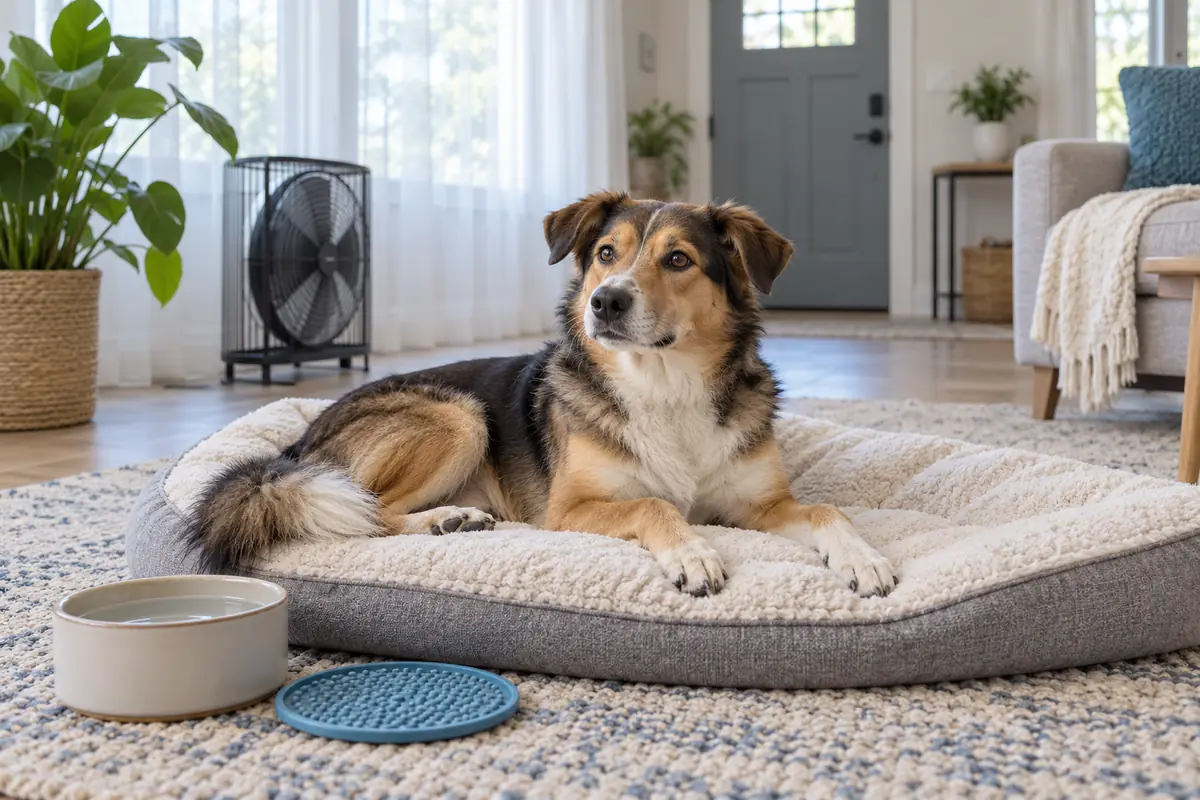
Choose a familiar resting area away from direct sun and busy windows. Offer comfortable bedding and access to a cooler safe surface if your dog prefers it.
Reduce obvious triggers without adding difficult confinement. A pen or closed room may suit one dog and increase another’s worry. Trial changes while you are home.
Never shut a panicking dog in a crate. Pacing that becomes frantic barrier chewing is not an improvement.
Keep departures manageable while assessing the setup. A comfortable-looking room cannot compensate for an absence longer than your dog can handle.
Calm set-up checklist
Dog Pacing and Panting When Left Alone: Stress, Heat or Pain?: calm set-up checklist
- Check the room temperature before leaving.
- Consider how conditions may change during the absence.
- Provide shade from direct sunlight.
- Check airflow and reliable cooling.
- Leave fresh, accessible water.
- Check that bowls cannot easily tip.
- Offer a potty break.
- Allow recovery after exercise.
- Provide a familiar resting spot.
- Keep cords and fan equipment inaccessible.
- Remove swallowable objects and household hazards.
- Test any barrier while you are home.
- Confirm the camera view and connection.
- Arrange care beyond your dog’s current comfort limit.
Pacing and panting plan in 5 steps
There is no fixed timetable. Health and safety come before increasing absence length.
| Step | What you do | Move on when |
|---|---|---|
| 1. Check physical causes | Review health, heat, water and potty needs; contact your vet as appropriate | Immediate concerns are addressed and your vet’s guidance permits practice |
| 2. Establish comfortable rest | Use a familiar area and observe ordinary resting with company | Your dog can rest comfortably in that setup |
| 3. Find an easy absence | Practice a separation shorter than the time worry usually begins | Comfortable behavior continues throughout |
| 4. Repeat and build gradually | Mix easy repetitions with small increases, watching live footage | Repeated observations support another manageable step |
| 5. Apply to daily departures | Practice relevant routines while covering longer unavoidable gaps | Your dog remains comfortable in those situations |
Swipe the table sideways to see every column.
Start with seconds if necessary. “Below threshold” means keeping practice short enough that worry does not build.
Return before distress develops. If pacing, panting or other worry appears, come back calmly and make the next attempt easier. Do not wait for silence during panic.
Use our Separation Anxiety Training Plan for detailed absence work. If preparations already cause worry, practice them separately with our Departure Cues guide.
What to do when you get home
Greet your dog calmly and assess their condition. Check the room and water supply, then offer an appropriate potty opportunity if they are otherwise comfortable.
Persistent panting or restlessness after your return needs attention rather than being dismissed as excitement. Follow the urgency guidance above.
Write down what happened, including recovery and any physical signs. Keep facts separate from guesses: “walked between door and bed repeatedly” is more useful than “had a terrible day.”
Save observations in our Separation Anxiety Log.
Absences you can't avoid
Arrange company before your dog exceeds their current comfortable duration. A familiar friend, family member or sitter may help; daycare suits only dogs comfortable in that environment.
A walker’s visit can meet a toilet need but cannot cover panic before and after the visit. Some dogs need someone present throughout the absence.
Use our Care Options guide to plan coverage and a backup. A camera helps you observe, but it cannot cool a room, refill water or protect a dog by itself.
Mistakes to avoid
Do not label all panting anxiety, or assume all pacing means boredom. Avoid testing with longer absences to see whether your dog eventually settles.
Never withhold water to prevent accidents. Do not increase exercise endlessly while overlooking heat, pain or rest.
Avoid punishment, aversive collars and leaving your dog to cry. Do not shout through a camera speaker.
Finally, eating a toy does not cancel out distress afterward, and a quiet, motionless dog is not necessarily relaxed.
When to get extra help
Seek veterinary advice for sudden changes, symptoms outside separation or uncertainty about physical causes. New pacing in an older dog particularly deserves assessment.
Dogs Trust identifies departure-related pacing, inability to settle, trembling, panting and drooling as possible distress signs. Those observations are useful to share, but they do not rule out illness.
Get qualified behavior help if your dog panics quickly, injures themselves or does not improve with manageable practice. Our Separation Anxiety Vet Visit Preparation guide helps organize videos and history without repeatedly provoking distress.
Helpful products
Picks on this page are a research-based assessment of features and intended use — not hands-on testing. We earn a small commission if you buy through the Amazon links on this page, at no extra cost to you. Affiliate disclosure
These picks are chosen from research, not from personal product testing. They are practical support options, not a fix on their own, and none of them replaces a cool room, fresh water or a vet check.
| Product type | Why it helps | Notes |
|---|---|---|
| Pet camera: Furbo 360° camera | Shows when pacing and panting start and whether rest follows | Limitation: it needs Wi-Fi and only shows pacing and panting; it cannot stop distress or tell you the room is cool enough. Alternative: an old phone or laptop recording or on a video call. |
| Stuffable rubber food toy: KONG Classic | Offers a familiar activity during comfortable alone time | Limitation: a distressed dog usually ignores food, so it helps calm dogs settle but won't fix fear. Alternative: scatter feeding. |
| Lick mat: LUKITO 2-pack | Gives some comfortable dogs a quiet food activity | Limitation: it can be chewed, so supervise at first and leave it only with dogs who use it safely. Alternative: a frozen stuffed food toy. |
Swipe the table sideways to see every column.
Choose suitable sizes, inspect for damage and count fillings toward daily food.
Bottom line
Check health, heat and basic comfort before assuming separation anxiety. Use short recordings to understand timing, then keep practice within your dog’s ability and cover longer gaps. Severe or persistent physical signs need veterinary care, not a harder training session.