On this page
- Can Labs be left alone for 8 hours?
- Why long absences are hard for Labs
- How long can my Lab be alone? Quick table
- Before you leave: Lab checklist
- Is it separation anxiety or boredom?
- Set up a safe alone zone
- Teach alone time step by step
- Labrador 8-hour workday plan
- Helpful products for alone time
- When to get extra help
Your Labrador may happily retrieve a toy, investigate every shopping bag, and follow you from room to room. Leaving that enthusiastic companion at home raises a practical question: can your dog comfortably fit around a normal working day?
We are dog owners, not vets. This guide separates workday planning from training, explains what to observe, and helps you arrange realistic support. Our product suggestions reflect intended uses and limitations; we have not tested these products ourselves.
Can Labs be left alone for 8 hours?
Yes—with limits and an individual care plan. Some healthy, gradually prepared adults can manage the periods between appropriate visits during an eight-hour working day. That is different from assuming every Lab should spend eight uninterrupted hours alone.
Want the general rules for every dog, by age and situation? Our guide on how long a dog can be left alone covers puppies, adults and seniors, signs the gap is too long, and options for long workdays.
Consider emotional comfort, toilet needs, health, and companionship. A dog who can physically wait for a toilet break may still become distressed much sooner.
Include commuting and errands in your absence. An eight-hour shift can easily mean a longer day from your dog's perspective.
Use recordings to establish what your Lab actually does. Sleeping comfortably, changing position, and engaging normally with the surroundings provide more useful information than finding no damage.
If your dog struggles between visits, arrange longer company. A quick midday interruption does not resolve distress throughout the remaining hours.
KONG Classic Stuffable Dog Toy (choose Large or X-Large on listing)
A suitably sized stuffable toy gives food-motivated Labs familiar enrichment during comfortable departures, without replacing company or gradual separation training.
Check price on AmazonWe earn a small commission if you buy through this link, at no extra cost to you. Disclosure
Why long absences are hard for Labs
Labradors were developed as working retrievers who partnered closely with people. Many are highly social, interested in shared activity, and responsive to opportunities to carry, search, and retrieve.
Puppies and adolescents can be energetic and mouthy. Without suitable outlets, investigating furniture or dismantling accessible objects may become entertainment. That does not automatically mean separation anxiety.
Labs are also often food-motivated. This can make enrichment useful, but eating is not a dependable test of emotional comfort. A dog may finish a stuffed toy and then begin pacing or howling.
When distressed, a Lab may chew or scratch around exits while attempting to regain access to people. Exit damage is concerning, but it is not unique to Labradors or sufficient for a diagnosis.
Young puppies have developing bladder control and frequent care needs. Neither enthusiasm for food nor a quiet temperament removes those needs.
How long can my Lab be alone? Quick table
These are cautious planning examples, not scientifically established Labrador age limits. Start training with comfortable seconds or minutes, and let observed behavior guide progress.
| Age | Typical comfortable alone time | Notes |
|---|---|---|
| 8–10 weeks | Initially seconds to minutes; some prepared puppies manage around 30–60 minutes | New puppies need frequent company, meals, rest, and toilet opportunities. |
| 10–12 weeks | Short practiced periods; some manage around an hour | Emotional readiness may be much shorter than the interval between toilet trips. |
| 3–4 months | Some prepared puppies manage roughly 1–2 hours | Check actual care needs and behavior rather than assuming readiness from age. |
| 5–6 months | Some prepared puppies manage roughly 2–3 hours | Continue frequent care; this does not establish readiness for a workday alone. |
| Adolescent | Individually established stretches of a few hours | Chewing, activity needs, confidence, and training history vary considerably. |
| Healthy, well-prepared adult | Some manage roughly 4–6 hours | A planning range, not a target; arrange earlier breaks when needed. |
| Senior or dog with health concerns | Often shorter, individually determined periods | Toileting, discomfort, mobility, or other medical needs may require additional visits. |
Swipe the table sideways to see every column.
If your adult Lab becomes distressed after a few minutes, their current limit is not the adult row. Plan around the dog in front of you.
Before you leave: Lab checklist
Can Labs Be Left Alone for 8 Hours?: before you leave: lab checklist
- Offer an unhurried toilet opportunity before departure.
- Provide suitable activity, including relaxed sniffing and optional brief retrieve practice.
- Allow excitement and breathing to settle before leaving.
- Prepare familiar food enrichment using part of the daily allowance.
- Leave fresh water and a comfortable resting area at an appropriate temperature.
- Remove laundry, trash, small objects, damaged toys, and accessible cords.
- Confirm caregiver arrangements and check that the planned absence fits demonstrated comfort.
Aim for a satisfying routine rather than exhaustion. Repeated intense fetch may leave some Labs excited instead of ready to rest.
An easy food puzzle after a suitable sniff walk can offer a quieter transition. Introduce that routine while you are home before relying on it during departures.
Is it separation anxiety or boredom?
Boredom can lead to exploratory chewing, scavenging, or attention to household objects. A bored dog may still move loosely, enjoy activities, and alternate investigation with relaxed rest.
Separation anxiety involves distress associated with being apart. Possible signs include:
- Persistent or near-continuous howling.
- Frantic destruction around doors or windows.
- Forceful escape attempts.
- House soiling that repeatedly occurs only when alone.
- Pacing, heavy panting, drooling, or inability to settle.
No sign establishes the cause by itself. Accidents can reflect illness or insufficient toilet opportunities, while barking may respond to outside activity.
Watch timing and context. Does worry begin when you collect your keys? Does your dog rest after finishing enrichment, or become increasingly agitated?
For a fuller comparison, see Separation Anxiety or Boredom? 10 Signs. Seek assessment when the pattern suggests distress rather than attempting to solve it with more exercise alone.
Set up a safe alone zone
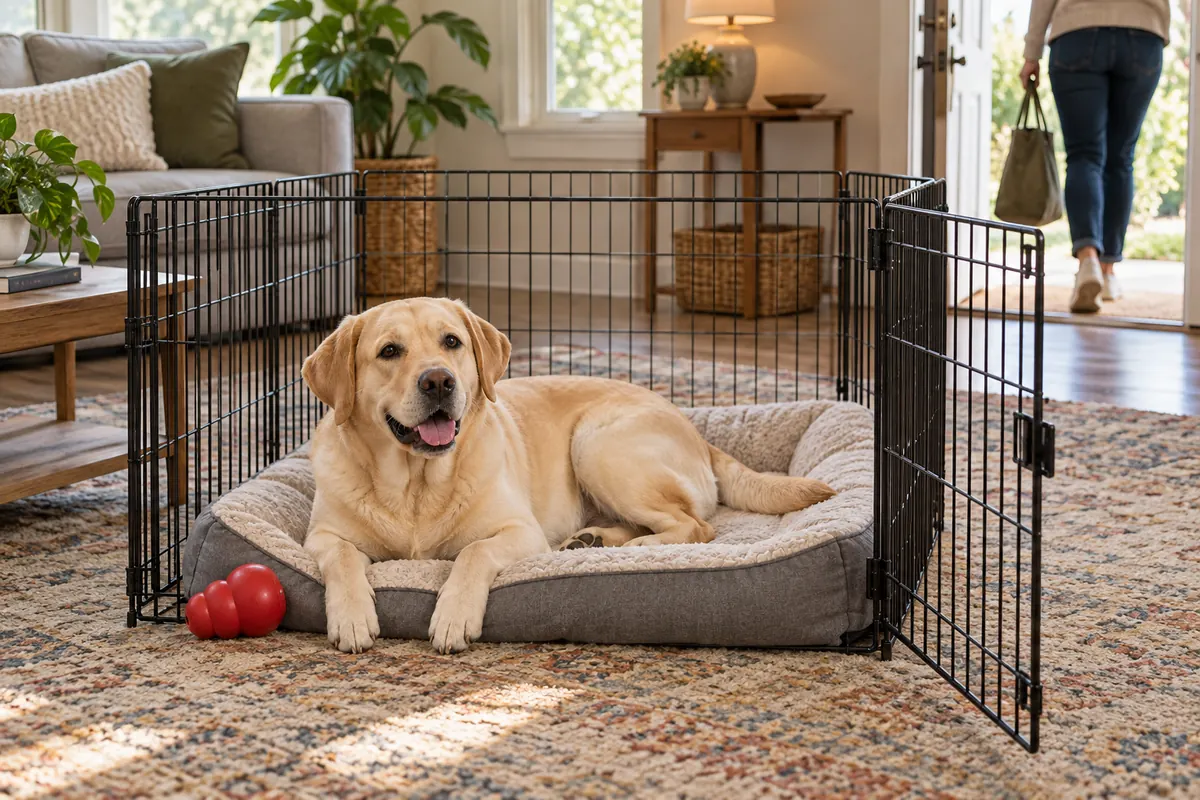
Choose a familiar, comfortable area where your Lab already rests. A pen or large crate may suit a dog introduced positively to confinement, but neither is automatically appropriate for separation anxiety.
Check pen stability, panel spacing, and climbing behavior while you are present. An athletic adolescent may push or climb equipment that contained them as a younger puppy.
A crate must allow natural standing, turning, sitting, and comfortable lying. Remove collars, tags, and harnesses before crating because they can snag.
Keep socks, towels, children's toys, food packaging, and other swallowable items inaccessible. Bedding is unsuitable if your dog tears it up or ingests filling.
Introduce the zone while you remain nearby. If closure causes frantic chewing, digging, or escape attempts, stop and reassess. A stronger crate can leave the panic unchanged while increasing injury risk.
Some dogs need a tolerated roomier setup or familiar company while professional guidance is arranged.
Teach alone time step by step
Use this progression flexibly. Repeat easy stages, and avoid making every exercise longer or harder.
- Establish comfortable nearby rest. Reward your Lab for choosing a bed or resting area while you remain close. Look for relaxed posture rather than demanding a rigid stay.
- Add small movements. Stand, move a step away, and return after a comfortable moment. Begin with seconds, reducing distance if your dog becomes watchful or repeatedly follows.
- Briefly leave sight. Step around a doorway and return before worry. Build gradually, keeping barriers optional if gates or closed doors themselves trigger distress.
- Practice mild departure cues. Pick up keys or put on shoes, then continue an ordinary activity. Stop repeating cues if your dog becomes increasingly tense.
- Try a tiny actual departure. Start recording and step outside briefly. Stay close enough to return promptly; do not wait through panic to obtain silence.
- Build comfortable minutes. Mix easier repetitions with modest increases. Observe pacing, breathing, food engagement, and settling rather than judging progress solely by barking.
- Explore longer periods carefully. Work toward tens of minutes, then a few hours only after repeated comfortable observations. Continue accounting for toilet opportunities, health, and companionship.
- Arrange support beyond current ability. Keep unavoidable work absences separate from training. If distress occurs, shorten future practice and seek help rather than pushing through a timetable.
A familiar food toy may support practice, but do not use it to distract your Lab while leaving for an absence they cannot manage. Watch what happens after the food ends.
Labrador 8-hour workday plan
This example assumes an adult comfortable with the intervals involved. Adjust for commuting, health, and individual behavior; puppies usually need substantially more frequent care.
Morning | Offer a toilet trip, a suitable sniff walk, and brief retrieve or training activity if helpful. Provide breakfast, water, and quiet recovery, followed by another toilet opportunity before departure.
Midday | Come home at lunch or arrange a walker or trusted neighbor for toileting, suitable activity, and company. Schedule the visit before your dog's comfortable limit, not automatically halfway through the shift.
Afternoon | Arrange another visit or extended company if the remaining gap is too long. A sitter may be more suitable than brief visits for a dog who becomes distressed when left again.
Evening | Return for a toilet trip and relaxed reconnection, then provide appropriate activity, dinner, and rest. Avoid turning the entire evening into intense entertainment to compensate for daytime absence.
Daycare can suit a socially comfortable Lab, provided the setting manages rest, group compatibility, and health appropriately. It is not automatically the best option for a dog overwhelmed by busy groups.
Build a backup arrangement for delays or canceled visits. A camera shows a problem but cannot provide the care your dog needs.
Helpful products for alone time
We earn a small commission if you buy through the Amazon links on this page, at no extra cost to you. Affiliate disclosure
| Product type | Why it helps | Notes |
|---|---|---|
| KONG Classic or Extreme stuffable toy | Offers familiar food enrichment and a chewing outlet during manageable departures. | Our top pick; size for a large dog, match chewing strength, supervise initially, and discard damaged toys. Linked pick is the KONG Classic (choose Large or X-Large on the listing for an adult Lab; it suits average chewers). Alternative for power chewers: the KONG Extreme. |
| Pet camera: Furbo 360 Dog Camera | Shows settling, pacing, vocalizing, and escape behavior after departure. | Secure cords; prioritize recordings over remote interaction. A camera only shows what happens; it does not treat anxiety. Alternative: a video call on a spare phone or tablet for short checks. |
| Foldable exercise pen or large crate: MidWest foldable exercise pen | Provides a managed area for a dog comfortable with confinement. | Introduce positively; stop if panic or unsafe escape attempts occur. Check the panel height on the listing (the 30-inch pen is sold for small to medium dogs); an adult Lab that jumps or leans on panels may need a taller pen. Alternative: the MidWest iCrate with divider (choose size by measuring your dog). |
| Lick mat: LUKITO lick mat 2-pack | Offers accessible licking with suitable food. | Supervise; remove if shredded and use xylitol-free ingredients. Silicone is not a chew toy. Alternative for dogs who chew mats: a stuffed KONG Classic. |
| Snuffle mat or food puzzle: AWOOF snuffle mat | Adds manageable searching or problem-solving to meals. | Start easy; avoid fabric or parts your dog may swallow. Fabric mats can be shredded, so pick it up when empty. Alternative for fabric chewers: a LUKITO lick mat. |
| Anxiety vest like ThunderShirt | May support some dogs during manageable situational stress. | Measure chest girth; introduce under supervision and monitor comfort and warmth. Optional support only, not a treatment for separation anxiety; see our ThunderShirt size guide. Alternative: an anxiety wrap (wrap vs ThunderShirt). |
| ADAPTIL/ThunderEase pheromone diffuser | Optional background support in a familiar room. | Evidence is mixed; combine with care and gradual training. Optional extra, not a replacement for training or company. Alternative: put the budget toward a midday walker visit. |
Swipe the table sideways to see every column.
Count fillings within daily food intake, especially for a food-motivated Lab. More food is not necessarily more useful enrichment.
No product makes an unsuitable absence appropriate. Remove equipment your dog damages, and avoid leaving unfamiliar mats or puzzles unattended.
When to get extra help
Can Labs Be Left Alone for 8 Hours?: when to get extra help
- Your Lab panics during brief departures or cannot settle when alone.
- Bar biting, forceful escape attempts, or self-injury occurs.
- Exit-focused destruction accompanies pacing, drooling, or persistent howling.
- New accidents, appetite changes, pain signs, or unusual thirst appears.
- Your dog swallows toy pieces, fabric, or household objects.
- You cannot find a comfortable starting point or behavior keeps worsening.
- Necessary work absences exceed what your current care arrangements cover.
Contact your vet for injuries, physical symptoms, or suspected ingestion. Save representative recordings for assessment without deliberately recreating a frightening episode.
For recurring separation distress, involve a qualified, reward-based behavior professional or veterinary behaviorist. Avoid punishment after damage or accidents; it does not teach your dog how to feel comfortable alone.