On this page
- Why smoke detector beeps scare dogs
- Signs your dog is afraid of beeping
- Beep fear check
- Right-now checklist
- Stop the chirp safely (never disable the alarm)
- When fear spreads to other beeps
- A low-volume beep training plan
- Build a safe retreat
- Helpful products
- Real alarms and fire drills with an anxious dog
- What not to do
- When to get extra help
- Bottom line
One brief chirp can send a dog under the bed. Afterward, a microwave timer or phone notification may produce the same trembling response. Although the sound seems minor to you, your dog's fear deserves a practical response.
We are dog owners, not vets. This guide separates immediate alarm safety from longer-term training. Our product suggestions reflect intended uses and limitations; we have not tested these products ourselves.
Why smoke detector beeps scare dogs
A detector chirp is abrupt, intermittent, and difficult to predict. It can interrupt sleep, recur without an obvious cause, and seem hard to locate—especially when the source is overhead or sounds reflect through a room.
Dogs hear a broader range of high frequencies than people. That does not mean every detector is inaudible to humans or that hearing alone explains an individual dog's fear.
Research summarized by UC Davis identifies intermittent, high-frequency household sounds, including detector battery warnings, as potential stressors. It does not establish that every dog reacts the same way.
One frightening experience may also create a learned association. A dog startled during sleep may later anticipate trouble from a similar beep.
Repeated exposure at frightening intensity can worsen sensitivity rather than teach acceptance. The goal is comfortable learning, not endurance.
ThunderShirt Classic Dog Anxiety Jacket
A snug anxiety wrap may provide comforting pressure for dogs who already tolerate it; responses vary, and it does not replace training.
Check price on AmazonWe earn a small commission if you buy through this link, at no extra cost to you. Disclosure
Signs your dog is afraid of beeping
Obvious signs include shaking, hiding, bolting, whining, and pacing. Some dogs cling to their person or repeatedly try to leave the room.
Subtler signs include lip licking, lowered posture, ears held back, freezing, or stopping an enjoyable activity. Panting in a comfortably cool room may also accompany fear.
Read the whole pattern. Trembling, panting, or drooling can have medical causes, and a quiet dog may still be tense.
Notice recovery after the sound ends. Remaining watchful, refusing food, or avoiding the room long afterward suggests the episode affected more than the moment of the chirp.
Beep fear check
| What you see | What it likely means | What helps first |
|---|---|---|
| Shaking or hiding immediately after a confirmed maintenance chirp | The sound may be a fear trigger | Offer a safe retreat while another adult addresses maintenance. |
| Distress during a full alarm or an unfamiliar signal | There may be a real emergency | Follow the evacuation plan; investigate only once safe. |
| Fear continues after the detector is working quietly | Anticipation or a room association may remain | Restore a calm routine and begin easier practice later. |
| Similar reactions to microwave, oven, or phone beeps | Fear may be generalizing between sounds | Reduce avoidable non-safety beeps and seek advice if spreading. |
| Panting, trembling, or agitation without beeps | Noise fear may not explain everything | Contact your vet about new or persistent symptoms. |
| A recording causes freezing or food refusal | Training intensity is too high | Stop and make the next session easier. |
Swipe the table sideways to see every column.
These are starting points, not diagnoses. Never identify an alarm solely from your dog's response.
Right-now checklist
Dog Afraid of Smoke Detector Beeping: right-now checklist
- Check for an emergency; if an alarm sounds or you are uncertain, evacuate rather than troubleshoot indoors.
- Take people and pets outside when required, using your established exit plan.
- Once a maintenance chirp is confirmed, move your dog to a quieter, secure area.
- Offer calm company or gentle contact if welcomed; allow safe hiding.
- Have another adult follow the detector's instructions for prompt maintenance where possible.
- Keep doors and gates secure because frightened dogs may bolt.
- Avoid forced treats, handling, or training while your dog is overwhelmed.
- Monitor recovery and contact your vet if distress is severe or physical symptoms appear.
Do not delay evacuation to put on an anxiety wrap, fit ear protection, or collect enrichment.
Stop the chirp safely (never disable the alarm)
Learn your detectors' signals before an incident. Low-battery, fault, end-of-life, smoke, and CO signals vary; consult the specific manual rather than relying on a universal beep-count rule.
For a confirmed replaceable-battery warning, replace the battery promptly with the specified type and follow the reset and testing instructions. A sealed-battery unit may require replacement of the whole alarm.
Ten-year sealed-battery smoke alarms can reduce routine battery changes, but they still need testing and eventual replacement. CO and combination-alarm replacement schedules can differ; follow their labels.
The U.S. Fire Administration advises monthly smoke-alarm testing and replacement according to the alarm type and manufacturer. Record test dates, required battery changes, and replacement dates so maintenance is less likely to become a surprise.
Interconnected alarms may sound together. Preserve that safety function and use compatible replacements; consult a qualified professional for hardwired equipment or uncertainty.
Never remove batteries and leave the detector inactive, cover it, disconnect it, or relocate it merely to reduce your dog's exposure. Ask your landlord or local fire department's nonemergency service for maintenance guidance when needed.
When fear spreads to other beeps
A dog may begin reacting to sounds that resemble the original trigger. Similar pitch, rhythm, location, or surrounding activity can become relevant.
Keep a brief log of the sound, your dog's response, and recovery. Distinguish mild orientation from freezing, hiding, or panic.
For optional appliance or phone notifications, use quieter settings or reduce unnecessary beeps where practical. Keep all safety alarms functional and audible.
Practice one manageable sound at a time rather than playing a collection of beeps. Spreading fear, prolonged recovery, or substantial disruption to daily life warrants veterinary advice and an individual behavior plan.
If household appliances are a trigger too, our guide on helping a dog scared of the vacuum cleaner shows how to separate cleaning from training and introduce sound and movement one step at a time.
A low-volume beep training plan
Desensitization means exposure gentle enough to remain comfortable. Counterconditioning pairs that sound with something pleasant. Begin on a quiet day after your dog has recovered.
- Choose a comfortable starting setting. Use a familiar room and allow free movement away. Prepare small treats your dog normally enjoys. Do not begin beneath the real detector.
- Find a controllable recording. Use a separate playback device with the speaker away from your dog. Preview recordings without your dog present to avoid accidental loud sounds or advertisements.
- Start extremely quietly. Play a brief beep at barely audible volume, or farther away if needed. If your dog stiffens, hides, or becomes vigilant, the starting level is too difficult.
- Pair sound with a reward. Let the quiet beep occur, then offer a small treat. Keep your movements ordinary and avoid luring your dog toward the speaker.
- Keep sessions brief. Use a few comfortable repetitions, then stop for rest. Your dog should remain free to leave; staying still under pressure is not relaxed participation.
- Increase one difficulty gradually. After repeated comfortable sessions, make a small change in volume or location—not both together. Mix easier repetitions into practice.
- Stop at early worry. Pause if your dog freezes, scans, pants, retreats, or refuses familiar food. Make the next session easier rather than continuing until fear escalates.
- Review real-life needs separately. Recordings cannot reproduce every acoustic detail of an actual detector. Continue maintenance, retreat access, and emergency preparation; seek help if no comfortable training level is available.
Do not use the detector's test button as repeated training playback. Necessary safety testing and behavior practice have different purposes.
Build a safe retreat
Choose a familiar room or resting spot away from the most intense sound when possible. Provide comfortable bedding, water, and an accessible hiding option.
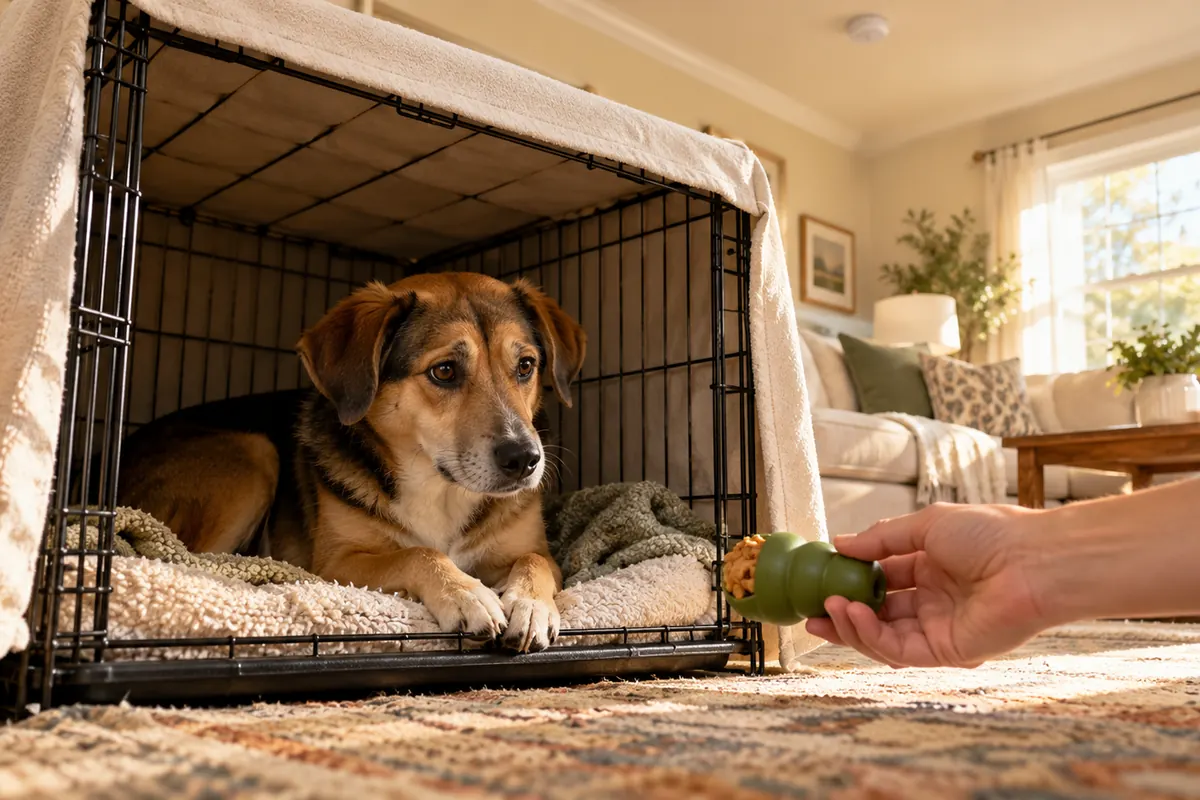
A covered crate can suit a dog who already rests there voluntarily. Keep airflow clear and fabric beyond chewing reach. Do not close a frightened dog inside if confinement adds distress.
Gentle background sound may soften intermittent household noise, but never turn it up enough to obscure safety alarms. Everyone must still be able to hear and respond.
Comforting your dog is fine when welcomed. Let them choose contact or space rather than pulling them from hiding.
For broader support, see our noise phobia guide. If a pressure wrap is not helping, read ThunderShirt not working? fixes rather than tightening it or treating immobility as success.
Helpful products
Picks on this page are a research-based assessment of features and intended use — not hands-on testing. We earn a small commission if you buy through the Amazon links on this page, at no extra cost to you. Affiliate disclosure
| Product type | Why it helps | Notes |
|---|---|---|
| ThunderShirt or similar snug anxiety wrap | Gentle pressure may support some dogs during manageable noise episodes. | Our top pick as optional support; introduce calmly, measure correctly, and monitor warmth and movement. |
| Covered crate or crate cover: MidWest crate cover | Offers a den-like retreat for dogs comfortable with it. | Preserve airflow; never force confinement during panic. |
| Calming donut bed: Best Friends by Sheri donut | Provides a familiar resting surface for dogs who enjoy bolsters. | Match sleeping preference and access needs; bedding does not treat fear. Choose a size your dog can curl up in. |
| KONG Classic stuffed toy | Offers familiar food enrichment during easy counterconditioning practice. | Size appropriately, supervise initially, and remove damaged toys. |
| Lick mat: LUKITO 2-pack | Provides accessible licking with suitable food. | Supervise; remove if shredded and use xylitol-free ingredients. |
| ThunderEase/ADAPTIL pheromone diffuser | Optional background support in the resting area. | Evidence is mixed; follow placement instructions. |
| White noise machine: Yogasleep Dohm Classic | May soften sudden, non-emergency background sounds. | Keep volume low enough that safety alarms remain clearly audible. |
Swipe the table sideways to see every column.
Introduce equipment separately on quiet days. No accessory makes flooding acceptable or justifies leaving a maintenance warning unresolved.
Real alarms and fire drills with an anxious dog
A real smoke or CO alarm requires a safety response, not a training session. Move outside and call 911 when appropriate. For a CO alarm, do not search indoors for the source or reenter until emergency responders permit it.
Keep a leash accessible and assign household roles in advance. Know where your dog commonly hides and identify usable exits and an outdoor meeting place.
Practice calmly walking to the exit and meeting point without sounding an alarm. Build comfortable leash handling and following cues separately.
Maintain required detector testing. Where practical, have another adult keep your dog securely away from the loudest exposure during a scheduled test.
If a pet cannot be reached safely during an emergency, tell firefighters where they may be. Never reenter a dangerous building to retrieve them.
What not to do
Do not punish shaking, hiding, barking, or attempts to retreat. Fear is not disobedience.
Avoid flooding: repeated loud recordings, holding your dog beneath the detector, or preventing escape until they stop reacting.
Never disable smoke or CO protection. A silent home without working detection is not a safe solution.
Do not force a wrap, ear protection, crate, or food on an overwhelmed dog. Introduce aids calmly beforehand and discontinue anything that increases distress.
Avoid assuming the problem is harmless because the sound is brief. Recovery and effects on ordinary life matter too.
When to get extra help
Dog Afraid of Smoke Detector Beeping: when to get extra help
- Fear spreads to additional beeps or ordinary household sounds.
- Your dog remains distressed long after the sound stops.
- Panic causes bolting, escape attempts, or injury.
- Eating, sleeping, toileting, or normal movement changes.
- Trembling or panting also occurs without an identifiable sound.
- You cannot find a comfortable level for recorded-sound practice.
- Necessary alarm testing or emergency handling feels difficult to manage safely.
Start with your vet to assess health contributors. A qualified, reward-based behavior professional or veterinary behaviorist can help plan training and emergency handling; your vet can discuss medication options when fear is severe.
Bottom line
A detector chirp can be genuinely frightening to a dog, but working smoke and CO alarms remain essential. Confirm safety, address maintenance promptly, and provide a comfortable retreat.
Later, use carefully controlled recordings and pleasant associations at a tolerable level. Spreading fear or severe distress deserves professional help rather than louder practice.