On this page
You reach for the vacuum, and your dog disappears—or charges toward it barking. Both reactions can make ordinary cleaning stressful. The useful first step is understanding whether your dog wants distance, wants to chase movement, or shows a mixture of both.
We are dog owners, not vets. This guide provides a manageable training framework rather than a fixed deadline. Our product suggestions reflect intended uses and limitations; we have not tested these products ourselves.
Why dogs fear the vacuum
Vacuum fear is a familiar household problem. The appliance combines motor noise, vibration, airflow, movement, and unfamiliar smells from collected dust.
Its movements may feel unpredictable: it approaches, changes direction, disappears behind furniture, then returns. Some dogs become worried before it starts because getting it from storage predicts the noise.
Chasing can have a different emphasis. Movement may attract a dog inclined to pursue or control moving objects, including dogs with herding tendencies. Excitement, frustration, and fear can overlap.
Do not assume a barking dog is playing or that every chaser has a particular instinct. Watch posture, recovery, and the ability to disengage.
Whatever the explanation, repeated frightening encounters are not necessary for learning. You can manage cleaning separately while practicing easier experiences.
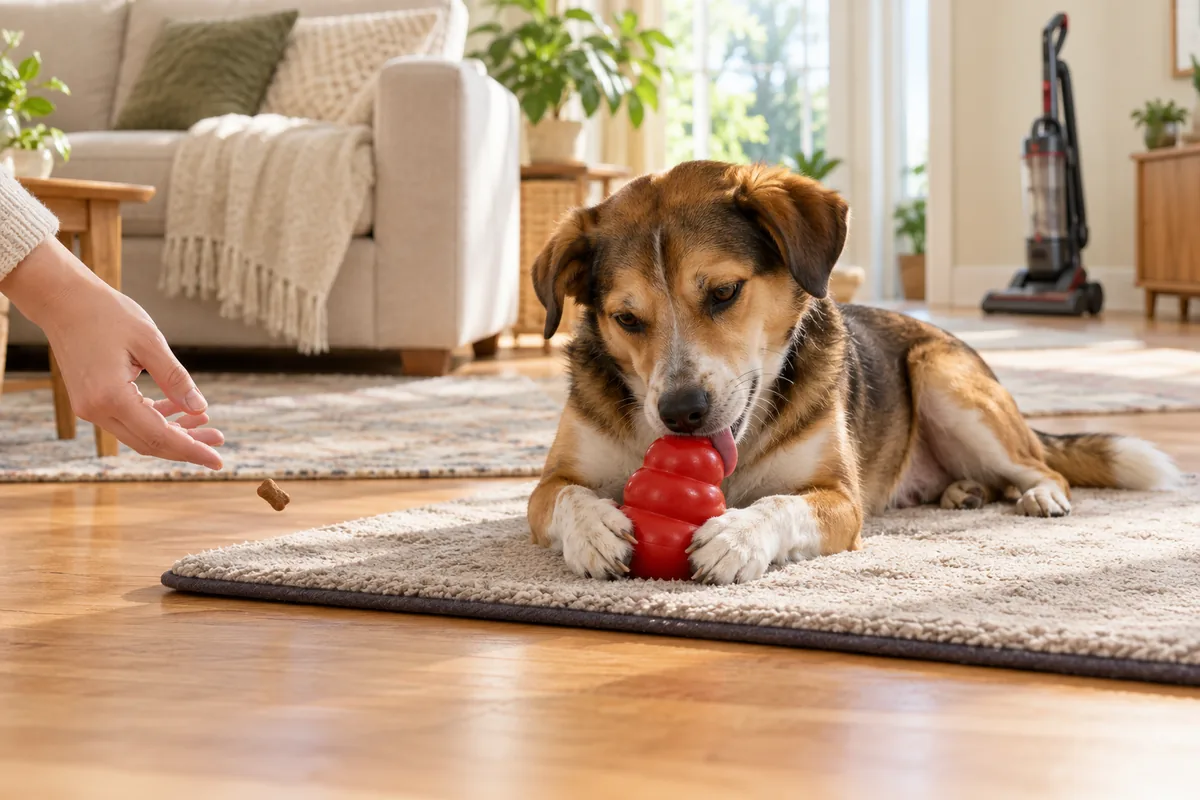
KONG Classic Stuffable Dog Toy
A familiar stuffed KONG offers food enrichment in a quieter room and during easy training; some frightened dogs cannot comfortably eat.
Check price on AmazonWe earn a small commission if you buy through this link, at no extra cost to you. Disclosure
Vacuum fear check
| What your dog does | What it may mean | First step |
|---|---|---|
| Hides when you open the vacuum cupboard | Preparation cues already predict something unpleasant | Arrange a comfortable retreat before bringing out the vacuum. |
| Trembles or pants when the motor starts | Sound or vibration may be frightening | Increase separation and begin later training at a much easier level. |
| Stares, stalks, or circles the moving head | Movement may trigger chasing, herding-like behavior, or worry | Prevent access and practice calm disengagement without motor noise. |
| Barks and lunges, then retreats | Fear and attempts to create distance may be involved | Stop the approach and offer a safe escape route. |
| Bites the head, wheels, or hose | High arousal, fear, or pursuit creates an injury risk | Switch off, separate safely, and seek guidance if repeated. |
| Reacts mainly when a robot changes direction | Unpredictable autonomous movement may be the trigger | Disable surprise schedules and separate during cleaning. |
Swipe the table sideways to see every column.
These observations guide the starting point; they do not establish a diagnosis. Your dog may need different practice for sound and movement.
Signs your dog is stressed by the vacuum
Watch for hiding, shaking, tucked posture, pacing, panting, or repeated attempts to leave. Barking and lunging can also accompany fear.
Subtler signals include lip licking, turning away, ears held back, freezing, and becoming unusually watchful.
Food provides useful context, but eating does not prove complete comfort. Look for a loose body and the ability to look away, rest, and move normally.
If your dog will not take familiar food, do not keep offering increasingly tempting treats while continuing the exposure. Reduce the difficulty.
What to do on cleaning day
Prepare your dog's retreat before moving the vacuum. Choose a familiar room where the sound is softer and your dog can rest comfortably.
Offer a familiar stuffed toy or chew only if appropriate and safely used. If your dog ignores it and remains tense, the room may not provide enough distance.
A second person can remain with the dog or take them for a suitable walk while you clean. For dogs uncomfortable being separated, familiar company may matter more than enrichment.
Gentle background sound may soften the vacuum noise, but do not make it loud or obscure safety alarms.
If your dog also startles at footsteps and doors outside your apartment, our guide for a dog anxious about apartment hallway noise uses the same gentle, low-volume approach for building noise.
If your dog rushes or bites the appliance, switch it off and prevent another approach without grabbing near the mouth. Stop cleaning until you can establish safe separation.
A quieter vacuum or cordless stick model may reduce particular triggers, but a new appliance still needs introduction. Keep cleaning sessions short where practical.
Cleaning-day checklist
Dog Scared of the Vacuum Cleaner? A Calm, Step-by-Step Fix: cleaning-day checklist
- Choose a familiar retreat before bringing out the vacuum.
- Check that distance or a closed door reduces the sound enough for comfortable rest.
- Arrange a second person or suitable outing if your dog cannot relax separately.
- Offer familiar, safe enrichment without expecting eating to overcome fear.
- Secure gates and doors without trapping a panicking dog.
- Keep cords, hoses, rotating brushes, and charging equipment inaccessible.
- Use gentle background sound only at a comfortable volume.
- Stop and reassess if your dog freezes, escalates, or attempts escape.
- Allow recovery afterward rather than immediately beginning a training session.
Cleaning management is a legitimate solution while training progresses. Your dog does not need to remain nearby to learn eventually.
The desensitization ladder
Desensitization introduces a trigger gently enough that the dog remains comfortable. Counterconditioning pairs that manageable experience with something pleasant.
Practice separately from necessary cleaning. Secure the unplugged vacuum against falling, allow retreat, and progress according to behavior rather than a calendar.
- Introduce the stationary, switched-off vacuum. Place it in the room at a comfortable distance, potentially near a doorway rather than beside your dog. Offer treats when your dog notices it, without encouraging an approach.
- Practice relaxed observation. Reward looking at the vacuum and then looking away or returning to a resting activity. Sniffing is optional. Keep sessions brief and finish while your dog remains comfortable.
- Add tiny movement while it remains off. Have another person shift the handle or roll it slightly away from the dog, then offer a treat. Stop if attention becomes rigid or your dog retreats.
- Build gentle off-motor movement. Gradually practice a short cleaning-like motion at a distance. Change movement size without also moving closer. Avoid passing the vacuum toward your dog's body.
- Introduce motor sound from another room. Return to greater distance before switching on briefly. A helper can offer treats while the sound occurs. If even this is frightening, stop and seek an easier setup or professional guidance.
- Extend comfortable sound exposure. Keep the vacuum stationary and distant while modestly increasing duration. Include easy repetitions and breaks. Do not increase sound exposure simply because your dog remains silent.
- Combine sound and limited movement. At a distance already comfortable, add a small movement away from the dog. Reward relaxed observation and disengagement. Reduce difficulty if chasing, barking, or tense monitoring begins.
- Gradually approach ordinary nearby cleaning. Build short sections of normal vacuuming at a comfortable distance, preserving an exit route. Nearby does not mean beside your dog; continuing to use another room remains acceptable.
If worry appears, stop and make the next session easier. Recorded sound can sometimes provide additional volume control, but it does not reproduce vibration, airflow, or movement.
Robot vacuums
Robot vacuums add autonomous starts, changes of direction, docking sounds, and occasional contact with objects. Do not leave a dog to “work it out” through repeated pursuit or retreat.
Schedule cleaning when your dog is out with a caregiver or comfortable in another room. Disable surprise starts during introduction.
Begin with the robot switched off and stationary. Later, start it while your dog is comfortably occupied behind a safe boundary, at a distance where they remain relaxed. Being busy is not enough if they stop eating, freeze, or monitor it tensely.
Use available no-go zones or room boundaries as management, not a substitute for supervision. Keep docking cables inaccessible and stop access if your dog bites or rides the appliance.
Puppies and the vacuum
Early exposure should mean pleasant, manageable experience—not full-volume cleaning beside a puppy.
Begin with the stationary appliance, then introduce movement and sound separately. Allow investigation without pushing, carrying, or luring the puppy toward it.
Protect sleep and choose a quiet time when the puppy is comfortable and receptive. End before they become tired or overwhelmed.
If a puppy reacts strongly, use the same distance and retreat principles as for an adult. Young age does not make frightening exposure harmless or establish a deadline for acceptance.
Dogs that chase, bark at or bite the vacuum
Management comes first because brushes, cords, and sudden movement create risks.
Teach “go to mat” away from the vacuum initially. Reward approaching the mat, relaxing, and remaining comfortable while ordinary household movements occur.
Later, use the mat at a safe distance during easy practice. It should not become a command to remain beside something frightening.
A secure gate may prevent access for a dog comfortable behind barriers. A second person can use a leash attached to a suitable harness at sufficient distance, without tethering unattended, tightening to force proximity, or allowing a lunge into the appliance.
For intense biting or inability to disengage, seek individual help. See our dog barking guide for broader vocalizing guidance and our noise phobia guide when sound sensitivity extends beyond cleaning.
Helpful products
Picks on this page are a research-based assessment of features and intended use — not hands-on testing. We earn a small commission if you buy through the Amazon links on this page, at no extra cost to you. Affiliate disclosure
| Product type | Why it helps | Notes |
|---|---|---|
| KONG Classic stuffed with food | Offers familiar enrichment in a quieter room or during easy counterconditioning. | Our top pick as support; size appropriately, supervise initially, and remove damage. Limitation: it does not fix fear on its own, and a very stressed dog may not eat. Alternative: a lick mat. |
| Lick mat: LUKITO 2-pack | Provides accessible licking with suitable food. | Supervise; remove if shredded and use xylitol-free ingredients. Alternative: a stuffed KONG for dogs who prefer to chew. |
| White noise machine: Yogasleep Dohm Classic | May soften intermittent cleaning sounds in the retreat. | Keep volume comfortable and safety alarms audible. Limitation: masks only part of the motor noise, not vibration or movement. Alternative: a fan or soft music in a farther room. |
| Baby gate or exercise pen: MidWest exercise pen | Keeps comfortable, barrier-tolerant chasers away from moving equipment. | Check stability and climbing; stop if confinement causes panic. Alternative: a closed door between your dog and the room being cleaned. |
| Calming donut bed: Best Friends by Sheri donut | Provides a familiar resting spot for dogs who enjoy bolsters. | Use existing preferences; a new bed is unnecessary. Limitation: adds comfort, not distance. Alternative: your dog's existing bed or blanket in the retreat. |
| ThunderShirt-style snug anxiety wrap: ThunderShirt Classic | May support some dogs during manageable stress. | Use only if already tolerated; monitor warmth, fit, and movement. Limitation: does not help every dog. Alternative: skip the wrap and rely on distance and enrichment. |
| ThunderEase/ADAPTIL pheromone diffuser: ThunderEase diffuser | Optional background support in a familiar room. | Evidence is mixed; follow placement instructions. Alternative: rely on distance, a quiet room, and familiar company. |
Swipe the table sideways to see every column.
No aid makes an overwhelming session appropriate. Food refusal, rigid attention, or repeated escape attempts means reassess rather than add more products.
Mistakes to avoid
Never chase your dog with the vacuum, even as a joke. Avoid punishment for hiding, barking, or growling.
Do not flood your dog with prolonged noise or block escape until they stop reacting. Stillness can reflect fear rather than acceptance.
Avoid using treats to lure your dog into a distance they would not otherwise choose. Pair manageable exposure with rewards instead.
Do not progress sound, proximity, movement, and duration together. If a session goes poorly, return to easier practice.
Finally, avoid judging quieter models solely by how they sound to you. Observe your dog's response to the complete appliance.
When to get extra help
Dog Scared of the Vacuum Cleaner? A Calm, Step-by-Step Fix: when to get extra help
- Fear begins before the vacuum appears or prevents normal use of rooms.
- Barking, chasing, or biting cannot be managed safely.
- Your dog injures themselves or redirects biting toward a person.
- Fear spreads to other appliances or household noises.
- Recovery remains difficult long after cleaning ends.
- New sensitivity accompanies pain signs or other health changes.
- You cannot find a comfortable starting point for practice.
Start with your vet for sudden changes, physical symptoms, or severe fear. A certified behavior professional using reward-based methods or a veterinary behaviorist can help individualize the plan.
Bottom line
A vacuum combines noise, motion, and other sensations that can frighten or excite a dog. Safe separation on cleaning day prevents unnecessary rehearsals while training develops.
Introduce the off, stationary appliance first, then movement and distant sound in manageable steps. Comfortable retreat remains an acceptable long-term option; severe or worsening reactions deserve help.