On this page
- First 24 hours after a complaint
- Find out what really happens when you leave
- Incident log
- What's causing the barking?
- Talking to your neighbor
- Replying to a landlord or property manager
- Reply templates you can edit
- Your 2-week action plan
- Reduce noise triggers at home
- When to get professional help
- What not to do
- Helpful products
- Follow-up checklist
- Bottom line
A complaint can leave you embarrassed, worried about housing, or defensive about a dog you rarely hear barking. Take a breath before replying. Your neighbor may be hearing something that happens only after you leave.
We are dog owners, not vets, trainers, or lawyers. This guide focuses on gathering facts, communicating calmly, and reducing the immediate problem while you arrange appropriate help—not interpreting your legal position or promising an outcome.
First 24 hours after a complaint
Acknowledge the message without arguing about details you have not checked. Thank the person for bringing it to your attention and ask when they hear the barking.
If the complaint is about howling or crying rather than barking, the plan is similar, but the causes can differ. See our guide on why dogs whine or howl when left alone for what the sound may mean and a quiet-alone checklist.
Not sure what happens after you leave? Our guide on how to record your dog when you leave shows how to set up a phone or camera, how long to film and how to read the footage honestly before you reply.
Avoid saying “my dog never barks” or promising complete silence tomorrow. You may know your dog's behavior while home, but not during absences.
Save the complaint, including its date and any stated response deadline. If it came through a conversation, make a brief factual note afterward.
Next, check your dog's immediate needs and arrange temporary support for necessary absences. If there are signs of injury, frantic escape behavior, or severe distress, contact your vet promptly.
Do not make a rushed purchase of a bark collar or shut your dog into unfamiliar confinement.
Furbo 360° Dog Camera
A pet camera records when barking starts and what accompanies it, helping you respond with observations rather than assumptions.
Check price on AmazonWe earn a small commission if you buy through this link, at no extra cost to you. Disclosure
Find out what really happens when you leave
Record the next few ordinary absences when safe. Start before departure and include sound, your dog's resting area, and the exit they approach.
Note:
- When you left and returned.
- When barking began.
- Whether it occurred continuously or in separate bouts.
- What happened immediately before each bout.
- Whether your dog rested between events.
- Any pacing, panting, drooling, scratching, or food refusal.
Do not prolong a distressing absence for evidence. If you see panic, return or arrange a caregiver rather than waiting for a complete recording.
A neighbor's timing can help locate an event in footage. Keep their report separate from what you personally observed. If the dog leaves the camera view, record that limitation rather than guessing.
Our Best Pet Camera for Separation Anxiety guide explains recording options and features.
Incident log
These rows are examples, not expected behavior or recommended departure lengths.
| Date | Time you left | Barking start | How long | What you saw on video | Notes |
|---|---|---|---|---|---|
| Example only: Monday | 8:40 a.m. | 8:43 a.m. | Repeated bouts during 4 minutes observed | Pacing and whining near door | Returned; arranged company |
| Example only: Tuesday | 10:10 a.m. | 10:27 a.m. | About 20 seconds | Barked after hallway door slammed, then rested | Timing matched neighbor's report |
Swipe the table sideways to see every column.
Keep the original recordings and short, timestamped highlights. Missing footage stays marked as missing.
A consistent log helps you compare days and communicate changes without claiming certainty you do not have.
What's causing the barking?
The complaint describes a noise problem, not its cause. More than one factor can contribute.
| Type of barking | What it often looks like on video | What helps first |
|---|---|---|
| Separation-related distress | Starts around departure with pacing, whining, drooling, or exit-directed behavior | Arrange company and seek professional assessment |
| Alert barking | Bouts follow footsteps, deliveries, passing people, or other noises | Reduce exposure and move the resting area |
| Boredom or unmet activity needs | Restlessness and activity-seeking without obvious panic | Improve the daily routine and suitable enrichment |
| Toilet or other care needs | Restlessness later in a long absence, sometimes with accidents | Provide earlier care visits and assess health changes |
| Temperature discomfort | Panting, seeking cooler spots, or difficulty settling | Correct unsafe conditions and seek veterinary advice when needed |
| Confinement distress | Barking and escape behavior focused on crate bars, gates, or a closed room | Stop the distressing setup and seek a safer arrangement |
Swipe the table sideways to see every column.
The ASPCA's page on separation anxiety describes persistent barking or howling alongside signs such as pacing, drooling, and escape behavior. These observations warrant assessment rather than a home diagnosis.
Use our Separation Anxiety Signs guide for a fuller checklist. Our Dog Barking When Left Alone guide covers causes and humane training in more detail.
Talking to your neighbor
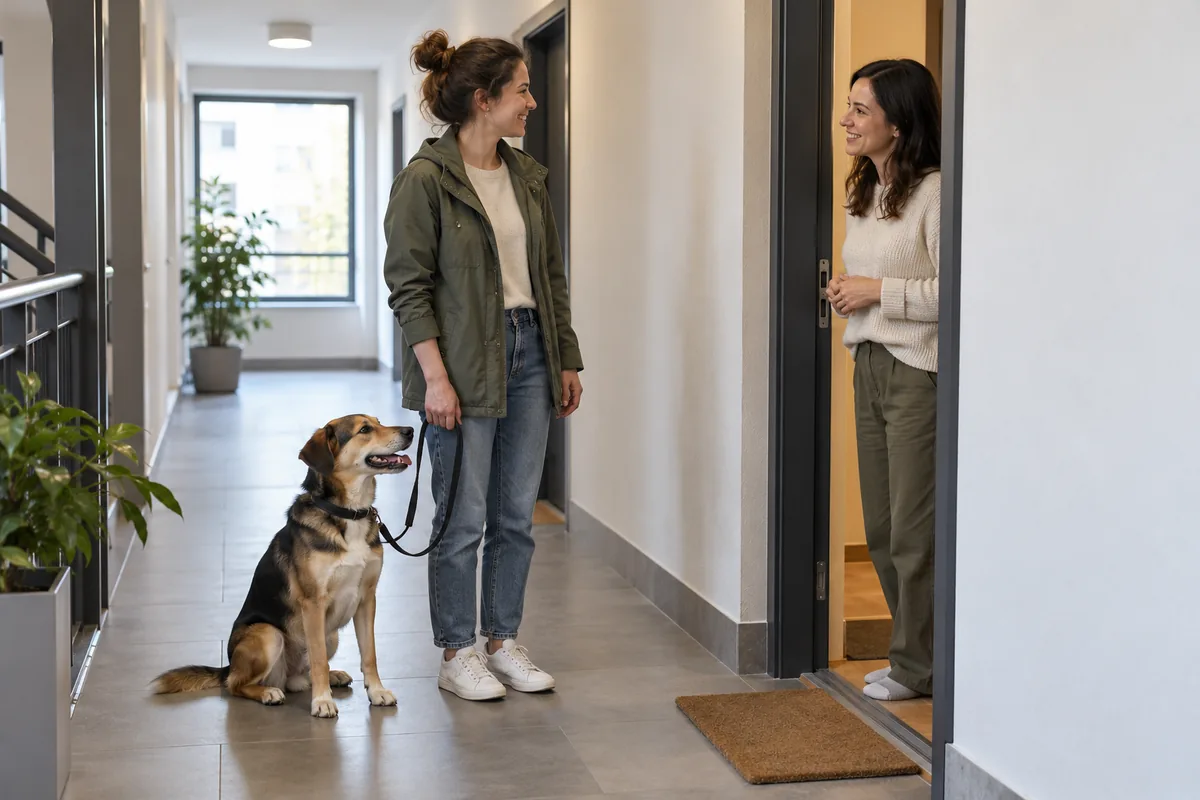
Choose a calm moment for a brief conversation or send a short note. Ask for specific dates, approximate start times, and whether barking comes in bursts or continues.
Listen without asking them to diagnose your dog or monitor every absence. They may be working, sleeping, or caring for someone and simply need the noise addressed.
Explain the concrete steps you are taking: recording, arranging care, and reviewing triggers. Offer a reasonable update date rather than an outcome promise.
If a conversation becomes heated, end it politely and use a brief written message later. Avoid confronting neighbors about making a report.
Replying to a landlord or property manager
Reply in writing, keeping the message short and factual. Identify the report, request any missing dates or times, summarize your current actions, and give a review date.
Do not state that barking was constant if you have not established that, or dismiss the report because one recording was quiet. Describe what you know and what you are checking.
Keep copies of messages, logs, and relevant updates. Read your own lease, building or HOA rules, and local noise requirements.
Rules differ by city, state, HOA, and lease. If you receive a formal notice, fine, or eviction threat, get local legal or tenant advice promptly. A behavior plan does not determine your legal position or replace advice about a deadline.
Reply templates you can edit
Friendly note to a neighbor
Hi [name],
Thank you for letting me know about the barking you heard. I'm checking what happens while I'm out and arranging [care/support] while I investigate.
If convenient, could you share the dates and approximate times you heard it, and whether it was in bursts or continued?
I'll check back with you by [date].
Thank you, [name]
Written reply to a landlord or property manager
Hello [name],
Thank you for forwarding the report dated [date]. Please send any available dates, times, and duration details so I can compare them with my observations.
My current plan is to [record absences], [arrange suitable care], and [seek professional guidance/reduce identified triggers]. I will review the information and provide an update by [date].
Please confirm receipt and any requested follow-up date.
Regards, [name] [unit/contact details]
Your 2-week action plan
This is an organizing schedule, not a promise that barking will resolve within two weeks.
- Days 1–3: acknowledge and clarify. Send a calm reply, request useful timing details, save the correspondence, and review any deadlines. Check your dog's health and immediate safety.
- Days 1–3: gather safe observations. Record ordinary absences without deliberately provoking distress. Begin the incident log and identify what remains unknown.
- Days 1–3: arrange temporary cover. Use a familiar sitter, friend, family member, suitable daycare, or bring your dog along where appropriate. Confirm the arrangement actually helps your dog settle.
- Days 4–7: address the likely triggers. Move the resting area, reduce window activity, or add gentle sound masking if footage supports alert barking. Meet exercise, rest, water, and toilet needs.
- Days 4–7: arrange appropriate help. Contact your vet for suspected distress or health changes. Share short clips and seek a qualified, reward-based professional when indicated.
- Week 2: begin or refine the training plan. For separation-related distress, use gradual, comfortable practice rather than full-length absences. Our Separation Anxiety Training Plan explains that process.
- Week 2: review and update. Compare representative recordings, check whether care coverage is sufficient, and follow up on the agreed date. Report observations and next steps, including uncertainty or setbacks.
A walker may solve an overdue potty break but leave hours of distress before and afterward. True panic may require more continuous company while a professional plan is developed.
Reduce noise triggers at home
Move your dog's bed away from the front door, shared walls, and busy windows when possible. Keep the resting spot familiar and comfortable.
For dogs reacting to hallway or street sounds, try low-volume white noise or a fan. Test it while home; louder is not automatically better.
Closed blinds or suitable window film may reduce visual triggers. Keep cords inaccessible, maintain ventilation, and avoid creating a hot resting area.
A comfortable interior room may help some dogs, but confinement can worsen distress for others. Check the response rather than assuming a quieter room solves the problem.
These changes manage exposure. They do not teach a panicking dog to feel comfortable alone.
When to get professional help
Start with your vet to investigate pain, medical changes, or other contributors, especially if barking is new or accompanied by changes in appetite, drinking, sleep, or toileting.
Seek prompt help for escape attempts, injuries, heavy drooling, or distress during even brief absences. A qualified, reward-based behavior professional or veterinary behaviorist can help assess the pattern and plan care.
Our Separation Anxiety Vet Visit Prep guide explains what to record and bring. For temporary care, use How to Prep a Pet Sitter for an Anxious Dog.
Tell professionals about your work schedule and housing concerns early. A plan needs to be practical as well as humane.
What not to do
Do not punish barking, yell through the door, or scold after returning. Your dog cannot learn comfortable separation from being frightened.
Avoid bark collars of every kind, including shock, spray, citronella, and ultrasonic anti-barking devices. An unpleasant consequence can add fear to an already distressing situation. Suppressing sound also does not establish that the dog feels better.
Do not leave a distressed dog to “get used to it,” rely on a stronger crate, or repeatedly test the longest absence they tolerate.
Avoid hostile replies, public arguments, or blaming another dog without evidence. Calm, accurate communication gives everyone a clearer picture.
Helpful products
Picks on this page are a research-based assessment of features and intended use — not hands-on testing. We earn a small commission if you buy through the Amazon links on this page, at no extra cost to you. Affiliate disclosure
These are support tools, not products we have personally tested. Each one manages part of the problem; none replaces care cover or a training plan.
| Product type | Why it helps | Notes |
|---|---|---|
| Pet camera: Furbo 360° camera | Records barking timing and accompanying behavior | Shows when barking starts and how long it lasts. Limitation: needs steady 2.4GHz Wi-Fi, and saved video history needs the paid Furbo Nanny subscription (free live view only, so you may need to screen-record clips on your phone). Alternative: an old phone or tablet running a free video-call or camera app. |
| White noise machine: Yogasleep Dohm | May mask hallway or street triggers | Best for dogs who bark at hallway or street noise. Limitation: masks hallway and street sounds but does not help distress barking on its own. Alternative: a fan or a free white-noise app on an old phone. |
| Food-stuffable toy: KONG Classic | Offers familiar departure enrichment for dogs able to enjoy it | Optional; test it while you are home first. Limitation: many anxious dogs will not eat when alone, and it must be the right size for your dog's mouth. Alternative: a lick mat such as the LUKITO 2-pack. |
Swipe the table sideways to see every column.
An old phone or tablet with a free camera or video-call app may replace a dedicated camera. Check recording capability, secure cables, and protect account access.
Test food toys under supervision first. Use a camera to see what happens after the food ends, rather than assuming occupation means lasting comfort.
Follow-up checklist
Neighbor or Landlord Complaint About Your Dog Barking When You're Out: A Calm Action Plan: follow-up checklist
- Confirm the dates and times reported.
- Keep copies of messages and any formal documents.
- Review footage alongside reports without guessing missing details.
- Record both barking and comfortable resting.
- Maintain care coverage for absences beyond current tolerance.
- Check whether environmental changes actually help.
- Attend veterinary or behavior appointments as arranged.
- Send a factual update on the agreed date.
- Ask whether the neighbor has noticed changes without demanding ongoing monitoring.
- Review the lease and seek local advice for formal notices or threats.
An update can be simple: what you observed, what you changed, and when you will review again. If progress is uneven, say so and explain the next step.
Bottom line
Treat a complaint as information you could not gather while away. Respond calmly, record safely, and arrange short-term support while identifying the cause.
Use professional help for distress, keep communication factual, and follow through on updates. Protecting your dog's welfare and respecting your neighbors belong in the same plan.