On this page
- Does the other dog help?
- Why only one dog panics
- Filming both dogs
- Together or apart when you leave?
- Safe set-up for multi-dog homes
- Multi-dog leaving checklist
- Practising alone time with one dog
- Feeding and chews when you leave
- Improving or getting worse?
- Mistakes to avoid
- When to get extra help
- Helpful products
- Bottom line
You might expect two dogs to keep each other company while you are out. Yet one dog may pace at the door or howl while the other settles down for a nap.
That difference can be confusing, but it gives you useful information. We are dog owners, not vets or trainers. This guide helps you observe both dogs, protect their relationship and plan gentle practice for the dog who struggles.
Does the other dog help?
Sometimes canine company appears to make being without people easier. In other homes, the anxious dog continues to search for their person even with a companion nearby.
Dogs Trust's separation anxiety advice notes that getting another dog may provide company, but it won't solve separation anxiety. Our second dog guide discusses that question in more detail; here, the focus is on the dogs already sharing your home.
| What you see | What it may mean | What to try |
|---|---|---|
| Both dogs rest comfortably together | Company may be compatible with settling | Keep the familiar arrangement and review other short recordings |
| One dog paces while the other sleeps | The anxious dog may be distressed about a person's absence | Arrange human company and begin tiny practice absences |
| One dog rests only when the other is nearby | Canine company may be reassuring | Keep them together if safe and discuss the pattern with a professional |
| One dog repeatedly follows or nudges the other | The worried dog may be seeking contact or disturbing their companion | Provide space and observe both dogs' body language |
| Both dogs become restless after departure | Either dog may be reacting to the absence or to the other dog | End the practice and seek guidance before trying again |
| One dog stiffens around a food toy | There may be tension or resource guarding | Remove food from shared practice and consult a professional |
| One dog scratches the exit while the other hides | The escape attempt may be affecting both dogs | Arrange human care cover and address safety promptly |
Swipe the table sideways to see every column.
These are possibilities rather than diagnoses. A dog's behavior can change with the room, time of day or person leaving, so compare more than one comfortable observation.
Furbo 360° Dog Camera
A pet camera shows how both dogs cope and interact after you leave, helping you adjust practice and care.
Check price on AmazonWe earn a small commission if you buy through this link, at no extra cost to you. Disclosure
Why only one dog panics
Dogs in the same household can have different histories, health needs and ways of coping. One may have learned to rest comfortably when people leave, while the other may struggle with separation from a particular person.
Some dogs find it difficult to be physically alone and appear more comfortable with canine company. Others remain distressed even when another dog stays. Our separation anxiety vs isolation distress guide explains why that distinction matters.
A calm companion is not responsible for fixing the anxious dog's fear. If the worried dog repeatedly follows, climbs on or bothers them, the companion also needs space and support.
New behavior deserves a health check. Pain, illness or sensory changes can affect either dog, even when the other dog's routine has stayed the same.
Filming both dogs
Set up a camera where it can show the main resting area and exit. If the dogs use different rooms, you may need a second view or an old phone placed safely out of reach. Check that each dog's body and the spaces around beds and doors are visible.
Start recording before you pick up keys or prepare to leave. For an initial observation, make the absence very short, watch live and stay close enough to return promptly. If either dog becomes distressed, return calmly; do not prolong the absence to get more footage.
Note what each dog does separately:
- Does either dog pace, pant, drool, bark or scratch?
- Can the quieter dog move away and rest undisturbed?
- Does either dog block the other's access to a bed, water or doorway?
- Does behavior change when a food toy appears or runs out?
- Do the dogs settle, stay tense or become more agitated?
A single quiet clip does not prove that a longer absence will be comfortable. Review several short observations and share relevant clips with your vet or behavior professional. Our best pet camera guide covers equipment options.
Together or apart when you leave?
There is no universal answer. Choose an arrangement that both dogs have shown they can use safely and comfortably while you are home.
| Situation | Try first | Avoid |
|---|---|---|
| Both dogs rest comfortably together | Keep their familiar shared space for tiny observed absences | Separating them abruptly just to test a theory |
| One dog bothers the other when worried | Arrange human company and provide space for both | Leaving them to work it out during a long absence |
| Food or toys create tension | Feed separately under supervision and remove items before reunion | Leaving valuable chews with both dogs together |
| Dogs play roughly when unattended | Use a previously comfortable separation setup and care cover | Assuming a camera can prevent an injury |
| One dog becomes upset behind a gate | Return to an easier arrangement and seek guidance | Leaving that dog to panic behind the barrier |
| Both relax in separate familiar rooms | Practice brief separations while home, then assess tiny absences | Suddenly separating them for a full workday |
| One dog becomes upset when their companion leaves | Keep the familiar arrangement and get help with gradual practice | Removing the companion suddenly |
| One dog guards beds, doorways or people | Create distance safely and consult a qualified professional | Scolding or punishing growling, which can make fear worse, or forcing the dogs together |
Swipe the table sideways to see every column.
If you cannot safely separate dogs for food without causing panic, skip the food toys for that departure and arrange human help. Safety and comfort for both dogs come first.
Safe set-up for multi-dog homes
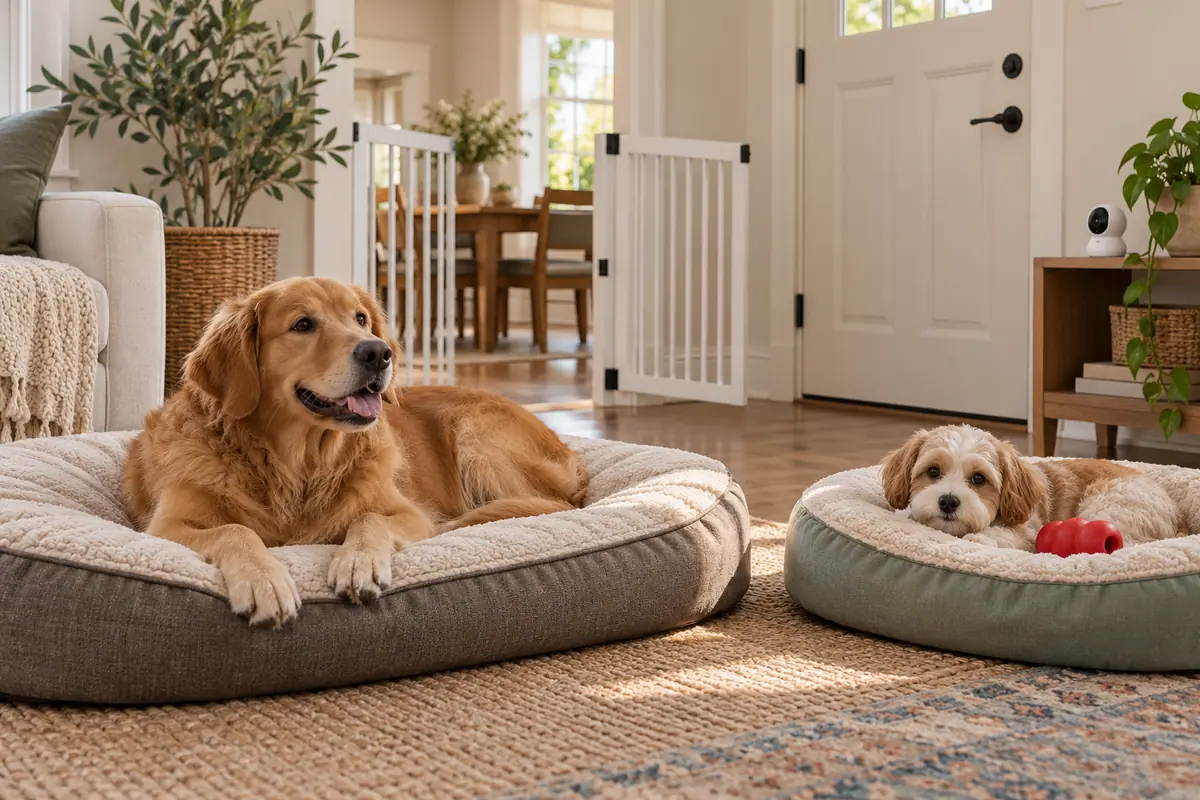
Give each dog access to fresh water and a comfortable resting place. Place beds so one dog can move away without being trapped beside the other. Keep pathways clear and remove cords, toxic items and other hazards.
A walk-through gate can create separate areas while allowing a view of the home. It is useful only if both dogs remain comfortable with it. Some dogs jump, push or chew gates, and a barrier can increase distress.
Separate rooms may suit dogs who already relax apart. Introduce them gradually while you are present; a closed door should never be used to leave a panicking dog confined.
If the dogs remain together, remove items that could trigger guarding and ensure both can rest without being crowded. Our dog gate vs exercise pen guide explains room-level choices.
Individual walks, sniffing time and attention can also help you meet each dog's needs. Choose activities suited to each dog rather than assuming the same routine works equally well for both.
Multi-dog leaving checklist
Separation Anxiety in Multi-Dog Homes: When Only One Dog Panics Alone: multi-dog leaving checklist
- Confirm who will provide company during longer absences.
- Give each dog a suitable toilet opportunity.
- Meet each dog's movement and sniffing needs.
- Provide fresh, accessible water for both dogs.
- Set out enough safe resting places.
- Keep routes between beds and water clear.
- Remove cords, toxic items and chewable hazards.
- Check that gates and doors are secure and familiar.
- Remove shared items that may trigger guarding.
- Give food toys separately only if both dogs are comfortable apart.
- Check that each dog's area is visible on camera.
- Start recording before departure cues.
- Keep practice shorter than either dog's comfort limit.
- Confirm a backup carer for unexpected delays.
Practising alone time with one dog
The ASPCA's separation anxiety advice describes treatment as helping a dog tolerate being alone by gradually getting used to short absences. While you work on it, the ASPCA suggests avoiding leaving the dog alone except during training, for example by having a family member, friend or sitter stay with them, or using doggy daycare.
Start with the arrangement in which both dogs are most comfortable. If they normally rest together safely, practice a tiny departure with both present while you watch live. Return before either dog becomes worried.
Repeat easy attempts before making a small increase. If the anxious dog starts pacing or the other dog becomes tense, return calmly and make the next attempt easier. There is no need to wait for silence.
Practicing separately can also be useful, but only after both dogs have learned to relax apart while you are home. Begin with a very brief, comfortable separation and keep an adult available for each dog if needed. Do not remove one dog's companion suddenly and leave the other to cope.
The anxious dog may find being without their person difficult even when their companion stays. Conversely, the previously relaxed dog may struggle when the dogs are separated. Adjust the plan for both.
Our separation anxiety training plan provides the full method. For unavoidable longer gaps, use our care options guide to plan suitable company.
Feeding and chews when you leave
A food toy can be an enjoyable activity, but two toys do not automatically prevent conflict. One dog may finish first and approach the other, or guard a resting place even when the food is gone.
Give long-lasting chews and stuffed toys apart, in areas both dogs already accept, and supervise new arrangements. Pick up finished toys before allowing the dogs back together. If separation itself causes worry, provide the activity while a person supervises or omit it during departure.
Some anxious dogs will not eat when their person leaves. Record that observation and make the practice easier; the toy cannot resolve panic. Our how to stuff a KONG guide and enrichment guide offer activity ideas.
Improving or getting worse?
Look for patterns across similar short absences, not a perfect performance every day.
| What you see on video | Likely improving | Likely getting worse |
|---|---|---|
| The anxious dog's movement | Settles sooner with a loose body | Pacing starts earlier or continues longer |
| Vocalizing | Becomes less frequent and shorter | Becomes persistent or escalates |
| Exit behavior | Can move away from the door and rest | Scratches, chews or attempts escape |
| The companion dog | Rests undisturbed and can move freely | Hides, avoids the other dog or cannot settle |
| Interaction | Both dogs choose their own resting places | Repeated crowding, blocking or tension |
| Food activity | Eats comfortably, then continues to rest | Stops eating when people leave or tension develops |
| Overall absence | Both remain relaxed for a slightly longer comfortable gap | Either dog shows new or stronger distress |
Swipe the table sideways to see every column.
Quietness alone is not proof of progress. Watch for trembling, rigid posture or hiding. If you are unsure what a clip shows, save it and ask a qualified professional.
Mistakes to avoid
Do not assume the calm dog makes every absence safe, or expect them to manage the other dog's distress. Do not suddenly separate dogs who are used to being together.
Avoid leaving high-value chews together or forcing dogs to share a bed. Never scold or punish growling, which can make fear worse; a warning is information that the dogs need space and help.
Never use bark-control devices, leave a distressed dog to cry until quiet, or shut a panicking dog in a crate, pen or room and leave. A barrier is a management tool only when the dog is comfortable with it.
Do not judge progress from your greeting alone. Video can show whether both dogs actually rested before you returned.
When to get extra help
Dogs Trust's separation anxiety advice explains that changes in behavior are often influenced by physical health, so see your vet if either dog's behavior has recently changed.
Contact your vet promptly for injuries, dangerous escape attempts, persistent food refusal or signs of illness. If either dog guards resources, snaps or repeatedly cannot settle around the other, keep them safely managed and ask for a qualified, reward-based behavior professional.
Seek support if one dog panics quickly, both dogs become distressed or you cannot arrange a setup that keeps each dog safe. Bring short videos and notes showing when behavior begins and which people or dogs are present.
Helpful products
Picks on this page are a research-based assessment of features and intended use — not hands-on testing. We earn a small commission if you buy through the Amazon links on this page, at no extra cost to you. Affiliate disclosure
These picks are chosen from research, not from personal product testing, and none of them replaces company or a gradual training plan.
| Product type | Why it helps | Notes |
|---|---|---|
| Pet camera: Furbo 360° camera | Lets you observe both dogs and their interactions | Our top pick. Limitation: it needs Wi-Fi and only shows what happens; it cannot comfort your dogs, and one camera may miss a room. Alternative: an old phone or laptop on a video call. |
| Rubber food toy for each dog: KONG Classic | Offers a familiar activity during calm practice | Limitation: a determined chewer can damage it and some dogs guard it from other dogs, so feed apart and supervise first. Alternative: a scatter of food in separate rooms. |
| Walk-through pet gate: Carlson walk-thru gate | Can provide separate spaces when both dogs accept it | Limitation: some dogs jump or climb gates, and a gate does not treat anxiety. Alternative: separate rooms with doors, only if each dog is comfortable. |
Swipe the table sideways to see every column.
Bottom line
Your dogs may share a home and still have different needs when you leave. Observe both, protect their access to space and resources, and build absences at a pace each can handle. Arrange human company for longer gaps and involve your vet or a qualified professional when distress or tension continues.