On this page
- Why working from home can make alone time harder
- Settling while you work
- Workday practice ladder
- Closed office door or gate practice
- Video calls and meetings
- Tiny real absences during the workday
- Sample work-from-home day
- Work-from-home alone-time checklist
- Working or getting worse?
- Mistakes to avoid
- When to get extra help
- Helpful products
- Bottom line
Working from home can make life with a dog easier: you are nearby for walks, water refills and company. But if your dog rarely experiences an empty house, even a quick trip outside may feel unfamiliar or difficult.
You do not need to stop enjoying your dog's company to help them feel safer alone. We are dog owners, not vets or trainers. The aim is to use small, manageable moments in your day while making sure your dog gets the care and support they need.
Why working from home can make alone time harder
A dog who spends most days with someone nearby may have few opportunities to practice being alone. That does not mean working from home causes separation anxiety, or that a dog who follows you has it.
The important question is what happens when access to you changes. Some dogs rest comfortably outside the office. Others become upset when a door closes, and some settle while you are elsewhere in the house but struggle as soon as you leave it.
Barking, howling, whining, pacing, panting, drooling, scratching at exits or toileting during absences can point to distress. A recording helps you see when those behaviors start and whether they fade or intensify.
For the broader question of following from room to room, see our velcro dog guide. This article focuses on using the workday to make space for gentle practice.
Furbo 360° Dog Camera
A pet camera shows how your dog copes behind the office door or during a short departure.
Check price on AmazonWe earn a small commission if you buy through this link, at no extra cost to you. Disclosure
Settling while you work
Begin by making the workday comfortable for both of you. A suitable walk or sniffing activity, toilet break and breakfast before focused work can help your dog rest. Their needs depend on age, health and energy; the aim is to meet those needs, not exhaust them.
Place a familiar bed or mat near your desk if that is where your dog relaxes. Another dog may prefer a quiet spot outside the office. Offer water and keep cords, headphones and office supplies out of reach.
Notice and calmly reward your dog when they choose to settle. You might place a small treat on the mat or offer a familiar food toy. Affection and company are fine too; your dog does not need to spend the whole day apart from you.
A toy can be useful during a work block, but supervise new toys first. Once the food is gone, check whether your dog remains comfortable rather than assuming the activity has taught independence.
Workday practice ladder
This is a flexible example, not a schedule. Stay at any step for as long as your dog needs. If they struggle, return calmly and make the next attempt easier. Our separation anxiety training plan covers the wider step-by-step approach.
| Step | What you do | Move on when |
|---|---|---|
| 1. Settle nearby | Sit at your desk while your dog rests on a familiar bed | Your dog can relax without constant prompting |
| 2. Move within the room | Stand up or take a few steps away, then return | Your dog remains comfortable with the movement |
| 3. Approach the doorway | Walk toward the office door and come back | Your dog stays relaxed as you move away |
| 4. Briefly step out of sight | Step around the doorway for a moment, then return | Your dog handles repeated easy gaps calmly |
| 5. Practice a barrier | Briefly close a familiar gate or door while you remain nearby | Your dog is relaxed rather than pushing, scratching or vocalizing |
| 6. Practice an inside-door gap | Remain just outside the room for a few comfortable seconds | Video shows comfortable behavior across several easy attempts |
| 7. Practice a real departure | Step outside the home briefly while watching live video | Your dog stays relaxed at that duration |
| 8. Build gradually | Mix easy short attempts with small increases | Your dog remains comfortable and you can arrange cover for longer gaps |
Swipe the table sideways to see every column.
Some dogs find a closed office door easier than an empty house. Others panic as soon as they cannot follow you. Start wherever your dog stays calm, even if that means practicing only movement within the room.
Closed office door or gate practice
Introduce the area while you are home and available. A dog-proofed room with a comfortable bed and water may work, or your dog may prefer to remain near your desk while you build confidence.
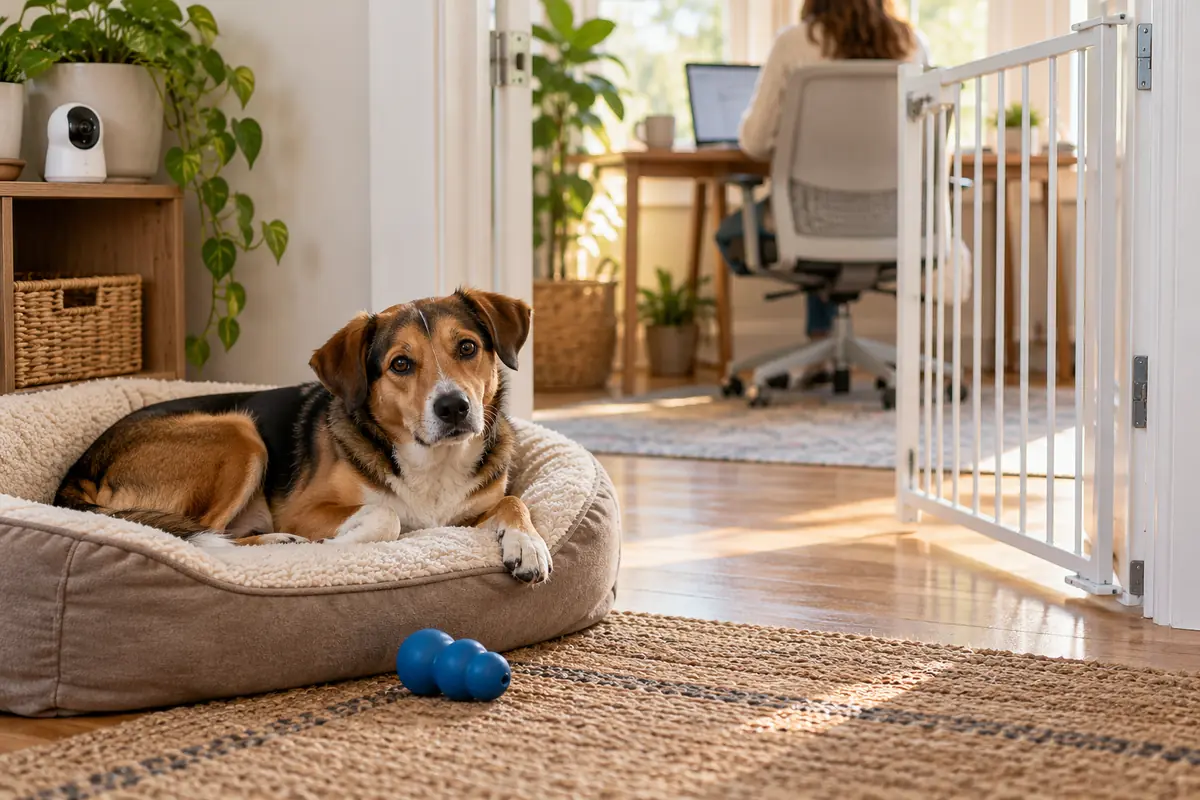
If using a gate, begin with it open. Once your dog is comfortable nearby, briefly close it while staying close and reopen it before worry develops. A closed office door should be introduced just as gradually.
Watch for gate pushing, climbing, chewing, scratching, persistent whining or pacing. These may mean the barrier itself is difficult. Return calmly and reassess; do not leave a panicking dog shut behind it.
Our dog gate vs exercise pen guide compares room-level setups. A barrier can help manage space, but it does not treat separation anxiety.
Video calls and meetings
A meeting is not the time to test a difficult new separation. If your dog normally rests beside you, letting them stay in the office may be the easiest option while you take the call.
Before the meeting, offer a toilet break and suitable activity. Set up a comfortable spot away from desk cables. If your dog safely enjoys a familiar food toy, you can offer it before the call; check that it is appropriate to use without continuous supervision.
For longer meetings, arrange another household member or sitter if your dog needs more attention than you can provide. A closed door is an option only after your dog has learned to relax with it for the relevant period.
If your dog becomes distressed during a call, help them rather than waiting for quiet. Afterward, adjust the next meeting plan. Your dog's need for support does not make them a bad coworker.
Tiny real absences during the workday
Practice leaving the home separately from being behind an office door. The change in context may matter: a dog who can relax while you are in the next room may still worry when the front door closes.
Choose a quiet moment when you can monitor video and return immediately. At first, your practice might be opening and closing the door, then stepping outside for a few comfortable seconds.
As your dog progresses, a brief trip to collect mail or take out the trash may become possible. A walk to the corner is a later step only if its entire duration is within your dog's demonstrated comfort. Household tasks are not targets your dog must reach by a certain date.
The ASPCA's separation anxiety advice describes treatment as helping a dog tolerate being alone by gradually getting used to short absences. While you work on it, the ASPCA suggests avoiding leaving the dog alone except during training, for example by having a family member, friend or sitter stay with them, or using doggy daycare.
Keep keys and shoes low-key, and sometimes handle them without leaving. Our departure cues guide explains how to introduce that practice gently.
Sample work-from-home day
This is an example, not a required schedule. Adapt activity, breaks and practice to your dog's needs and your work.
| Time of day | What to do with your dog | Why it helps |
|---|---|---|
| Before work | Offer a toilet break, suitable walk and breakfast | Meets needs before a focused work block |
| Start of work | Provide water and a familiar bed near or away from the desk | Gives your dog a comfortable resting choice |
| Midmorning | Practice one easy step from the ladder | Builds a small success when you can monitor |
| Before a meeting | Offer a toilet break and settle your dog in a familiar place | Reduces avoidable interruptions and discomfort |
| Lunch | Take a suitable walk or have calm play | Provides movement, sniffing and time together |
| Afternoon | Review video and, if appropriate, repeat an easy practice | Helps you choose the next step from evidence |
| End of work | Offer another toilet opportunity and enjoyable activity | Maintains a predictable routine |
| Evening | Arrange company for any longer absence | Prevents leaving the dog beyond current comfort |
Swipe the table sideways to see every column.
If the day is packed, skip the training session and provide the care your dog needs. Practice is most useful when you can observe and respond.
Work-from-home alone-time checklist
Dog Separation Anxiety When You Work From Home: Practising Alone Time While You're In the House: work-from-home alone-time checklist
- Give your dog a suitable toilet break before focused work.
- Provide appropriate movement and sniffing opportunities.
- Keep fresh water accessible.
- Set up a familiar, comfortable resting spot.
- Remove office cords and chewable hazards.
- Check that gates or doors are safe and familiar.
- Plan meetings around your dog's current needs.
- Arrange another carer for gaps your dog cannot handle.
- Choose a quiet time when you can monitor practice.
- Start the camera before moving away or leaving.
- Keep the practice within your dog's comfort.
- Return calmly if worry appears.
- Note what happened before choosing the next step.
- Supervise new food toys before using them during work.
Working or getting worse?
Compare similar, short sessions over time. The table offers clues rather than a diagnosis.
| What you see | Likely working | Likely getting worse |
|---|---|---|
| Resting near the desk | Settles with loose posture | Remains tense and watches your movements |
| Office-door practice | Handles a brief gap and resumes resting | Scratches, pushes or vocalizes at the barrier |
| Movement | Briefly notices you stand, then relaxes | Follows urgently or begins pacing |
| Food toy | Eats comfortably and can rest afterward | Abandons familiar food when you move away |
| Real departures | Remains relaxed for an easy observed absence | Whines, pants or drools as you leave |
| Exit behavior | Can move away from the door | Chews, scratches or attempts to escape |
| Overall pattern | Comfortable gaps gradually become more reliable | Worry starts earlier or lasts longer |
| Quiet behavior | Sleeps or rests with a relaxed body | Freezes, trembles or hides |
Swipe the table sideways to see every column.
A quiet dog is not always a calm dog. Save clips that concern you and share them with your vet or a qualified behavior professional.
Mistakes to avoid
Do not shut the office door for a long meeting before your dog is comfortable with it. Being in the house does not prevent distress if your dog cannot reach you.
Avoid using every break to increase difficulty. Repeat easy steps, and do not leave for a longer errand simply because one short session went well.
Never punish vocalizing, scratching or accidents, use bark-control devices, or leave a distressed dog to cry until quiet. Never shut a panicking dog in a crate, pen or room and leave.
Do not assume a food toy, a camera or a tired dog can safely manage an absence beyond their limit. Our how to stuff a KONG guide offers enrichment ideas, while the working full time guide discusses arranging care around work.
When to get extra help
Dogs Trust's separation anxiety advice explains that changes in behavior are often influenced by physical health, so see your vet if your dog's behavior has recently changed.
Contact your vet promptly about injuries, escape attempts, persistent food refusal or other signs of illness. A qualified, reward-based behavior professional can help if your dog panics immediately, struggles even with tiny steps or cannot safely use a barrier.
Arrange a family member, friend, sitter or suitable daycare for absences beyond your dog's comfort. Our care options guide can help you compare arrangements.
If your work routine later changes, our back-to-office guide covers that transition separately.
Helpful products
Picks on this page are a research-based assessment of features and intended use — not hands-on testing. We earn a small commission if you buy through the Amazon links on this page, at no extra cost to you. Affiliate disclosure
These picks are chosen from research, not from personal product testing, and none of them replaces company or a gradual training plan.
| Product type | Why it helps | Notes |
|---|---|---|
| Pet camera: Furbo 360° camera | Shows how your dog copes during practice and short departures | Our top pick. Limitation: it needs Wi-Fi and only shows what happens; it cannot comfort your dog. Alternative: an old phone or laptop on a video call. |
| Rubber food toy: KONG Classic | Offers a familiar activity while you work | Limitation: a determined chewer can damage it and it only lasts a while, so supervise first. Alternative: a scatter of food or a frozen lick mat. |
| Walk-through pet gate: Carlson walk-thru gate | Can help introduce a comfortable office boundary | Limitation: some dogs jump or climb gates, and a gate does not treat anxiety. Alternative: a closed door, only if your dog is calm with it. |
Swipe the table sideways to see every column.
Our best pet camera guide explains recording options. Supervise a lick mat initially too, since some dogs chew the edges.
Bottom line
Your dog can enjoy being near you while learning that small moments apart are safe. Use comfortable resting spots, brief practice you can monitor and realistic meeting plans. Build real departures gradually and arrange company whenever your dog cannot yet cope.